Public-domain ebook
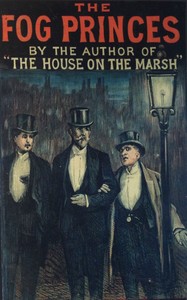
The fog princes
Language: en375 downloads on Project Gutenberg
Subjects
In: Historical Novels·Novels·British Literature
Public-domain ebook sourced from Project Gutenberg #72077.
Public-domain ebook
Language: en375 downloads on Project Gutenberg
Subjects
In: Historical Novels·Novels·British Literature
Public-domain ebook sourced from Project Gutenberg #72077.
The opening · free to read
Among the noblemen’s seats of the United Kingdom there are many more imposing, many more ancient, than Llancader Castle; but there are none better adapted to the requirements of modern life, none where lifts and electric bells combine more harmoniously with old tapestry and heavily decorated ceilings. It is built in the hybrid classical style of the Jacobean period, and is pleasantly placed among lawns and trees and artificial fishponds not far from the banks of the River Wye.
The Earl of St. Austell, by far the largest landowner in this part of the country, and possessor of estates rich in relics of the past, knew how to avail himself of all the resources of the present. He had the reputation in the country of being a good and beneficent landlord; while in town, in the greenrooms of theatres where ballet was the principal attraction, he had a reputation for munificence of quite another sort.
Lady St. Austell was an amiable and still handsome woman, easy-going to a fault, whose chief grief and grievance was, not her husband’s peccadilloes, but the fact that she had not borne him an heir. In their three daughters the earl took but slight interest; and the countess being allowed full liberty to conduct their education on what principles she pleased, tried to make up for their not being sons by giving them the same education as if they had been.
If these young ladies had possessed brains or strength of character out of the common, this system might have answered very well. Unluckily, however, they were commonplace girls, and their unusual training only served to foster a belief in their own superiority, and thus to emphasize a certain lack of feminine grace and charms which, considering their parentage, was difficult to account for.
On a warm afternoon in early August the eldest and the youngest daughter were sitting at work in a pleasant room, pannelled with light oak and hung with large flowered cretonne, which looked out on to a wide lawn dotted with trees and brightened with flower-beds. In the distance could be seen, through a clearing made specially in the thick groves which line the banks of the winding Wye, the rugged grey walls of ruined Carstow Castle.
“Where’s Marion?” asked Lady Catherine suddenly, looking up from a Latin exercise she was preparing for her tutor.
Lady Catherine was a reddish-haired, freckled little girl of sixteen, very plump and very merry looking.
“Oh, wherever Rees Pennant is, I suppose,” answered her eldest sister, Elizabeth, glancing out of window between the stitches of crewel work over which she was bending.
Lady Elizabeth was, like her younger sister, round-cheeked and blue-eyed; she had a fair complexion, golden hair, eyebrows and eye lashes, a self-satisfied expression, and a figure which all the back-boards, reclining boards, and all the dancing masters in Europe could never have saved from being round-shouldered and “dumpy.”
Lady Catherine burst into a merry laugh, and from a sofa in the shadier depths of the long room a plaintive, but cracked, voice wailed out a request in French that “miladi Katte” would be quieter, and would remember that “madame la comtesse,” her mother, wished her to overcome her propensity to unladylike outbursts of merriment.
Mademoiselle de Laval, the duenna of the earl’s daughters, had been specially chosen for the post for her abnormal ugliness, Lord St. Austell holding that women’s virtue was always in inverse proportion to their beauty. He had over-reached himself, however, for mademoiselle, being a martyr to neuralgia and rheumatism, and finding herself very comfortable in her Welsh home, would not for worlds have endangered her situation by any indiscreet prying into the amusements of her charges.
Lady Kate, with a grimace in her direction, crossed the room to her sister, and sat down on a footstool by her side, with a scandal-loving expression on her face.
“Rees Pennant,” she repeated in a hissing whisper; “do you think she is in love with him?”
“I am sure of it!” cried Elizabeth, with all the superiority in such matters which twenty possesses over sixteen.
Lady Kate chuckled to herself with intense amusement.
“Of course he isn’t in love with her,” she suggested, with a sister’s partiality. “Marion is so gawky and Rees is so handsome. It would be like a figure of Raffaele falling in love with an Anglo-Saxon saint.”
“What’s the use of their falling in love, either of them?” said Elizabeth prosaically. “They can’t marry.”
“Why not? He is the eldest son, and Captain Pennant’s family is as old as ours. And look at us! We’re not beauties, and I know papa does not mean to give us very handsome fortunes, or else you would have had an offer before this. You’re twenty, you know.”
“Certainly. And I don’t want any offer,” answered her sister, not without a pardonable suspicion of tartness. “But I certainly shouldn’t condescend to flirt with a man beneath me in rank, and without a penny. And there must be madness in the family, or Captain Pennant would never have adopted a fisherman’s baby and brought it up as his own child.”
“Deborah’s very pretty,” said Lady Kate, thoughtfully. “If we were half as good-looking we should have been photographed all over the place as beauties.”
“Pretty! Do you think so?” asked her sister, with an air of matter-of-fact impartiality. “I don’t admire those big, coarse-looking women. I like a face which shows signs of the higher intelligence, a face which lights up. And Deborah has no conversation. I can’t admire a girl without conversation.”
“Papa can though,” said Kate, rather maliciously. “He admires Deborah, and I am sure you can’t say he likes coarse-looking women.”
“A gentlemen’s taste in beauty is not the same as a lady’s,” said Elizabeth, moving restlessly, and wishing that her persistent little sister would let her change this awkward subject.
“I know it isn’t. I expect some women would admire Mademoiselle de Laval,” whispered Kate, glancing towards the dozing French governess, whose wide nose and mouth, leathern complexion and well-defined moustache formed a combination of feminine attractions rarely to be met with. “But do you know, Betty, after mature consideration of the subject, I would rather be pretty according to the gentlemen’s standard than according to the ladies’.”
Lady Elizabeth, who, although extremely erudite, was rather dull, did not perceive all the point of this speech, but felt that the pert girl was slyly laughing at her. She was too good-tempered to grow cross, however; she only grew didactic.
“You can’t expect much refinement from a fisherman’s daughter, of course,” she said in obstinate tone. “I’ve always pitied poor Mrs. Pennant--who comes of one of the oldest families in England, better than her husband’s--for having to submit to such an absurd caprice of his. She feels it, poor thing, dreadfully.”
“Yes, and turns up her eyes over it, and acts quite a pretty pantomime of resignation over it still, though Deborah’s been one of the family eighteen years. The consequence is that the boys have never learnt to look upon her as a sister, and so they’re falling in love with her. Godwin, and Hervey--yes, and Rees too, whatever Marion may like to think.”
“So much the better. Then Rees can marry the girl, though I think one of the gamekeepers would be a more suitable match.”
“Betty, how can you? You talk just like an ordinary spiteful girl. Deborah is as much a lady as we are ourselves.”
“Very well then. Don’t let’s talk any more about it. We shall only quarrel. And all about a girl who thinks that a smattering of French, German and the piano form a good education.”
There was a pause. But Kate, who always liked to worry a subject to death, soon broke out again.
“Betty, why do you think papa wouldn’t let Rees marry Marion? He’s so fond of Rees, he really treats him almost as if he were his own son.”
“You don’t understand papa,” said Elizabeth, with authority. “He always seems so easy-going that people don’t guess that he’s just like a rock underneath. Nobody thinks so much of class distinctions and money distinctions--those are almost the same thing nowadays--as he does. Rees would have no more chance as a son-in-law than--than Amos Goodhare,” she ended contemptuously.
Lady Kate laughed and pretended to shudder.
“Oh, old Amos,” she cried with real disgust. “Don’t speak of that man. I can’t bear him. I think he has such shifting eyes and such a bad, horrible face. I never could understand why papa allowed such a man into the house at all.”
“He is really a well-read man, and he looks just such a man as a librarian ought to look,” said Elizabeth, in a reserved tone, as if she knew more than she intended to tell.
Kate looked hard at her sister, and then edged her footstool close up to her side.
“Betty,” she whispered, with a very curious expression, “did you ever notice the extraordinary likeness there is between Mr. Goodhare and--papa?”
“Nonsense, child,” said Lady Elizabeth, blushing violently, and trying to rise.
But Lady Kate, who was a sturdily built girl, with little fat, but muscular hands, held her down.
The book keeps going
Reading is free forever. Sign up and watch scenes appear while you read.



Scenes Storieta drew for other classics.
New illustrated classics
Once or twice a month: the latest books to get full character casts, scene art, and free comic editions. No account needed.