Public-domain ebook
There was an old woman—
Language: en330 downloads on Project Gutenberg
Subjects
In: Science-Fiction & Fantasy·Novels·American Literature
Public-domain ebook sourced from Project Gutenberg #72082.
Public-domain ebook
Language: en330 downloads on Project Gutenberg
Subjects
In: Science-Fiction & Fantasy·Novels·American Literature
Public-domain ebook sourced from Project Gutenberg #72082.
The opening · free to read
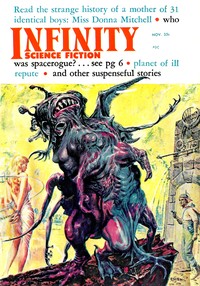
Miss Mitchell had ideas--and 31 identical sons!
[Transcriber's Note: This etext was produced from Infinity November 1958. Extensive research did not uncover any evidence that the U.S. copyright on this publication was renewed.]
Since I was raised from earliest infancy to undertake the historian's calling, and since it is now certain that I shall never claim that profession as my own, it seems fitting that I perform my first and last act as an historian.
I shall write the history of that strange and unique woman, the mother of my thirty brothers and myself, Miss Donna Mitchell.
She was a person of extraordinary strength and vision, our mother. I remember her vividly, seeing her with all her sons gathered 'round her in our secluded Wisconsin farmhouse on the first night of summer, after we had returned to her from every part of the country for our summer's vacation. One-and-thirty strapping sons, each one of us six feet one inch tall, with a shock of unruly yellow hair and keen, clear blue eyes, each one of us healthy, strong, well-nourished, each one of us twenty-one years and fourteen days old, one-and-thirty identical brothers.
Oh, there were differences between us, but only we and she could perceive them. To outsiders, we were identical; which was why, to outsiders, we took care never to appear together in groups. We ourselves knew the differences, for we had lived with them so long.
I knew my brother Leonard's cheekmole--the right cheek it was, setting him off from Jonas, whose left cheek was marked with a flyspeck. I knew the faint tilt of Peter's chin, the slight oversharpness of Dewey's nose, the florid tint of Donald's skin, I recognized Paul by his pendulous earlobes, Charles by his squint, Noel by the puckering of his lowerlip. David had a blue-stubbled face, Mark flaring nostrils, Claude thick brows.
Yes, there were differences. We rarely confused one with another. It was second nature for me to distinguish Edward from Albert, George from Philip, Frederick from Stephen. And Mother never confused us.
She was a regal woman, nearly six feet in height, who even in middle age had retained straightness of posture and majesty of bearing. Her eyes, like ours, were blue; her hair, she told us, had once been golden like ours. Her voice was a deep, mellow contralto; rich, firm, commanding, the voice of a strong woman. She had been Professor of Biochemistry at some Eastern university (she never told us which one, hating its name so) and we all knew by heart the story of her bitter life and of our own strange birth.
"I had a theory," she would say. "It wasn't an orthodox theory, and it made people angry to think about it, so of course they threw me out. But I didn't care. In many ways that was the most fortunate day of my life."
"Tell us about it, Mother," Philip would invariably ask. He was destined to be a playwright; he enjoyed the repetition of the story whenever we were together.
"I had a theory. I believed that environment controlled personality, that given the same set of healthy genes any number of different adults could be shaped from the raw material. I had a plan for testing it--but when I told them, they discharged me. Luckily I had married a wealthy if superficial-minded executive, who had suffered a fatal coronary attack the year before. I was independently wealthy, thanks to him, and free to pursue independent research, thanks to my University discharge. So I came to Wisconsin and began my great project."
We knew the rest of the story by heart, as a sort of litany.
We knew how she had bought a huge, rambling farm in the flat green country of central Wisconsin, a farm far from prying eyes. Then, how on a hot summer afternoon she had gone forth to the farmland nearby, and found a fieldhand, tall and brawny, and to his great surprise seduced him in the field where he worked.
And then, the story of that single miraculous zygote, which our mother had extracted from her body and carefully nurtured in special nutrient tanks, irradiating it and freezing it and irritating it and dosing it with hormones until, exasperated, it sub-divided into thirty-two, each one of which developed independently into a complete embryo.
Embryo grew into fetus, and fetus into child, in Mother's ingenious artificial wombs. One of the thirty-two died before birth of accidental narcosis; the remainder survived, thirty-one identical males sprung from the same egg, to become us.
With the formidable energy that typified her, Mother single-handed nursed thirty-one baby boys; we thrived, we grew. And then the most crucial stage of the experiment began. We were differentiated at the age of eighteen months, each given his own room, his own particular toys, his own special books later on. Each of us was slated for a different profession. It was the ultimate proof of her theory. Genetically identical, physically identical except for the minor changes time had worked on our individual bodies, we would nevertheless seek out different fields of employ.
She worked out the assignments at random, she said. Philip was to be a playwright, Noel a novelist, Donald a doctor. Astronomy was Allan's goal, Barry's biology, Albert's the stage. George was to be a concert pianist, Claude a composer, Leonard a member of the bar, Dewey a dentist. Mark was to be an athlete; David, a diplomat. Journalism waited for Jonas, poetry for Peter, painting for Paul. Edward would become an engineer, Saul a soldier, Charles a statesman; Stephen would go to sea. Martin was aimed for chemistry, Raymond for physics, James for high finance. Ronald would be a librarian, Robert a bookkeeper, John a priest, Douglas a teacher. Anthony was to be a literary critic, William a librarian, Frederick an airplane pilot. For Richard was reserved a life of crime; as for myself, Harold, I was to devote my energies to the study and writing of history.
This was my mother's plan. Let me tell of my own childhood and adolescence, to illustrate its workings.
My first recollections are of books. I had a room on the second floor of our big house. Martin's room was to my left, and in later years I would regret it, for the air was always heavy with the stink of his chemical experiments. To my right was Noel, whose precocious typewriter sometimes pounded all night as he worked on his endless first novel.
But those manifestations came later. I remember waking one morning to find that during the night a bookcase had been placed in my room, and in it a single book--Hendrik Willem van Loon's Story of Mankind. I was four, almost five, then; thanks to Mother's intensive training we were all capable readers by that age, and I puzzled over the big type, learning of the exploits of Charlemagne and Richard the Lionhearted and staring at the squiggly scratches that were van Loon's illustrations.
Other books followed, in years to come. H.G. Wells' Outline of History, which fascinated and repelled me at the same time. Toynbee, in the Somervell abridgement, and later, when I had entered adolescence, the complete and unabridged edition. Churchill, with his flowing periods and ringing prose. Sandburg's poetic and massive life of Lincoln; Wedgwood on the Thirty Years' War; Will Durant, in six or seven block-like volumes.
I read these books, and where I did not understand I read on anyway, knowing I would come back to that page in some year to come and bring new understanding to it. Mother helped, and guided, and chivvied. A sense of the panorama of man's vast achievement sprang up in me. To join the roll of mankind's chroniclers seemed the only possible end for my existence.
Each summer from my fourteenth to my seventeenth, I travelled--alone, of course, since Mother wanted to build self-reliance in us. I visited the great historical places of the United States: Washington, D.C., Mount Vernon, Williamsburg, Bull Run, Gettysburg. A sense of the past rose in me.
Those summers were my only opportunities for contact with strangers, since during the year and especially during the long snowbound winters we stayed on the farm, a tight family unit. We never went to public school; obviously, it was impossible to enroll us, en masse, without arousing the curiosity my mother wished to avoid.
Instead, she tutored us privately, giving us care and attention that no professional teacher could possibly have supplied. And we grew older, diverging toward our professions like branching limbs of a tree.
As a future historian, of course, I took it upon myself to observe the changes in my own society, which was bounded by the acreage of our farm. I made notes on the progress of my brothers, keeping my notebooks well hidden, and also on the changes time was working on Mother. She stood up surprisingly well, considering the astonishing burden she had taken upon herself. Formidable was the best word to use in describing her.
We grew into adolescence. By this time Martin had an imposing chemical laboratory in his room; Leonard harangued us all on legal fine points, and Anthony pored over Proust and Kafka, delivering startling critical interpretations. Our house was a beehive of industry constantly, and I don't remember being bored for more than three consecutive seconds, at any time. There were always distractions: Claude and George jostling for room on the piano bench while they played Claude's four-hand sonata, Mark hurling a baseball through a front window, Peter declaiming a sequence of shocking sonnets during our communal dinner.
We fought, of course, since we were healthy individualists with sound bodies. Mother encouraged it; Saturday afternoon was wrestling time, and we pitted our growing strengths against one another.
Mother was always the dominant figure, striding tall and erect around the farm, calling to us in her familiar boom, assigning us chores, meeting with us privately. Somehow she had the knack of making each of us think we were the favorite child, the one in whose future she was most deeply interested of all. It was false, of course; though once Jonas unkindly asserted that Barry must be her real favorite, because he, like her, was a biologist.
I doubted it. I had learned much about people through my constant reading, and I knew that Mother was something extraordinary--a fanatic, if you like, or merely a woman driven by an inner demon, but still and all a person of overwhelming intellectual drive and conviction, whose will to know the truth had led her to undertake this fantastic experiment in biology and human breeding.
I knew that no woman of that sort could stoop to petty favoritism. Mother was unique. Perhaps, had she been born a man, she would have changed the entire course of human development.
When we were seventeen, she called us all together round the big table in the common room of our rambling home. She waited, needing to clear her throat only once in order to cut the hum of conversation.
"Sons," she said, and the echo rang through the entire first floor of the house. "Sons, the time has come for you to leave the farm."
One could not become a doctor or a chemist or a novelist or even an historian in a total vacuum. One had to enter the world. And one needed certain professional qualifications.
The book keeps going
Reading is free forever. Sign up and watch scenes appear while you read.



Scenes Storieta drew for other classics.
New illustrated classics
Once or twice a month: the latest books to get full character casts, scene art, and free comic editions. No account needed.