Public-domain ebook
Mr. Replogle's dream
English331 downloads on Project GutenbergDownload EPUB
Public-domain ebook sourced from Project Gutenberg #72120.
Public-domain ebook
English331 downloads on Project GutenbergDownload EPUB
Public-domain ebook sourced from Project Gutenberg #72120.
The opening · free to read
This was a proud day in the life of modern art. This exhibition would prove that the machine could not conquer man.
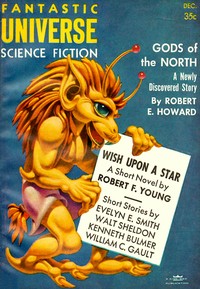
[Transcriber's Note: This etext was produced from Fantastic Universe December 1956. Extensive research did not uncover any evidence that the U.S. copyright on this publication was renewed.]
The Cimabue Gallery was the last stronghold of nostalgia--expensive nostalgia. Apart for the robot attendants--unfortunately necessary, the times being what they were--there was practically nothing machine-made about the Gallery, dedicated as it was to being more than a mere commercial venture. Evelyn E. Smith returns to these pages with a gently ironic story of men and dreams--the day after tomorrow....
"This," said Mr. Ditmars, "is a proud day in the life of the Cimabue Gallery."
"It is a proud day in the life of modern art," added Mr. Replogle, feeling that Mr. Ditmars was giving too parochial a picture of the situation, "for it proves with more force than ever that the machine will not conquer man."
Both partners gazed with varying degrees of complacency at the large, brightly-colored oil paintings that covered the refined pastel walls of the Cimabue. There was almost nothing machine-made about the gallery--the thick, soft rugs had been hand-woven at fabulous expense by workmen in the less industrialized areas of the Middle East, the furnishings hand-carved by tribesmen deep in the heart of the Australian bush. The only exception was the robot attendants, which were, unfortunately, necessary, for no one paid attention to human beings any more unless they were top management or very high in the hierarchy of handcrafters.
Cimabue could afford all this luxury, and more too, for, now that big business had become an art, art had become a big business. People saved the excess from their government subsidies--or, if they were lucky enough to have professional status, their salaries--to buy a painting, a holograph manuscript ... anything to distinguish their homes from the uniform grey mass of material comforts which the government bestowed on everyone alike. As a result, the partners were as wealthy as anyone outside the ruling class could hope to be. However, Mr. Replogle, at least, was not happy. He suffered from nightmares.
"But where is Orville?" demanded the man from the Times-Herald-Mirror. "We haven't come to interview you two--you always say the same thing about every new artist you discover. In fact, we already have your words set up in type."
Mr. Ditmars gave him a benign smile. "Orville's case is different. Never before in history has an absolutely unknown artist received such an immediate ovation from the public. Why, almost every picture on exhibit is already sold--the buyers have kindly allowed us to retain them on our walls for the duration of the show as a service to the public."
"Cimabue is more than a mere commercial venture," Mr. Replogle added, wishing he could slip off for a paraspirin; his head hurt most mechanically. "It is a cultural institution."
"Yeah, Orville did get pretty good write-ups," the World-Post and Journal man conceded, "though any half-way decent artist sells like hotcakes these days. People naturally go for anything that's hand-made." And he fingered his hand-painted tie self-consciously. "But it can't last."
This disturbed Mr. Replogle more than it should have. But he had been bothered for many years by his recurring dream--a dream so frightful that he did not dare to confide it to anyone because of its terrifying plausibility. And anything said or done by day that seemed to approach that midnight horror roused him to immediate defensiveness. "Oh, yes it can last!" he protested. "It will! It must! For art is the people's last bulwark against the machine--the one area which cannot be mechanized, which reassures the human race that it still is pre-eminent."
"Kindly do not touch the pictures," the roboguard droned.
"I was only feeling Orville's impasto," the lady from the Woman's Own News defended herself. "Very thick."
I couldn't have told her to stop, Mr. Replogle reflected bitterly. Coming from me it would have been rude, but from a robot it's all right. Everyone knows a robot's only aim is to serve man. Our altruism depends on our individual consciences; theirs is built-in and, hence, more reliable.
"But where is Orville?" the man from the Times-Herald-Mirror persisted. "He was supposed to be here at three-thirty, and it's almost four now."
"Softly, softly," said Mr. Ditmars. "The robobar doesn't open itself until four anyway, so you know you're in no hurry.... And, remember, a great artist mustn't be rushed--he is not a machine, you know."
"Hervey McGeachin is bringing him," Mr. Replogle explained. "One could hardly hurry McGeachin," he added ... unnecessarily, for everyone knew that one didn't hurry the richest man in the United States--one awaited his pleasure. Beside being fabulously wealthy, McGeachin had the reputation of being something of a recluse, but this did not make him more newsworthy, for all members of top management tended to be a bit eccentric. The rank was hereditary--it took more than one generation for a family to begin to understand its machines--and there was a lot of inbreeding, with the usual results.
"Orville is a protege of Mr. McGeachin's, isn't he?" asked the lady from Woman's Own.
"Yes," Mr. Ditmars said. "All that was in the press release. He's one of Mr. McGeachin's employees. Mr. McGeachin discovered him personally, and he got in touch with us." Mr. Ditmars almost swelled with visible pride; Mr. Replogle wished he would exercise a bit more self-restraint. Such an open display of emotion was vulgar--almost mechanical, one might say. Especially since they themselves were management, in a way, although one didn't, of course, apply such a word to those who dealt in the arts and crafts. The general public feared and respected the management which governed them, but they loved entrepreneurs.
"A factory hand!" Woman's Own gushed. "What a story that will make!"
The male reporters laughed as one male. "Where have you been all these years, cookie?" asked the World-Post and Journal. "I doubt if there's a factory left in the United States that isn't mechanized to the very hilt by now--with robot labor for the more specialized operations."
"I know," she sighed. "Deep down inside of me I really know. I was just hoping. I suppose I am--" and she batted her eyelashes "--like all females, an incurable romantic. What do you suppose Orville is, then?"
"Might be a clerk," Time-week suggested. "A lot of the big places still use live clerical help for tone, and, of course, you always need a few human beings around in case the machines break down."
"I somehow got the impression that he was an executive," Mr. Ditmars said frostily.
"Let's hope not. It would ruin the human element in the story. You can't expect our readers to identify with management."
"A minor executive, that is," Mr. Replogle hastened to inform them, before Ditmars could open his big mouth again. "More like a shipping clerk."
"Is Orville his first or his last name?" Woman's Own wanted to know.
"Just Orville," Mr. Ditmars said. "Like Rembrandt."
"Of course Rembrandt did have a last name," Mr. Replogle pointed out. "He just isn't known by it."
"And Orville's more like Grandma Moses, anyhow, I would say," commented the Times-Herald-Mirror.
"He is a primitive, true," Mr. Replogle said judiciously. "If you insist upon pinning a label on him, you might call him a post pre-Raphaelite, with just a soupcon of Rousseau."
"I didn't know Rousseau painted," the World-Post and Journal man said, busily clicking on his typopad.
"Not that one," Mr. Replogle told him kindly. "The other two."
"How old is Orville?" Woman's Own held her typopad at the ready. "How many children does he have? Is he married? Fond of animals? What does he eat for breakfast?"
"For heaven's sake," Mr. Ditmars exploded, "it isn't the man himself that matters--it's the man as interpreted through his art! And you can see that art for yourself." He waved his arms toward the pale gallery walls. "Drink it in and absorb the essence of the artist."
"But we'd like a little more factual data, as a point of departure. After all, our readers--"
"All right, all right," Mr. Ditmars said before Mr. Replogle could stop him, "I'll give you all the facts we have--to wit, none. All we know about Orville we put into the release. McGeachin's been keeping him under wraps. We don't know a thing about him. He's eccentric--McGeachin, I mean."
"Could be Orville also," the World-Post and Journal suggested.
Mr. Ditmars sighed. "Could be Orville also," he conceded.
The book keeps going
Reading is free forever. Sign up and watch scenes appear while you read.



Scenes Storieta drew for other classics.
New illustrated classics
Once or twice a month: the latest books to get full character casts, scene art, and free comic editions. No account needed.