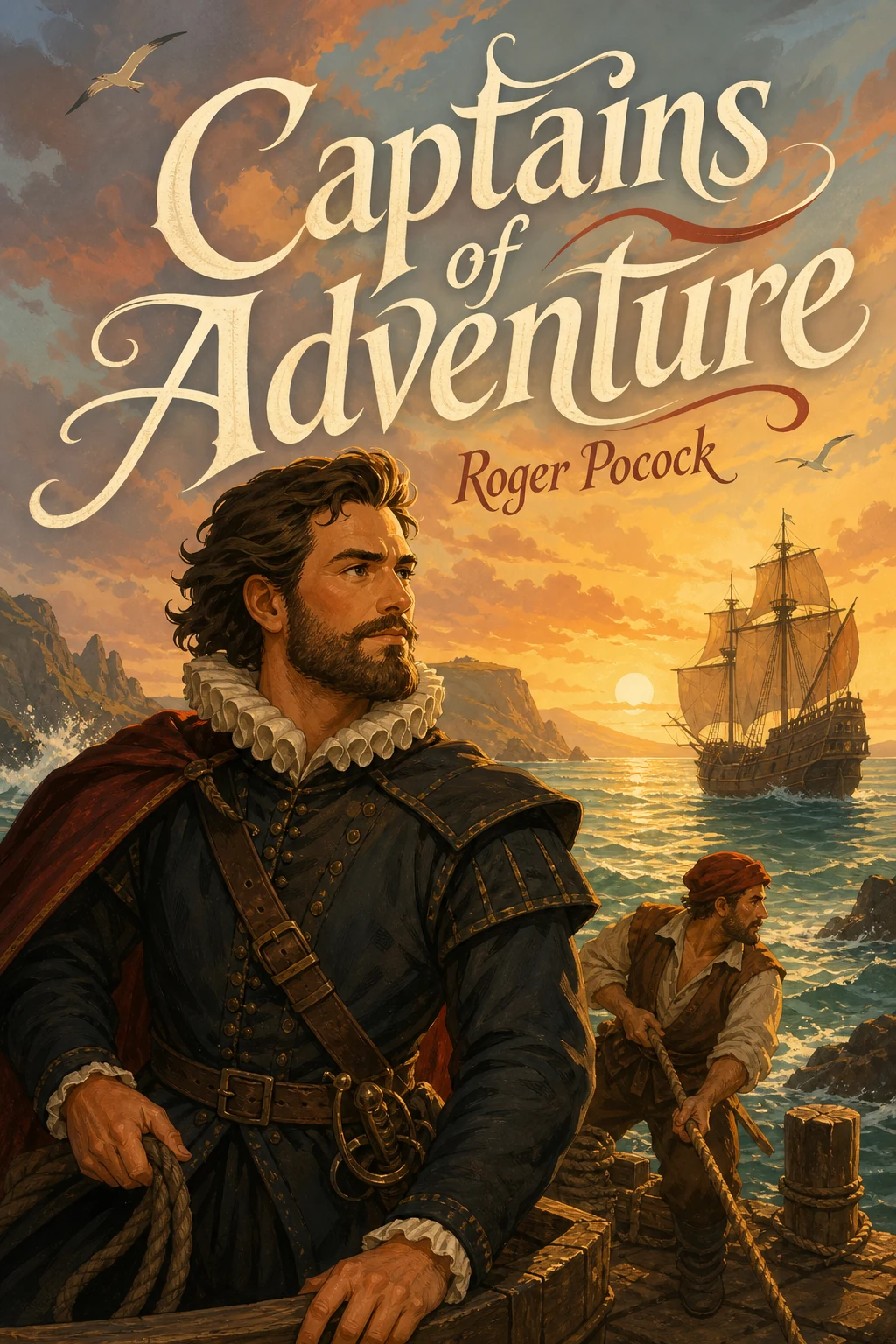
Storieta illustrated edition
Captains of adventure
by Roger Pocock
English959 downloads on Project GutenbergDownload EPUB
AdventureHistory - OtherAdventure and adventurers
Public-domain ebook sourced from Project Gutenberg #72176.
Storieta illustrated edition
by Roger Pocock
English959 downloads on Project GutenbergDownload EPUB
Public-domain ebook sourced from Project Gutenberg #72176.
Captains of Adventure is a wide-ranging history of adventurers, from the Vikings’ voyages to America through crusaders, explorers, corsairs, pioneers, soldiers, sea hunters, and figures such as Columbus, Francis Drake, Kit Carson, Buffalo Bill, Gordon, and the conquerors of the Poles. Its focus is the lone-hand pioneer rather than the regular soldier: men and women drawn toward hazardous enterprises for their own sake, not merely for money or official duty. Across fifty-six chapters, the book follows adventure through wilderness, ocean, battle, empire, deserts, and the farthest reaches of the world, while also considering the adventurers of its own era and the emerging possibilities of flight.
The author writes with a forceful, highly personal voice, part history, part seaman’s judgment, and part tall tale. Humor, sharp opinions, vivid landscapes, practical knowledge, and skepticism toward celebrated reputations sit alongside genuine admiration for courage and resourcefulness. The prose has the expansive, masculine rhetoric and imperial outlook of its period, but its lively irreverence keeps it from sounding ceremonious. It should appeal to readers who enjoy historical adventure, exploration narratives, maritime lore, frontier lives, and strongly voiced storytelling.
The opening · free to read
What is an adventurer? One who has adventures? Surely not. A person charged by a wild rhinoceros is having an adventure, yet however wild the animal, however wild the person, he is only somebody wishing himself at home, not an adventurer. In dictionaries the adventurer is “one who seeks his fortune in new and hazardous or perilous enterprises.” But outside the pages of a dictionary, the man who seeks his fortune, who really cares for money and his own advantage, sits at some desk deriding the fools who take thousand-to-one chances in a gamble with Death. Did the patron saint of adventurers, Saint Paul, or did Saint Louis, or Francis Drake, or Livingstone, or Gordon seek their own fortune, think you? In real life the adventurer is one who seeks, not his fortune, but the new and hazardous or perilous enterprises. There are holy saints and scoundrels among adventurers, but all the thousands I have known were fools of the romantic temperament, dealing with life as an artist does with canvas, to color it with fierce and vivid feeling, deep shade and radiant light, exulting in the passions of the sea, the terrors of the wilderness, the splendors of sunshine and starlight, the exaltation of battle, fire and hurricane.
All nations have bred great adventurers, but the living nation remembers them sending the boys out into the world enriched with memories of valor, a heritage of national honor, an inspiration to ennoble their manhood. That is the only real wealth of men and of peoples. For such purposes this book is written, but so vast is the theme that this volume would outgrow all reasonable size unless we set some limit. A man in the regular standing forces of his native state is not dubbed adventurer. When, for example, the immortal heroes Tromp and De Ruyter fought the British generals at sea, Blake and Monk, they were no more adventurers than are the police constables who guard our homes at night. Were Clive and Warren Hastings adventurers? They would turn in their graves if one brought such a charge. The true type of adventurer is the lone-hand pioneer.
It is not from any bias of mine that the worthies of Switzerland, the Teutonic empires and Russia, are shut out of this poor little record; but because it seems that the lone-hand oversea and overland pioneers come mainly from nations directly fronting upon the open sea. As far as I am prejudiced, it is in favor of old Norway, whose heroes have entranced me with the sheer glory of their perfect manhood. For the rest, our own English-speaking folk are easier for us to understand than any foreigners.
As to the manner of record, we must follow the stream of history if we would shoot the rapids of adventure.
Now as to the point of view: My literary pretensions are small and humble, but I claim the right of an adventurer, trained in thirty-three trades of the Lost Region, to absolute freedom of speech concerning frontiersmen. Let history bow down before Columbus, but as a foremast seaman, I hold he was not fit to command a ship. Let history ignore Captain John Smith, but as an ex-trooper, I worship him for a leader, the paladin of Anglo-Saxon chivalry, and very father of the United States. Literature admires the well advertised Stanley, but we frontiersmen prefer Commander Cameron, who walked across Africa without blaming others for his own defects, or losing his temper, or shedding needless blood. All the celebrities may go hang, but when we take the field, send us leaders like Patrick Forbes, who conquered Rhodesia without journalists in attendance to write puffs, or any actual deluge of public gratitude.
The historic and literary points of view are widely different from that of our dusty rankers.
When the Dutchmen were fighting Spain, they invented and built the first iron-clad war-ship--all honor to their seamanship for that! But when the winter came, a Spanish cavalry charge across the ice captured the ship--and there was fine adventure. Both sides had practical men.
In the same wars, a Spanish man-at-arms in the plundering of a city, took more gold than he could carry, so he had the metal beaten into a suit of armor, and painted black to hide its worth from thieves. From a literary standpoint, that was all very fine, but from our adventurer point of view, the man was a fool for wearing armor useless for defense, and so heavy he could not run. He was killed, and a good riddance.
We value most the man who knows his business, and the more practical the adventurer, the fewer his misadventures.
From that point of view, the book is attempted with all earnestness; and if the results appear bizarre, let the shocked reader turn to better written works, mention of which is made in notes.
As to the truthfulness of adventurers, perhaps we are all more or less truthful when we try to be good. But there are two kinds of adventurers who need sharply watching. The worst is F. C. Selous. Once he lectured to amuse the children at the Foundling Hospital, and when he came to single combats with a wounded lion, or a mad elephant he was forced to mention himself as one of the persons present. He blushed. Then he would race through a hair-lifting story of the fight, and in an apologetic manner, give all the praise to the elephant, or the lion lately deceased. Surely nobody could suspect him of any merit, yet all the children saw through him for a transparent fraud, and even we grown-ups felt the better for meeting so grand a gentleman.
The other sort of liar, who does not understate his own merits, is Jim Beckwourth. He told his story, quite truthfully at first, to a journalist who took it down in shorthand. But when the man gaped with admiration at the merest trifles, Jim was on his mettle, testing this person’s powers of belief, which were absolutely boundless. After that, of course he hit the high places, striking the facts about once in twenty-four hours, and as one reads the book, one can catch the thud whenever he hit the truth.
Let no man dream that adventure is a thing of the past or that adventurers are growing scarce. The only difficulty of this book was to squeeze the past in order to make-space for living men worthy as their forerunners. The list is enormous, and I only dared to estimate such men of our own time as I have known by correspondence, acquaintance, friendship, enmity, or by serving under their leadership. Here again, I could only speak safely in cases where there were records, as with Lord Strathcona, Colonel S. B. Steele, Colonel Cody, Major Forbes, Captain Grogan, Captain Amundsen, Captain Hansen, Mr. John Boyes. Left out, among Americans, are M. H. de Hora who, in a Chilian campaign, with only a boat’s crew, cut out the battle-ship Huascar, plundered a British tramp of her bunker coal, and fought H. M. S. Shah on the high seas. Another American, Doctor Bodkin, was for some years prime minister of Makualand, an Arab sultanate. Among British adventurers, Caid Belton, is one of four successive British commanders-in-chief to the Moorish sultans. Colonel Tompkins was commander-in-chief to Johore. C. W. Mason was captured with a shipload of arms in an attempt to make himself emperor of China. Charles Rose rode from Mazatlan in Mexico to Corrientes in Paraguay. A. W. V. Crawley, a chief of scouts to Lord Roberts in South Africa, rode out of action after being seven times shot, and he rides now a little askew in consequence.
To sum up, if one circle of acquaintances includes such a group to-day, the adventurer is not quite an extinct species, and indeed, we seem not at the end, but at the beginning of the greatest of all adventurous eras, that of the adventurers of the air.
A reverent study of heroes in novels, also in operas and melodramas, where one may see them for half-a-crown, has convinced me that they must be very trying to live with. They get on people’s nerves. Hence the villains.
Now Harold of the Fair Hair was a hero, and he fell in love with a lady, but she would not marry him unless he made himself king of Norway. So he made himself the first king of all Norway, and she had to marry him, which served her right.
But then there were the gentlemen of his majesty’s opposition who did not want him to be king, who felt that there was altogether too much Harold in Norway. They left, and went to Iceland to get away from the hero.
Iceland had been shown on the map since the year A. D. 115, and when the vikings arrived they found a colony of Irish monks who said they had come there “because they desired for the love of God to be in a state of pilgrimage, they recked not where.”
Perhaps the vikings sent them to Heaven. Later on it seems they found a little Irish settlement on the New England coast, and heard of great Ireland, a colony farther south. That is the first rumor we have about America.
The Norsemen settled down, pagans in Christian Iceland. They earned a living with fish and cattle, and made an honest penny raiding the Mediterranean. They had internecine sports of their own, and on the whole were reasonably happy. Then in course of trade Captain Gunbjorn sighted an unknown land two hundred fifty miles to the westward. That made the Icelanders restless, for there is always something which calls to Northern blood from beyond the sea line.
Most restless of all was Red Eric, hysterical because he hated a humdrum respectable life; indeed, he committed so many murders that he had to be deported as a public nuisance. He set off exultant to find Gunbjorn’s unknown land. So any natural born adventurer commits little errors of taste unless he can find an outlet. It is too much dog-chain that makes biting dogs.
When he found the new land it was all green, with swaths of wild flowers. I know that land and its bright lowlands, backed by sheer walled mountains, with splintered pinnacles robed in the splendors of the inland ice. The trees were knee high, no crops could possibly ripen, but Eric was so pleased that after two winters he went back to Iceland advertising for settlers to fill his colony. Greenland he called the place, because “Many will go there if the place has a fair name.” They did, and when the sea had wiped out most of the twenty-five ships, the surviving colonists found Greenland commodious and residential as the heart could wish.
They were not long gone from the port of Skalholt when young Captain Bjarni came in from the sea and asked for his father. But father Heljulf had sailed for Greenland, so the youngster set off in pursuit although nobody knew the way. Bjarni always spent alternate yuletides at his father’s hearth, so if the hearth-stone moved he had to find it somehow. These vikings are so human and natural that one can follow their thought quite easily. When, for instance, Bjarni, instead of coming to Greenland, found a low, well timbered country, he knew he had made a mistake, so it was no use landing. Rediscovering the American mainland was a habit which persisted until the time of Columbus, and not a feat to make a fuss about. A northerly course and a pure stroke of luck carried Bjarni to Greenland and his father’s house.
Because they had no timber, and driftwood was scarce, the colonists were much excited when they heard of forests, and cursed Bjarni for not having landed. Anyway, here was a fine excuse for an expedition in search of fire-wood, so Leif, the son of Red Eric, bought Bjarni’s ship. Being tall and of commanding presence he rallied thirty-five of a crew, and, being young, expected that his father would take command. Eric indeed rode a distance of four hundred feet from his house against the rock, which was called Brattelid, to the shore of the inlet, but his pony fell and threw him, such a bad omen that he rode home again. Leif Ericsen, therefore, with winged helmet and glittering breastplate, mounted the steerboard, laid hands on the steer-oar and bade his men shove off. The colonists on rugged dun ponies lined the shore to cheer the adventurers, and the ladies waved their kerchiefs from the rock behind the house while the dragon ship, shield-lines ablaze in the sun, oars thrashing blue water, and painted square-sail set, took the fair wind on that famous voyage. She discovered Stoneland, which is the Newfoundland-Labrador coast, and Woodland, which is Nova Scotia. Then came the Further Strand, the long and wonderful beaches of Massachusetts, and beyond was Narragansett Bay, where they built winter houses, pastured their cattle, and found wild grapes. It was here that Tyrkir, the little old German man slave who was Leif’s nurse, made wine and got most gorgeously drunk. On the homeward passage Leif brought timber and raisins to Greenland.
Leif went away to Norway, where as a guest of King Olaf he became a Christian, and in his absence his brother Thorwald made the second voyage to what is now New England. After wintering at Leif’s house in Wineland the Good he went southward and, somewhere near the site of New York, met with savages. Nine of them lay under three upturned canoes on the beach, so the vikings killed eight just for fun, but were fools, letting the ninth escape to raise the tribes for war. So there was a battle, and Thorwald the Helpless was shot in the eye, which served him right. One of his brothers came afterward in search of the body, which may have been that same seated skeleton in bronze armor that nine hundred years later was dug up at Cross Point.
Two or three years after Thorwald’s death his widow married a visitor from Norway, Eric’s guest at Brattelid, the rich Thorfin Karlsefne. He also set out for Vinland, taking Mrs. Karlsefne and four other women, also a Scottish lad and lass (very savage) and an Irishman, besides a crew of sixty and some cattle. They built a fort where the natives came trading skins for strips of red cloth, or to fight a battle, or to be chased, shrieking with fright, by Thorfin’s big red bull. There Mrs. Karlsefne gave birth to Snorri the Firstborn, whose sons Thorlak and Brand became priests and were the first two bishops of Greenland.
After Karlsefne’s return to Greenland the next voyage was made by one of Eric’s daughters; and presently Leif the Fortunate came home from Norway to his father’s house, bringing a priest. Then Mrs. Leif built a church at Brattelid, old Eric the Red being thoroughly disgusted, and Greenland and Vinland became Christian, but Eric never.
As long as Norway traded with her American colonies Vinland exported timber and dried fruit, while Greenland sent sheepskins, ox hides, sealskins, walrus-skin rope and tusks to Iceland and Europe. In return they got iron and settlers. But then began a series of disasters, for when the Black Death swept Europe, the colonies were left to their fate, and some of the colonists in despair renounced their faith to turn Eskimo. In 1349 the last timber ship from Nova Scotia was lately returned to Europe when the plague struck Norway. There is a gap of fifty-two years in the record, and all we know of Greenland is that the western villages were destroyed by Eskimos who killed eighteen Norsemen and carried off the boys. Then the plague destroyed two-thirds of the people in Iceland, a bad winter killed nine tenths of all their cattle, and what remained of the hapless colony was ravaged by English fishermen. No longer could Iceland send any help to Greenland, but still there was intercourse because we know that seven years later the vicar of Garde married a girl in the east villages to a young Icelander.
Meanwhile, in plague-stricken England, Bristol, our biggest seaport, had not enough men living even to bury the dead, and labor was so scarce that the crops rotted for lack of harvesters. That is why an English squadron raided Iceland, Greenland, perhaps even Vinland, for slaves, and the people were carried away into captivity. Afterward England paid compensation to Denmark and returned the folk to their homes, but in 1448 the pope wrote to a Norse bishop concerning their piteous condition. And there the story ends, for in that year the German merchants at Bergen in Norway squabbled with the forty master mariners of the American trade. The sailors had boycotted their Hanseatic League, so the Germans asked them to dinner, and murdered them. From that time no man knew the way to lost America.
In the seventh century of the reign of Our Lord Christ, arose the Prophet Mahomet. To his followers he generously gave Heaven, and as much of the earth as they could get, so the true believers made haste to occupy goodly and fruitful possessions of Christian powers, including the Holy Land. The owners were useful as slaves.
Not having been consulted in this matter, the Christians took offense, making war upon Islam in seven warm campaigns, wherein they held and lost by turns the holy sepulcher, so that the country where our Lord taught peace, was always drenched with blood. In the end, our crusades were not a success.
About Saint Louis and the sixth crusade:
At the opening of the story, that holy but delightful king of France lay so near death that his two lady nurses had a squabble, the one pulling a cloth over his face because he was dead, while the other snatched it away because he was still alive. At last he sent the pair of them to fetch the cross, on which he vowed to deliver the Holy Land. Then he had to get well, so he did, sending word to his barons to roll up their men for war.
Among the nobles was the young Lord of Joinville, seneschal of Champagne--a merry little man with eight hundred pounds a year of his own. But then, what with an expensive mother, his wife, and some little worries, he had to pawn his lands before he could take the field with his two knights-banneret, nine knights, their men-at-arms, and the servants. He shared with another lord the hire of a ship from Marseilles, but when they joined his majesty in Cyprus he had only a few pounds left, and the knights would have deserted but that the king gave him a staff appointment at eight hundred pounds a year.
The king was a holy saint, a glorious knight errant, full of fun, but a thoroughly incompetent general. Instead of taking Jerusalem by surprise, he must needs raid Egypt, giving the soldan of Babylon the Less (Cairo) plenty of time to arrange a warm reception. The rival armies had a battle on the beach, after which Saint Louis sat down in front of Damietta, where he found time to muddle his commissariat.
On the other hand, the soldan was not at all well, having been poisoned by a rival prince, and paid no heed to the carrier pigeons with their despairing messages from the front. This discouraged the Moslems, who abandoned Damietta and fled inland, hotly pursued by the French. As a precaution, however, they sent round their ships, which collected the French supplies proceeding to the front. The Christians had plenty of fighting and a deal of starving to do, not to mention pestilence in their ill-managed camps. So they came to a canal which had to be bridged, but the artful paynim cut away the land in front of the bridge head, so that there was no ground on which the French could arrive. In the end the Christians had to swim and, as they were heavily armored, many were drowned in the mud. Joinville’s party found a dry crossing up-stream, and their troubles began at the enemy’s camp whence the Turks were flying.
“While we were driving them through their camp, I perceived a Saracen who was mounting his horse, one of his knights holding the bridle. At the moment he had his two hands on the saddle to mount, I gave him of my lance under the armpit, and laid him dead. When his knight saw that, he left his lord and the horse, and struck me with his lance as I passed, between the two shoulders, holding me so pressed down that I could not draw the sword at my belt. I had, therefore, to draw the sword attached to my horse, and when he saw that he withdrew his lance and left me.”
Here in the camp Joinville’s detachment was rushed by six thousand Turks, “who pressed upon me with their lances. My horse knelt under the weight, and I fell forward over the horse’s ears. I got up as soon as ever I could with my shield at my neck, and my sword in my hand.
The book keeps going
Reading is free forever. Sign up and watch scenes appear while you read.



Scenes Storieta drew for other classics.
Captains of adventure stays free to read. A free account keeps it in your library, with 25 credits to illustrate scenes as you go.