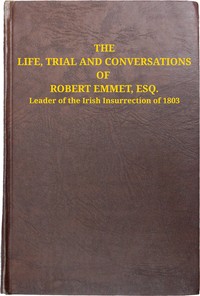
THE LIFE, TRIAL AND CONVERSATIONS OF ROBERT EMMET, ESQ. =Leader of the Irish Insurrection of 1803:= ALSO, THE CELEBRATED SPEECH MADE BY HIM ON THE OCCASION.
O breathe not his name, let it sleep in the shade, Where cold and unhonoured his relics are laid; Sad, silent, and dark be the tears that we shed, As the night dew that falls on the grass o’er his head But the night dew that falls, though in silence it weeps Shall brighten with verdure the grave where he sleeps And the tear that we shed, though in secret it rolls, Shall long keep his memory green in our souls.—MOORE
Stereotyped from the last Dublin Edition.
NEW-YORK: PUBLISHED BY ROBERT CODDINGTON NO. 366 BOWERY, 1850.
THE UNINSCRIBED TOMB OF EMMET.
“Let my tomb remain uninscribed, and my memory in oblivion, until other times and other men can do justice to my character.”
“Pray tell me,” I said, to an old man who stray’d, Drooping over the grave which his own hands had made, “Pray tell me the name of the tenant who sleeps ’Neath yonder lone shade where the sad willow weeps; Every stone is engrav’d with the name of the dead, But yon black slab declares not whose spirit is fled.”
In silence he bow’d, then beckon’d me nigh, Till we stood o’er the grave—then he said with a sigh, “Yes, they dare not to trace e’en a word on this stone, To the memory of him who sleeps coldly alone; He told them—commanded—the lines o’er his grave, Should never be traced by the hand of a slave!
“He bade them to shade e’en his name in the gloom, Till the morning of freedom should shine on his tomb, ‘When the flag of my country at liberty flies, Then—then let my name and my monument rise.’ You see they obey’d him—’tis thirty-three years, And they still come to moisten his grave with their tears.
“He was young like yourself, and aspir’d to o’erthrow The tyrants who fill’d his lov’d island with woe; They crush’d his bold spirit—this earth was confin’d, Too scant for the range of his luminous mind.” He paus’d, and the old man went slowly away, And I felt, as he left me, an impulse to pray.
Grant, Heaven! I may see, ere my own days are done, A monument rise o’er my country’s lost son! And oh! proudest task, be it mine to indite The long-delay’d tribute a freeman must write; ‘Till then shall its theme in my breast deeply dwell, So peace to thy slumbers, dear shade, fare thee well!
THE LIFE AND CONVERSATIONS OF ROBERT EMMET, ESQ.
There are few persons whose name has been so hailed by the young and ardent, whose firmness and patriotism has been more admired, and whose character has produced a greater effect upon society, than the subject of these pages.
Robert Emmet was born in Dublin, in the year 1782, and was the son of Dr. Emmet, for many years state physician in Dublin. He was the youngest brother of Thomas Addis Emmet, who, before the rebellion of 1798, had abandoned a respectable situation at the Irish Bar, in order to project and carry into execution, the schemes of that day, for an Irish Republic, and of course, separation from Great Britain.
Emmet was moulded in Nature’s happiest form for his destined service. He possessed the physical qualities necessary for an accomplished speaker, with high intellect to master and employ knowledge, with imagination and feelings to sway the passions and command the heart; with the power of incessant labour to collect, discipline, and perfect the valued materials of a revolutionary measure, he was eminently calculated for the task which he had undertaken. And, had success depended upon the worth and the virtues of one man, Emmet would now have been hailed as the liberator of his country.
Early impressions are always the most lasting. Emmet had his young mind filled with a detestation of tyranny and injustice at an early age, by the virtue and patriotism of his private tutor, the Rev. Mr. Lewes, who, though a minister of the Established Church, was yet an enemy to its monopolizing power and persecuting spirit towards his Catholic fellow-subjects.
At the age of sixteen he entered Trinity College. Here his progress in classical and mathematical knowledge soon gained him honour and reputation. But his heated spirit had been worked up by the political enthusiasm in which he had been early initiated. At the Historical Society, of which he was a member, he expressed his sentiments so freely on English influence in Ireland, that he came under the suspicions of Lord Chancellor Clare, who ultimately expelled him from College, for denouncing, in a speech he made, the English form of government, and advocating that of a republic.
He had been sufficiently unguarded in his conduct, while the disturbances of ‘98 existed, to become an object of the vigilance of government, and had found it prudent to reside abroad so long as the habeas corpus act was suspended. He fled to the Continent, where an active correspondence was set on foot by the French government. Emmet, with the chiefs of the preceding Irish Rebellion were summoned to Paris. Consultations were held with them, and the organization of another revolution was commenced and prosecuted with increasing diligence. Nor was the then ruler of France, (Buonaparte) inattentive, or remiss to forward, by every means, in his power, the project. To Emmet was delegated the office of director and mover of this new attempt upon the British dominion in Ireland.
On the expiration of the habeas corpus act, he returned to Dublin, but thought it prudent, for the forwarding of the revolution, to live privately. He took obscure lodgings at Harold’s Cross, under the assumed name of Hewit. Here he held his meetings with his associates. These people hailed with transport the opportunity of recommencing another attempt on subverting British power in Ireland! and while some spread themselves over the country in every direction, others fixed themselves in the metropolis.
During the first four months after Emmet’s arrival, nothing of his machinations transpired. Soon after the King’s Proclamation, on the 8th of March, conceiving the moment of national alarm at the renovation of hostilities, and a threatened invasion, favourable to his projects, he became more active in his preparations. The whole of his family portion, which consisted of two thousand five hundred pounds, he devoted to his enthusiasm. In the beginning of April, he quitted his lodgings at Harold’s Cross, with the name of Hewit, and in the new name of Ellis he took the lease of a house, for which he paid a fine of sixty-one guineas, in Butterfield-Lane, near Rathfarnham. Here he harangued his associates, and encouraged them by hopes of a happy result to their labours.
‘Liberty,’ said he, ‘is the child of oppression, and the birth of the offspring is the death of the parent; while tyranny, like the poetical desert bird, is consumed in flames ignited by itself, and its whole existence is spent in providing the means of self-destruction. We have a complete exemplification of this in the past history and present state of Ireland, where increase of numbers and increase of intelligence, have been the direct result of that system which too long has ruled this kingdom.
‘The relentless oppression of the English Government forced the people into habits of temperance—necessity made them abstemious, and time reconciled them to their wholesome esculent, which providentially came, like the manna of the desert, to feed the sojourners in the land of their fathers.
‘When nature is easily satisfied, and the necessaries of life procured with little labour and care, increase of population will follow: because parents, who are contented with their own condition, will feel no uneasiness for their offspring, who can, without any difficulty, procure a situation similar to their own. Emigration from such a country was not to be expected; for men whose modified wants were amply satisfied at home, had no need to seek elsewhere for wealth they did not desire, or distinctions they did not value. Besides, Ireland has always had peculiar attractions in retaining her children: a Scotchman loves a Scotchman, but an Hibernian loves the green fields of his youth and to enjoy these there are few privations to which he will not cheerfully submit. The eccentric humour, the boisterous mirth, the kind and social intercourse, that characterize the peasantry, likewise spread their charms, and generally succeeded in subduing the aspiring notions of adventurers, and helped to retain the people at home. When to these were added the allurements of a more tender kind, and when no restraint was placed upon the natural instinct of man, we must not wonder that Ireland is blessed with a population without a parallel in Europe.
‘The base and cowardly conduct of the Irish proprietors in deserting the country, though at the moment a grievance, was absolutely productive of good. Their large domains were parcelled out to humble cottages; farms were divided and subdivided; cabins every where raised their unostentatious roofs; and every floor was blessed with a numerous progeny.
‘Ireland has been forced into agriculture;[1] and, this still farther tends to increase the population, and to give her that political importance she never could have acquired if the people had been immured in mineral dungeons, or confined to the fetid vapours of a manufacturing bastile. Rural labour is not more conducive to the health of the body, than it is beneficial to the exercise of the mind; and we always find the agriculturist superior to the mechanic not only in physical strength, but in moral energy. The one is a natural soldier, who commands respect, and exacts consideration; while the other is a mere animated machine, whose ideas serve but as internal wheels to keep his hands in motion. His frame is distorted, his mind crippled, and his courage annihilated: but the agriculturist is a man such as nature intended—fearless, active and resolute; the air he breathes ensures him health; the ground he tills supplies him with sustenance; and his occupations make him moral, hardy, and brave. This is the copy of a million portraits, and they are all found in Ireland.
‘The aspirations of civilized man after freedom are coeval with his existence. His rights, like the mountain torrent, may be diverted from their original channel, but cannot be effectually impeded in their course. Dams may be raised to stop the coming stream; but, if the congregated waters cannot find another way to the place of their destination, they will burst through every opposition, and overwhelm in destruction all the works of lordly and presumptive man.’
‘But we find,’ observed a bystander, ‘that very populous countries have continued in slavery.’
‘Numbers,’ rejoined Emmet, ‘whose minds are more enslaved than their bodies may submit to injustice; but numbers inspired with intelligence never can. The Irish people are not only shrewd, but informed; and for this good, as well as for every other blessing they possess, they are indebted to the folly and wickedness of their governors, Divide et impera has long been the maxim of those who oppressed us; but the result has been the reverse of their anticipations. The continued agitation, faction, and discord, consequent upon such a system of legislation, produced their moral effects, and, like the vivid lightning, served to purify the element they disturbed. The political whirlpool has drawn within its vortex every man in Ireland; discussion has been universally provoked; and the passions have been enlisted in the general conflict. The human intellect has been propelled, vulgar errors corrected, and the spirit of enquiry and investigation has gone abroad.