Public-domain ebook
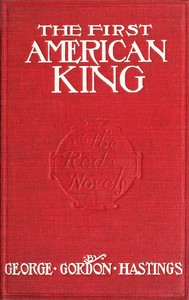
The first American King
Language: en520 downloads on Project Gutenberg
Subjects
In: Science-Fiction & Fantasy·Novels·American Literature
Public-domain ebook sourced from Project Gutenberg #72226.
Public-domain ebook
Language: en520 downloads on Project Gutenberg
Subjects
In: Science-Fiction & Fantasy·Novels·American Literature
Public-domain ebook sourced from Project Gutenberg #72226.
The opening · free to read
The establishment of Dr. James Belden was pleasantly situated upon the southern shore of Long Island, some ninety odd miles from the city. The spacious house was fitted with every modern convenience and comfort, and stood in extensive, well-wooded private grounds. There were good fishing and boating to be had and the white, well-kept Long Island roads afforded excellent facilities alike for riding and driving.
The establishment was in reality a cross between a sanatorium and a physical culture resort. The doctor-proprietor carefully examined each person upon arrival and kept his directing eye upon him during his stay. He prescribed the diet and the exercise suited to each case and saw to it personally that his instructions were carried out. Many a wreck of the city’s storm and stress had the Doctor sent back to the metropolis renovated and renewed, and many were the haggard devotees of late hours and city dissipation who had returned, after a sojourn at the retreat, with vigor in their limbs and the hue of health in their cheeks. In a word, the Doctor was a philanthropist, at a hundred a week, who extended a haven of rest for human wrecks and turned them out again on the high seas of life staunchly refitted to renew the struggle. The Doctor himself, in fact, often referred to his establishment as a haven of refuge, which nautical expression was, perhaps, not inapt, inasmuch as the harbor in question was not infrequently visited, in popular parlance, by “swells” and “high-rollers.”
Dr. Belden himself was an exceedingly genial person, who well knew how to keep his various guests amused and in good humor with themselves and the world in general. The one subject which disturbed the Doctor’s equanimity was the presence in the neighborhood of a recently established private asylum for the insane maintained by a Dr. Weldon. The similarity between the names Weldon and Belden had led upon certain occasions to various distressing and distinctly embarrassing mistakes. Thus, when distinguished visitors had at times mentioned that they were staying at Dr. Belden’s establishment, rustics of the neighboring villages had been known to tap their heads significantly and adopt either attitudes of alarm, or patronizing airs, as the case might be. While little Reggie Smithers had been sojourning at Dr. Belden’s the rumor had been circulated at his club that he was incarcerated in an asylum for lunatics and a friendly wag had written him a letter of condolence, in which he took occasion to remark parenthetically that he had always entertained an innate conviction that Reggie would eventually so wind up, at which Reggie had been exceedingly wroth and had felt impelled to cut short his stay and return as quickly as possible to the city, so as to give the lie to the rumor.
The early summer of nineteen hundred found the sanatorium fairly well filled with guests, not the least notable among whom was Mr. Thomas Kearns, the widely-famed head of New York’s Secret Service Bureau, who had selected this quiet retreat at which to build up his magnificent muscular development and repair the ravages upon his general system incurred by his exciting and somewhat irregular mode of life in the city. To describe Mr. Kearns as widely famed was certainly not overstating the case, for he was conceded to be the ablest detector of crime in the country. So many were the great mysteries which he had unraveled and with so many important cases had he been connected that his fame had stretched far and wide, extending beyond the confines of the United States and reaching into foreign lands. In a word, his reputation was international and his achievements had been lauded in many countries and in many tongues.
His fellow-townsmen of the great metropolis--in fact, his countrymen at large--were proud of Thomas Kearns. When Americans traveling abroad heard of some mystery which the secret police of European capitals were unable to solve, they were wont to smile in a superior way and exclaim: “They ought to send for Kearns over here--our Kearns. He would show them what’s what!”
Everybody from the doorman at Police Headquarters to the Police Commissioners and the heads of the city government treated Mr. Kearns with distinguished consideration; he was regarded as one of the Institutions of the city. No one ever dreamed of interfering with Mr. Kearns. And well he justified this trust. Under his administration the criminal classes were kept in a subjection and awe which rendered life and property more secure in New York than in any other great city of the world. No criminal from other cities dared seek abode in the metropolis without first reporting to Mr. Kearns as to his advent, his place of domicile, the causes of his visit, and the duration of his stay, and no man of criminal record might, under any circumstances, by day or by night, venture to put foot south of Fulton Street, into the great financial centres where the heaped-up wealth of the city was stored.
Possessed of ample means, no breath of suspicion had ever touched Mr. Kearns. The vicissitudes of his calling had enabled him upon many occasions to be of inestimable service to various financial powers, and these powers had gladly placed at his disposal information which had enabled him to build up a handsome private fortune. He was a man of some forty years, of medium height and well-rounded figure, with blue eyes, a ruddy complexion and the general appearance of a prosperous merchant; but the blue eyes had a very keen look at times and the lips a peculiar way of pursing themselves under the heavy, well-kept brown moustache.
It is true that here and there at times it was whispered about that Mr. Kearns’ success was largely due to the vast army of informers--“stool pigeons,” as they were technically termed--fostered and maintained by him among the criminals themselves, and that in many of his most famous cases the mystery had been solved by confessions procured through the exercise of the mysterious rites of the “third degree.” The precise nature of these rites was known to none save the initiated, but it was darkly hinted that, in certain subterranean cells beneath Mr. Kearns’ official quarters, tortures were practised beside which the horrors of the Spanish Inquisition paled into insignificance.
As to the truth of these rumors there seemed to be no precise means of ascertaining, but certain it was that Mr. Kearns’ methods were eminently successful and--nothing pays like success!
With that easy geniality which was one of his characteristics, within twenty-four hours after his arrival Mr. Kearns was on terms of friendly acquaintance with the various other guests. Most of these were men about town, of various ages, but all suffering from much the same physical troubles, and all possessed of much the same manners, habits and train of thoughts. Of men of this stamp, Mr. Kearns saw enough in the city and they did not particularly interest him. Among these guests, the one who most attracted his interest and attention was Professor Walter Stuart Dean, of Chicago. Professor Dean until recently had filled the chair of Science at Chicago University, but had been forced out because of a book on political economy he had published. Some of the theories set forth in this work were of so advanced and radical a character as to give offense to certain patrons of the Institution. Professor Dean’s views were held to be nothing short of an assault upon the sacred Rights of Property. As one obese and influential patron of the seat of learning put it, “Capital stood aghast” at Professor Dean’s views. As someone must suffer whenever poor, timid Capital is thrown into a fright, Professor Dean, in spite of his conceded great abilities, was made to pay the penalty.
The Professor, however, accepted the situation with much equanimity. He had succeeded in selling to one of the great cable companies an invention in connection with the transmission of messages and had received quite a goodly sum. This placed him in a position of pecuniary ease so far as the immediate future was concerned, and he had come to Dr. Belden’s establishment to recruit his energies in preparation for the launching of a scientific scheme, very comprehensive and ambitious in its scope, dealing with the question of aërial navigation.
The Professor was a man of some forty-seven years, tall and thin and with that slight stoop of the shoulders peculiar to the student. The face was clean-shaven and pale, with a marked puff of the flesh above each eye where the brows were wont to contract in the intensity of thought. When the firm, well-cut features lighted in a smile, the face became positively handsome. One of the Professor’s hobbies, which he was fond of discussing with Mr. Kearns, was the question of the economic condition of the masses of the people. The Professor contended--and it pained his kindly nature that such was the case--that the great mass of the people were not as well-off as they should be; that the true happiness and well-being of the great body of mankind had not advanced in proportion to the world’s progress in other directions.
Another pet subject of discussion with the Professor was his theories of aërial navigation. In fact, he declared that he had fully and satisfactorily solved the problem and was prepared in the near future to produce a craft with which the air could be navigated at will, both in safety and at high speed. His plans for this work, he explained, were fully perfected and the completed invention would have been an accomplished fact some time before had he not been hampered by lack of means. But with the funds received from the sale of his electrical device to the cable company he was in possession of sufficient means to put through the work properly, and he intended to devote himself actively to this matter as soon as his present vacation was over. In the meantime, he had written on the subject of aërial navigation sundry pamphlets which had attracted attention in scientific circles.
At first, Mr. Kearns was disposed to regard Professor Dean’s projects in this connection as partaking of the visionary, but as he grew to know him better, the Professor’s clear-headedness and conservatism made more and more of an impression upon him and he came to regard aërial navigation, with Professor Dean as its introducer, as not such an unlikely possibility in the near future.
Another acquaintance made by Mr. Kearns was that of Dr. Raoul Jaquet. Dr. Jaquet was not a guest of Dr. Belden’s famous establishment, but lived in a cottage of his own some little distance away. He was on friendly terms with Dr. Belden, who spoke of him as a man of remarkable attainments in certain branches of scientific research, notably in chemistry and toxicology. Dr. Jaquet cultivated friendly relations with Professor Dean and Mr. Kearns, and his visits to Dr. Belden’s establishment became more frequent than ever. All three were fond of exercise on foot and they took long rambles together over the surrounding country.
The book keeps going
Reading is free forever. Sign up and watch scenes appear while you read.



Scenes Storieta drew for other classics.
New illustrated classics
Once or twice a month: the latest books to get full character casts, scene art, and free comic editions. No account needed.