Storieta
Sign up
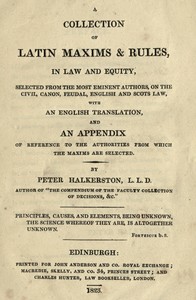
Cover of A collection of Latin maxims & rules, in law and equity: selected from the most eminent authors, on the civil, canon, feudal, English and Scots law, with an English translation, and an appendix of reference to the authorities from which the maxims are selected

Public-domain ebook

A collection of Latin maxims & rules, in law and equity: selected from the most eminent authors, on the civil, canon, feudal, English and Scots law, with an English translation, and an appendix of reference to the authorities from which the maxims are selected

by Peter Halkerston

Language: en1,461 downloads on Project Gutenberg

Subjects

In: Law & Criminology·Encyclopedias/Dictionaries/Reference

Public-domain ebook sourced from Project Gutenberg #72240.

About this book

Peter Halkerston’s work is a systematic compilation of legal maxims drawn from the most eminent authorities across civil, canon, feudal, English and Scots law. The opening pages set out his purpose: to furnish lawyers with a memorized “pillars” of law, offering every maxim he could locate that proved useful, together with his own English translations. Halkerston acknowledges the labour involved in rendering the Latin, modestly claiming his rendering is “pretty correct” though not perfect. The book proceeds to define the nature of a rule in law, then presents a long series of paired Latin statements and their translations, each illustrating a principle ranging from procedural doctrines to equitable concepts.

The voice is that of an early‑19th‑century legal scholar, earnest and didactic, employing a formal, almost scholastic style that mirrors the language of contemporary treatises. Readers with an interest in historical jurisprudence, law students, historians of English and Scots law, or anyone fascinated by the Latin foundations of legal reasoning, will find the text rewarding, while modern practitioners may appreciate it as a window into the doctrinal vocabulary that shaped the common law and equity of Halkerston’s era.
Opening lines

Maxims are general principles. General principles afford the most beneficial subjects of reflection: hence it is obvious, that the memory cannot be too well stored with Maxims. With regard to Law, Maxims are the pillars upon which the system is erected. When the memory is stored with them, the Lawyer can have no difficulty in his practice, to fill up the outline.

Keep reading free · chapter 1 needs no account

More like this

Cover of A collection of Latin maxims and phrases literally translated
 Intended for the use of students for all legal examinations

A collection of Latin maxims and phrases literally translated Intended for the use of students for all legal examinations

John N. Cotterell

John N. Cotterell’s work is a compact reference that gathers a broad selection of Latin legal maxims, each…

Cover of Poine: a study in ancient Greek blood-vengeance

Poine: a study in ancient Greek blood-vengeance

Hubert Joseph Treston

Hubert J. Treston’s Poine is a scholarly study that treats ancient Greek blood‑vengeance as a window onto the…

The Journal of Negro History, Volume 6, 1921

The Journal of Negro History, Volume 6, 1921

Various

The Journal of Negro History, Volume 6 (1921) is a scholarly periodical devoted to the study of…

Cover of The Life of John Marshall, Volume 4: The building of the nation, 1815-1835

The Life of John Marshall, Volume 4: The building of the nation, 1815-1835

Albert J. Beveridge

Albert J. Beveridge’s fourth volume on John Marshall is a scholarly biography that situates the chief justice…

By Advice of Counsel

By Advice of Counsel

Arthur Cheney Train

By Advice of Counsel is a legal‑themed adventure that follows the bustling cases of the fictional firm Tutt &…

The Trial of Charles Random de Berenger, Sir Thomas Cochrane, commonly called Lord Cochrane, the Hon. Andrew Cochrane Johnstone, Richard Gathorne Butt, Ralph Sandom, Alexander M'Rae, John Peter Holloway, and Henry Lyte for A Conspiracy In the Court of King's Bench, Guildhall, on Wednesday the 8th, and Thursday the 9th of June, 1814

The Trial of Charles Random de Berenger, Sir Thomas Cochrane, commonly called Lord Cochrane, the Hon. Andrew Cochrane Johnstone, Richard Gathorne Butt, Ralph Sandom, Alexander M'Rae, John Peter Holloway, and Henry Lyte for A Conspiracy In the Court of King's Bench, Guildhall, on Wednesday the 8th, and Thursday the 9th of June, 1814

The work is a verbatim record of the 1814 trial held in the Court of King's Bench, Guildhall, concerning a…