Public-domain ebook
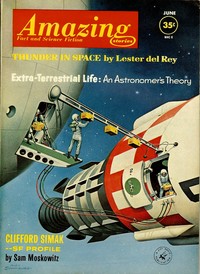
Thunder in space
Language: en409 downloads on Project Gutenberg
Subjects
In: Science-Fiction & Fantasy·Novels·American Literature
Public-domain ebook sourced from Project Gutenberg #72277.
Public-domain ebook
Language: en409 downloads on Project Gutenberg
Subjects
In: Science-Fiction & Fantasy·Novels·American Literature
Public-domain ebook sourced from Project Gutenberg #72277.
The opening · free to read
In the little formal garden in Geneva, the guards had withdrawn discreetly, out of sight and hearing of the two men who sat on a carved marble bench in the center of the enclosure.
The President of the United States was too old for the days of strained public and private meetings and the constant badgering of his advisers that had preceded this final, seemingly foredoomed effort. His hands trembled as he lifted them to light a cigarette. Only his voice still held its accustomed calm.
"Then it's stalemate, Feodor Stepanovich. I can make no more concessions without risking impeachment."
The dark, massive head of the Russian Premier nodded. "Nor can I, without committing political suicide." His English was better than the rural dialect of Russian he still retained. "Call it a double checkmate. Our predecessors sowed their seeds too deep for our spades. Or should I say, too high?"
Both heads turned to the north, where a bright spot was climbing above the horizon. The space station sparkled in sunlight far above Earth, sliding with Olympian deliberation past a few visible stars until it was directly overhead. Without a timetable or a telescope, there was no way of knowing whether it was the Russian Tsiolkovsky or the American Goddard, nor did either man care. Half the world lived in almost hysterical fear of one or the other, with the rest of the human race existing in terror of both.
The Premier muttered something from the ugliness of his childhood experiences, but the President only sighed unhappily, as if sorry that his own background gave him no such expressions.
A few minutes later, the leaders separated. As they moved across the garden, their escorts surrounded them, clearing the way toward the cars that would take them to the airport. Behind them, professional diplomats stopped puzzling over the delay and began spinning obfuscations to cynical reporters. The phrases had long since lost all meaning, but the traditions of propaganda had to be maintained.
In the UN, the Israeli delegate crumpled a news dispatch and began speaking without notes, demanding that space be inter-nationalized. It was the greatest speech of his career, and even the delegate from Egypt applauded. But national survival could not be trusted to the shaky impartiality of the UN. The resolution was vetoed by both the United States and Russia.
The Fourteenth Space Disarmament Conference was ended.
A month later, a thousand miles above Earth and exactly 180° behind the Tsiolkovsky, the Goddard swung steadily around the globe in a two-hour circumpolar orbit. Outwardly, it looked like the great metal doughnut that space artists had pictured for decades. On the inside, however, the evidence of hasty, crash-planned work was everywhere. The air fans whined and vibrated, the halls creaked and groaned, and the water needed to maintain balance gurgled and banged through ill-conceived piping. It was cramped and totally inadequate for the needs of the nation that had put it into space eight years before in a rush attempt to match the Russian "Sulky".
Jerry Blane should have been used to such conditions. He'd been one of the original space-struck men who'd helped to build it and then had been lucky enough to get a permanent assignment. Now he drifted in the weightless hub, watching the loading of a ship bound back for the home planet, wondering what hell's brew the boxes contained. The project that had usurped the cryogenic labs had involved its own crew of scientists, who were already on board the ship, taking their secret with them.
He shrugged, trying to dismiss the problem. The motion twitched him about, and he corrected automatically. His tall, thin body was accustomed to weightlessness.
Beside him, the head of the science corps on the station also floated in midair. The big body of Dr. Austin Peal was revealed in the single pair of shorts customary on the Goddard, and its darkness contrasted sharply with the blond hair and pale skin of Blane. Only the frowns matched.
The short, intense figure of General Devlin popped into the hub from the tube elevator ahead of the pilot, Edwards. In spite of the weightlessness, the station commandant managed to pull himself to rigid attention at sight of Blane. He scowled, but held out his hand with formal correctness.
"All right, Blane. You're in charge officially until I get back," he admitted grudgingly. He obviously resented the order that left a civilian in charge while he went down to testify for the station appropriations and receive new orders. "You'll find detailed notes on my desk. I suggest you follow them to the letter."
He grabbed a handhold and began pulling himself into the airlock to the ship without waiting for a reply.
Edwards had lingered. Now he also held out his hand. "Wish me luck, Jerry," he said. "I may need it."
Because of the contents of the boxes and the presence of Devlin, Edwards had been ordered to make his landing at Canaveral, under military security. Most space work was done from Johnston Island in the Pacific; the inadequate facilities at the Cape were supposed to be used only by smaller rockets. But lately the rules were shot in a lot of ways. Ever since the last meeting at Geneva, nothing seemed normal.
"You'll make out," Drake told him. "Our predictions give you perfect landing weather, at least."
"Yeah. Clear weather and thunder below." In the station slang, thunder stood for heavy trouble. The weather forecast didn't matter; there was always thunder below.
Edwards moved through the airlock and into his ship. A moment later, fire bloomed from the rocket tubes and the ship began moving away. In the station, motors began whining, restoring the hub's spin to match that of the rest of the Goddard.
From the viewing ports, Earth filled almost the entire field of vision, like a giant opal set in black velvet. More than half was covered by bright cloud masses, but the rest showed swirls and patterns of blue water, green forest and reddish brown barren patches. Over everything lay the almost fluorescent blue of atmosphere, forming a brilliant violet halo at the horizon. It looked incredibly beautiful. So, Blane thought, does a Portuguese man-of-war--until one sees the slime underneath or touches the poisoned stings.
"Why can't they leave us alone?" Peal asked, as if reading Blane's mind. "Why can't they blow themselves up quietly without ruining our chances here?"
Blane chuckled bitterly. He'd been on vacation down there a month before, and Earth was fresher in his memory than it was to Peal. "They don't see it that way. To them, we're the danger, the biggest sword of Damocles ever invented. They look up and see us going overhead, loaded with enough megaton bombs to blast life off Earth. Every time we orbit over them, they see Armageddon right over their heads, waiting some fool's itching finger. They could risk the holocaust when everything was halfway around the world, but not when it's where they can look up and see it. Most of the thunder down there is caused by the chained lightning we're carrying up here."
It wasn't an original idea. The panic on Earth had been increasing since the building of the Russian station. Now panic bred false moves, and errors bred more panic. Sooner or later, that panic could get out of hand and bring about the very ruin they feared.
"Besides," he added, "there's the expense of keeping us up here. They think the billions needed to maintain us are pauperizing them."
"We're paying three to one on every cent we get! Even forgetting the work in astronomy, bio-chemistry, cryogenics and high-vacuum research, our weather predictions are worth billions a year in crop returns."
Blane shrugged. "Most of our work is for the government without payment, so Congress still has to appropriate billions for us yearly. That's all the people see. We're poison down there. They'd vote to ditch us if they weren't so scared of the bombs on the Sulky."
"That's what comes of putting scientific tools under government control," Peal grumbled. "The stations should have been private enterprises from the beginning."
Blane nodded automatically. It was an old argument, and it made sense. But there was no chance of the government ever letting go now. They took the clanking elevator down toward the rim, while weight built up to the normal one-third Earth gravity that was produced by the spin at the outer edge of the Goddard. Then they moved along the hallway that circled the rim, through the recreation hall, past the vacuum labs that were busy with some kind of military development, and past the cryogenic section, where men were busy getting ready to resume normal work. Beyond that lay the weather study section. It should have been located in the hub, but there had been too little room, and the pickups were remotely controlled, flashing their pictures of Earth onto big screens here. Now the screens showed Madagascar to the west of them as they swung northward. Men were busy plotting the final details for next month's weather predictions.
Peal followed Blane through the side door into the little office of Devlin. The General was something of a martinet, but his discipline extended to himself. Everything was in order, and the list of instructions lay in a folder in the center of the desk. Blane glanced at it, then at the basket of communications from Earth. He grimaced, and passed some of the flimsies over to Peal. "There's more evidence, if you want to prove the profit we could show."
There were requests for projects to be done here, complaints--often angry--at projects already okayed but delayed by high-priority military research. There were applications from names already famous below. Five foundations were demanding that the lunar ships be rushed to completion.
The intercom came to life with a rasping parody of the voice of Devlin's secretary. "Mr. Blane, Captain Manners insists on seeing you. He's been waiting nearly an hour."
Blane flipped through Devlin's instructions. There was an entry on Manners there: Troublemaker, possibly paranoid. Add his figures to HQ report as routine only.
"Send him in," Blane ordered. The red-headed young captain had been assigned here only six months ago, but Blane had met him often enough to like him.
Almost at once, the connecting office door opened and Manners shoved in. He was obviously angry, but his voice didn't show it. "Thanks for seeing me, Blane. I'd just about decided you wouldn't." He slapped a piece of film down on the desk. "Here. Look at that!"
The film was slightly darkened. Blane turned it over, recognizing it as one of the strips worn by the men who worked in the bomb section to warn of any accidental exposure to radiation. But it was well under any dangerous level of exposure. He passed it to Peal, who studied it in curiosity.
"That's in five hours of routine work in the bomb bay," Manners said. "Routine work! And I checked the films before issuing them, so I know they weren't pre-exposed." He pulled out a sheet of paper covered with figures and dropped it on the desk. "The radiation's up in there again. Check it yourself if you won't accept my readings."
The book keeps going
Reading is free forever. Sign up and watch scenes appear while you read.



Scenes Storieta drew for other classics.
New illustrated classics
Once or twice a month: the latest books to get full character casts, scene art, and free comic editions. No account needed.