Public-domain ebook
The warriors
by Tom Purdom
English393 downloads on Project GutenbergDownload EPUB
Public-domain ebook sourced from Project Gutenberg #72278.
Public-domain ebook
by Tom Purdom
English393 downloads on Project GutenbergDownload EPUB
Public-domain ebook sourced from Project Gutenberg #72278.
The opening · free to read
Non-violent resistance: a paradox in terms. Yet all mankind knows that, with another war sure to sound the death-knell of the race, that an effective non-violent means of settling disputes must be found. Here is an original approach to what may be the most important problem of our time.
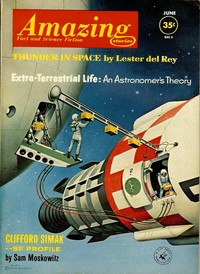
[Transcriber's Note: This etext was produced from Amazing Stories June 1962. Extensive research did not uncover any evidence that the U.S. copyright on this publication was renewed.]
Lights out, the convoy crept away from the Institute. MacFarland rode in the lead car with a driver and his chief psych technician, Crawford Bell. Three flat decked personnel carriers, flying the colors of a mercenary band, Sabo's Own Highland Regiment, patrolled their flanks. The scientists rode in the third and fourth cars in the line.
Crawford Bell had hooked a computer and a full communications set to the rear of the front seat. Now he pressed a button on the commo unit.
"Fourteen," a voice said over the loudspeaker.
"What's happening in town?" Crawford Bell asked. He spoke with the slow, gentle accents of Tennessee.
"They're turning everybody out. There must be fifty guys stirring everybody up, telling them their country's in danger and they'd better fight. There's a mob coming your way."
MacFarland looked across the plain to the city. He could see thousands of hand lights and a dark shape sprawled across the plain. The sound of the crowd was so faint he decided it was still a couple of miles away.
His hands tingled with excitement. This was only his third raid. He still hadn't lost his zest for modern warfare. War was a contest played for high stakes, the fortunes of nations, and it used every aptitude a man could have. Moving into battle under an African sky, he felt glad he didn't live in an earlier age. War was so interesting it would be a shame to spoil it with the agony and guilt of killing.
His objective was the airport. He was supposed to put Doctor Warren's team of biochemists on the midnight plane to Israel. An agent of the Department of Commerce, he had been sent to Belderkan to talk Doctor Warren into becoming a US citizen. It had been a tricky job. Doctor Warren hadn't been anxious to change countries. Only the offer of a lab on the star ship being built by the United States had tempted him. "I'll accept your offer, Mr. MacFarland--if the other members of my team accept it. Talk to them. I won't leave without them."
Harassed by the Belderkan Department of Trade using every weapon in the Twenty-First Century arsenal of persuasion, MacFarland had wrested a grudging decision from the other four scientists. Now all he had to do was get them out of the country. But Doctor Warren's wife had warned the Belderkan government her husband was switching his allegiance.
MacFarland studied the crowd through his glasses. They must have half the city out there. He knew the scientists weren't deeply committed to leaving. If the Belderkans managed to keep them off the plane, they would probably change their minds.
"We're in for a night's work," Crawford Bell said.
To reach the airport, they had to make a half circle around the city. "We haven't lost yet," MacFarland said. "We're going fast enough to cut in front of them before they get between us and the airport."
Standing up in the moving car, he comforted himself by looking at his troops. Crawford Bell was a first-rate technician. His psych team was one of the best in the world. Sabo's mercenary "Regiment" had a global reputation, too. So did the band of mercenaries hiding in ambush. If the quality of an army counted for anything, they had a fighting chance. The position was bad but the men were superb.
He was a soldier. He thought of himself as a soldier and he planned to conduct himself like a soldier and win a victory for his country. But he couldn't use physical violence.
Thirty-eight years before, the governments of the world had finally realized international violence could no longer be tolerated. Any violence between nations, even a fist fight between private citizens from different countries, could trigger Earth's destruction.
He knew the consequences to all mankind of any physical violence. He knew it like he knew he had two legs. He also knew that if he twisted the little finger of a Belderkan citizen, the UN Inspector Corps would arrest him within hours. The World Court would sentence him to five years in prison and fine the United States far more than it could possibly gain from Albert Warren's work.
"Masks," MacFarland yelled. Seconds later he peered at the night from inside a plastic hood. His mustache, rubbing against the inside of the mask, tickled his upper lip.
The helicopter didn't drop psycho-active gas. Instead, it marked them with its light so that far off the crowd would know where its quarry was. A loudspeaker begged the scientists to remember the humble people of Belderkan.
We taxed the labor of our people to give you luxury. We built you beautiful homes. We gave you women, if you wanted them, and all the laboratory equipment you desired. We gave you old age pensions. Remember the labors of our people!
A line of automobile headlights raced across the plain. MacFarland gave an order. The lights of the convoy jumped on.
The line of enemy cars was long and moving fast. He couldn't go around their rear and they were moving fast enough to head him off and hold him for as long as the crowd needed to surround the convoy.
He switched on his mike. "Sabo, can you break their line?"
"Right. Allenby, attack the cars!"
A personnel carrier, sixty men standing on its deck, charged the enemy vehicles. MacFarland grinned when he heard the bagpipes wail.
The carrier headed toward the tiny space between the fourth and fifth vehicles in the enemy line. It swerved suddenly and half a dozen kilted troopers jumped from the deck and landed among the enemy vehicles. Fans screamed as drivers maneuvered to avoid running them over. A second squad jumped off. A third squad landed on their heels. Soon only the piper stood on the deck of the carrier, proudly erect as his mess mates risked their lives among rampaging machines.
The enemy line disintegrated. MacFarland picked out a hole eighty yards wide and led the convoy forward. As they passed the carrier, he threw the piper a salute.
"Well done," he told the mike.
"Thank you," Sabo said.
"It was a good job," Crawford Bell said, "but we had all the advantages. Wait until it's them on foot and us mounted."
The crowd had grown bigger. Now its roar could be heard for miles. A helicopter hovered over it, probably broadcasting the same kind of propaganda as the helicopter over the convoy.
Aiming for the airport, the convoy had left the Institute on a Northeast tack. In trying to outrun the line of cars, they had turned until they were moving due north. The mob was running north, too, and had almost placed itself between the convoy and the airport.
"Cut right," MacFarland told his driver. "Full speed ahead. See if you can cross in front of the crowd."
The helicopter's spotlight irritated him. He didn't like bright lights. Turning around, he checked to see how the scientists were doing. They were all wearing masks and their positions told him nothing about their feelings. He waved and one of them waved back.
Now he could hear the helicopter over the crowd. It was describing the loss that threatened Belderkan. The situation didn't demand sophisticated propaganda.
In a world of unrestricted international trade, with a hundred and ten countries fighting to maintain high living standards, a nation had to maintain a good balance between its exports and imports. The new products talented brains could create were the key to survival. Albert Warren, inventor of several valuable life forms, creator of the currently accepted unified theory of the life process, was one of the world's most valuable natural resources. He and his colleagues were worth several battles.
Three helicopters swooped over the convoy. MacFarland ducked and looked for signs of gas. The helicopters held a position about twenty yards in front of his car and a few feet off the ground.
"Here it comes," Crawford Bell mumbled.
Men jumped out of the helicopters. MacFarland's driver reversed his engine. The convoy screamed to a halt. The men jumping from the copters hit the ground and threw themselves prostrate. In the tall grass they could be anywhere. The helicopter overhead switched off its light.
The book keeps going
Reading is free forever. Sign up and watch scenes appear while you read.



Scenes Storieta drew for other classics.
New illustrated classics
Once or twice a month: the latest books to get full character casts, scene art, and free comic editions. No account needed.