Public-domain ebook
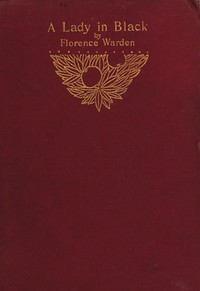
A lady in black
Language: en511 downloads on Project Gutenberg
Subjects
Public-domain ebook sourced from Project Gutenberg #72314.
Public-domain ebook
Language: en511 downloads on Project Gutenberg
Subjects
Public-domain ebook sourced from Project Gutenberg #72314.
The opening · free to read
BY FLORENCE WARDEN Author of “The House on the Marsh,” “A Terrible Family,” “Adela’s Ordeal,” “A Perfect Fool,” “A Sensational Case,” etc.
THE TRADE SUPPLIED BY THE INTERNATIONAL NEWS COMPANY, LONDON. NEW YORK. LEIPSIC.
[COPYRIGHT.]
Copyright, 1895, by The International News Company. [_All Rights Reserved._]
CONTENTS.
I.--A Mystery Somewhere II.--A Penitent III.--An Invitation and a Warning IV.--Was It a Recognition? V.--A Startling Visit VI.--Mr. Banks VII.--A Strange Fancy VIII.--A Haunted House IX.--A Picture X.--The Picking Up of Some Silver Threads XI.--An Interview with Mr. Banks XII.--A Horrible Secret XIII.--Mrs. Dale’s Version of the Story XIV.--No Mercy XV.--Some Explanations
A LADY IN BLACK.
CHAPTER I. A MYSTERY SOMEWHERE.
“And besides, you know, my dear Mrs. Rose, there is generally something wrong about a woman who dresses so very well.”
So spoke Mrs. Bonnington, the Vicar’s wife, laying down the law; a law indeed, which most English women are ready to take for granted. Mrs. Rose, a tall, thin, pale lady who had “nerves,” and who, on this bright April morning, wore a woollen shawl half off her shoulders as she sat in the warm sun by the dining-room window, assented readily.
“That’s what I always say. Especially a widow. I’m sure if anything were to happen to my husband,” went on Mrs. Rose euphemistically, “the last thing I should think about would be my dress. I should be far too unhappy to trouble myself about the fit of my dresses or the shape of my bonnets.”
Now this was perhaps true, as Mrs. Rose, though she spent as much money and as much thought upon her clothes as her compeers, never succeeded in looking as if her clothes had been made for her, or as if the subject of “fit” were of any importance.
Mrs. Bonnington shook her head with vague disquietude, and resumed her homily.
“I assure you the matter has caused me a good deal of anxiety. You know how solicitous both the Vicar and I are about the tone of the parish.”
“I do indeed,” murmured Mrs. Rose sympathetically.
“You know how hard we work to keep up a high standard. Why, everybody knows that it was through us that those objectionable people at Colwyn Lodge went away, and how we would do anything to rid the place of those terrible Solomons at Stone Court!”
At the other end of the room, a young face, with gray eyes full of mischief, was turned in the direction of Mrs. Bonnington with a satirical smile. Mabin Rose, the overgrown, awkward step-daughter of Mrs. Rose, who hated the Vicar’s wife, and called her a busybody and a gossip, brought her darning nearer to the table and dashed headlong into the fray.
“Papa wouldn’t thank you if you did drive the Solomons out of the parish, as you did the people at Colwyn Lodge, Mrs. Bonnington,” broke in the clear young voice that would be heard. “He says Mr. Solomon is the best tenant he ever had, and that he wishes that some of the Christians were like him.”
“Hush, Mabin. Go on with your work, and don’t interrupt with your rude remarks,” said Mrs. Rose sharply. “I am quite sure your father never said such a thing, except perhaps in fun,” she went on, turning apologetically to her visitor. “Nobody is more anxious about ‘tone’ and all those things than Mr. Rose, and he was saying only yesterday that he would rather I didn’t call upon this Mrs. Dale until something more was known about her.”
Again the young face at the other end of the table looked up mutinously; but this time Mabin controlled her inclination to protest. She looked down again, and began to darn furiously, to the relief of her feelings, but to the injury of the stocking.
“But a woman like yourself, with daughters to take care of, cannot be too careful. Young people are so easily led away; they think so much of the mere outside. They are so easily dazzled and taken in by appearances.”
Mabin grew red, perceiving that this little sermon by the way was directed at herself. Her step-sisters, Emily and Ethel, one of whom could be heard “practising” in the drawing-room, were not the sort of girls to be led away by anything.
“But why shouldn’t a nice face mean something nice?” put in the rash young woman again.
The fact was that Mabin had been charmed with the sweet pink-and-white face and blue eyes of Mrs. Dale, their new neighbor at “The Towers,” and was mentally comparing the widow’s childlike charms with the acidulated attractions of the Vicar’s dowdy wife.
“And why,” pursued Mabin, as both the elder ladies seemed to pause to gain strength to fall upon her together, “shouldn’t she be just as sorry for her husband’s death because she looks nice over it? It seemed to me, when she sat near us at church on Sunday, that she had the saddest face I had ever seen. And as for her corrupting us by her ‘tone,’ she won’t have anything to do with any of us. Mrs. Warren has called upon her, and the Miss Bradleys and Mrs. Peak and a lot more people, and she’s always ‘not at home.’ So even if she is wicked, I should think you might let her stay. Surely she can’t do us much harm just by having her frocks better made than the rest of us.”
When Mabin had finished this outrageous speech, there was an awful pause. Mrs. Rose hardly knew how to administer such a reproof as should be sufficiently scathing; while Mrs. Bonnington waited in solemn silence for the reproof to come. Mabin looked from her step-mother’s face to that of the Vicar’s wife, and thought she had better retire before the avalanche descended. So she gathered up her work hastily, running her darning-needle into her hand in her excitement, muttered an awkward apology and excuse for her disappearance at the same time, and shot out of the room in the ungainly way which had so often before caused her stepmother to shudder, as she did now.
When the door had closed upon the girl, closed, unfortunately, with a bang, Mrs. Bonnington sighed.
“I am afraid,” she said, unconsciously assuming still more of her usual clerical tone and accent, “that Mabin must be a great anxiety to you!”
Mrs. Rose sighed and closed her eyes for a moment, wearily.
“If you could realize how great an anxiety,” she murmured in a solemn tone, “you would pity me! If it were not that Mr. Rose gives his authority to support mine in dealing with her, she would be absolutely unmanageable, I assure you.”
“A froward spirit! And one singularly unsusceptible to good influences,” said the Vicar’s wife. “However, we must persevere with her, and hope for a future blessing on our labors, even if it should come too late for us to be witnesses of her regeneration.”
“I am sure I have always done my best for her, and treated her just as I have my own children. But you see with what different results! The seed is the same, but the soil is not. I don’t know whether you knew her mother? But I suppose Mabin must take after her. She is utterly unlike her father.”
“She is indeed. Mr. Rose is such a particularly judicious, upright man. The Vicar has the highest respect for him.”
Mrs. Bonnington paused, to give full effect to this noble encomium. Mrs. Rose acknowledged it by a graceful bend of the head, and went on:
“The great failing about poor Mabin is that she is not womanly. And that is the one thing above all that my husband asks of a woman. Let her only be womanly, he always says, and I will forgive everything else. Now my own girls are that, above everything.”
“Ah!” exclaimed Mrs. Bonnington with decision; “but that is just the fault of our age, Mrs. Rose. Girls are no longer brought up to be contented to be girls. They must put themselves on the same footing with their brothers. Mabin is in the fashion. And no doubt that is all she desires. You see how this Mrs. Dale has caught hold of her imagination, by nothing but her fashionable clothes!”
Mrs. Rose put on a womanly air of absolute helplessness:
“Well, what can I do?” said she.
Mrs. Bonnington came a little nearer.
“In the case of this Mrs. Dale,” said she in a lower voice, “go on just as you have begun. Do not call upon her. Do not have anything to do with her. To tell you the truth, it was about her that I came to see you this morning. She has already brought mischief into our own peaceful home. She is a dangerous woman.”
The book keeps going
Reading is free forever. Sign up and watch scenes appear while you read.



Scenes Storieta drew for other classics.
New illustrated classics
Once or twice a month: the latest books to get full character casts, scene art, and free comic editions. No account needed.