Public-domain ebook
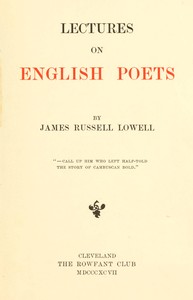
Lectures on English poets
Language: en559 downloads on Project Gutenberg
Subjects
In: Poetry·Essays, Letters & Speeches·British Literature
Public-domain ebook sourced from Project Gutenberg #72324.
Public-domain ebook
Language: en559 downloads on Project Gutenberg
Subjects
In: Poetry·Essays, Letters & Speeches·British Literature
Public-domain ebook sourced from Project Gutenberg #72324.
The opening · free to read
Even while they were yet ringing in the ears of those delighted audiences, Ticknor and Fields were eager to publish them, but Lowell withheld consent. The lectures had been rapidly written, and needed the labor of the file, and this the unexpected duties of the equally unexpected professorship precluded. There were five applicants for the chair vacated by Longfellow, but Lowell was not one of them; both his nomination and his appointment were made without his knowledge. He accepted the chair with the understanding that he should be allowed to spend one year abroad for some necessary study in Germany and Spain. Then his professorial duties engaged him and the “Lectures on English Poets” were left as a waif stranded on the forgotten columns of a newspaper. When at length the opportunity of leisure came Lowell found himself capable of better things, and he was satisfied with absorbing into later essays some fragments of the early lectures. There ended his concern for them; but an enthusiastic hearer had preserved the Boston “Advertiser’s” reports of them in a special scrap-book, which ultimately became the property of the University of Michigan and thus fell into the editor’s hands, who felt the charm thereof, and was desirous of sharing his pleasure with the Rowfant Club.
There is little doubt that Lowell had been too fastidious when he wrote to James T. Fields, in May, 1855: “It has just got through my skull, and made a dint into my sensorium, that you wrote me a note, ever so long ago, about my lectures and the publication of them. I don’t mean to print them yet--nor ever till they are better--but, at any rate, I consider myself one of your flock, though not, perhaps, as lanigerous as some of them.” And when Lowell’s literary executor wrote: “His powers of critical appreciation and reflection were displayed to advantage in these lectures. No such discourses had been heard in America. They added greatly to his reputation as critic, scholar, and poet,”--there could be no hesitation in setting aside Lowell’s modest self-depreciation. After the delivery of his first lecture, he had written to his friend Stillman: “So far as the public are concerned, I have succeeded.” And his words are as true in 1896 as they were in 1855; and although his literary art was not so consummate as it became in his ultimate development, these early lectures will aid and encourage the student by showing his growth: we see the rivulet become the flowing river.
We share, too, in the delight of his first audience on reading:
“The lines of Dante seem to answer his every mood: sometimes they have the compressed implacability of his lips, sometimes they ring like an angry gauntlet thrown down in defiance, and sometimes they soften or tremble as if that stern nature would let its depth of pity show itself only in a quiver of the voice.”
“So in ‘Paradise Lost’ not only is there the pomp of long passages that move with the stately glitter of Milton’s own angelic squadrons, but if you meet anywhere a single verse, that, too, is obstinately epic, and you recognize it by its march as certainly as you know a friend by his walk.”
“Who can doubt the innate charm of rhyme whose eye has ever been delighted by the visible consonance of a tree growing at once toward an upward and a downward heaven, on the edge of the unrippled river; or as the kingfisher flits from shore to shore, his silent echo flies under him and completes the vanishing couplet in the visionary world below.”
“Every desire of the heart finds its gratification in the poet because he always speaks imaginatively and satisfies ideal hungers.”
And see, too, how the “powers of critical appreciation” that Professor Norton has mentioned were bursting into blossom and giving promise of the golden harvest to come:
“Sir Thomas Browne, * a man who gives proof of more imagination than any other Englishman except Shakspeare.”
For subtlety and depth of insight Lowell has never excelled this early example, nor has he ever outdone the critical estimate, so true and so terse, of his final pronouncement upon Pope:
“Measured by any high standard of imagination, he will be found wanting; tried by any test of wit, he is unrivaled.”
And what of such a shining felicity as where he meets Sir Thomas Browne on common ground and the author of “Religio Medici” gravely smiles and acknowledges kinship:
“If a naturalist showed us a toad we should feel indifferent, but if he told us that it had been found in a block of granite we should instantly look with profound interest on a creature that perhaps ate moths in Abel’s garden or hopped out of the path of Lamech.”
Most truly “No such lectures had been heard in America,” and as truly they deserve to be made more than a delightful memory for the early hearers alone.
Lowell wrote to a friend that at his first lecture he had held his audience for an hour and a quarter, but the reporter’s notes of that lecture fall far short of that fullness; nevertheless, compared with Anstey’s shorthand notes of Carlyle’s lectures on the “History of Literature,” we come much nearer to the living voice in the Boston “Advertiser’s” reports of these Lowell lectures. Carlyle spoke without a written text, nor had he any notes save a few bits of paper which in his hyper-nervousness he twisted out of all hope of reportorial decipherment--and without once looking at them; Lowell had his manuscripts (written currente calamo, for the new wine of life was in full ferment and it was no small feat to bottle any of it successfully), and we are assured from internal evidence that the “Advertiser’s” reporter was allowed access to them. His text has a tang as characteristic as Thoreau’s wild apples, and we do not feel the dubiety of the blind patriarch, “The voice is Jacob’s, but the hands are Esau’s.” No; it is James Russell Lowell, his voice, his inimitable mark, and these are his words sounding in our ears after half a century.
The only attempt at “editing” has been as far as possible to reproduce the reporter’s “copy.” To that end Lowell’s profusion of capitals is retained (and the reader will bear in mind that the Transcendental spirit was then in both the air and the alphabet), and even his italics, suggested, as Mr. Underwood says, by the speaker’s emphasis, find their respective places. Here and there a compositor’s error has been corrected and a proof-reader’s oversight adjusted; sometimes this has been conjectural, and again the needful change was obvious. In all else, save the applause, this Rowfant Book may be called a faint echo of the Lowell Institute Lectures.
It is “printed, but not published” in loving fealty to Lowell’s memory, and every Rowfanter has at heart the assurance that his Shade will look upon this literary flotsam without a frown, or with one that will soon fade into forgiveness.
S. A. J.
ANN ARBOR, November 10th, 1896.
Mr. Lowell began by expressing his sense of the responsibility he had assumed in undertaking a course of lectures on English Poets. Few men, he said, had in them twelve hours of talk that would be worth hearing on any subject; but on a subject like poetry no person could hope to combine in himself the qualities that would enable him to do justice to his theme. A lecturer on science has only to show how much he knows--the lecturer on Poetry can only be sure how much he feels.
Almost everybody has a fixed opinion about the merits of certain poets which he does not like to have disturbed. There are no fanaticisms so ardent as those of Taste, especially in this country, where we are so accustomed to settle everything by vote that if a majority should decide to put a stop to the precession of the Equinoxes we should expect to hear no more of that interesting ceremony.
A distinguished woman [Mrs. Stowe] who has lately published a volume of travels, affirms that it is as easy to judge of painting as of poetry by instinct. It is as easy. But without reverent study of their works no instinct is competent to judge of the masters of either art.
Yet every one has a right to his private opinion, and the critic should deal tenderly with illusions which give men innocent pleasure. You may sometime see japonicas carved out of turnips, and if a near-sighted friend should exclaim, “What a pretty japonica!” do not growl “Turnip!” unless, on discovering his mistake, he endeavors to prove that the imitation is as good as the real flower.
In whatever I shall say, continued Mr. Lowell, I shall, at least, have done my best to think before I speak, making no attempt to say anything new, for it is only strange things and not new ones that come by effort. In looking up among the starry poets I have no hope of discovering a new Kepler’s law--one must leave such things to great mathematicians like Peirce. I shall be content with resolving a nebula or so, and bringing to notice some rarer shade of color in a double star. In our day a lecturer can hardly hope to instruct. The press has so diffused intelligence that everybody has just misinformation enough on every subject to make him thoroughly uncomfortable at the misinformation of everybody else.
Mr. Lowell then gave a brief outline of his course, stating that this first lecture would indicate his point of view, and treat in part of the imaginative faculty.
After some remarks upon Dr. Johnson’s “Lives of the Poets,” the lecturer proceeded: Any true criticism of poetry must start from the axiom that what distinguishes that which we call the poetical in anything, and makes it so, is that it transcends the understanding, by however little or much, and is interpreted by the intuitive operation of some quite other faculty of the mind. It is precisely the something-more of feeling, of insight, of thought, of expression which for the moment lulls that hunger for the superfluous which is the strongest appetite we have, and which always gives the lie to the proverb that enough is as good as a feast. The boys in the street express it justly when they define the indefinable merit of something which pleases them, by saying it is a touch beyond--or it is first-rate and a half. The poetry of a thing is this touch beyond, this third half on the farther side of first-rate.
Dr. Johnson said that that only was good poetry out of which good prose could be made. But poetry cannot be translated into prose at all. Its condensed meaning may be paraphrased, and you get the sense of it, but lose the condensation which is a part of its essence. If on Christmas day you should give your son a half-eagle, and should presently take it back, and give him the excellent prose version of five hundred copper cents, the boy would doubtless feel that the translation had precisely the same meaning in tops, balls, and gibraltars; but the feeling of infinite riches in a little room, of being able to carry in his waistcoat pocket what Dr. Johnson would have called the potentiality of tops and balls and gibraltars beyond the dreams of avarice--this would have evaporated. By good prose the Doctor meant prose that was sensible and had a meaning. But he forgot his own theory sometimes when he thought he was writing poetry. How would he contrive to make any kind of sense of what he says of Shakspeare? that
The book keeps going
Reading is free forever. Sign up and watch scenes appear while you read.



Scenes Storieta drew for other classics.
New illustrated classics
Once or twice a month: the latest books to get full character casts, scene art, and free comic editions. No account needed.