Public-domain ebook
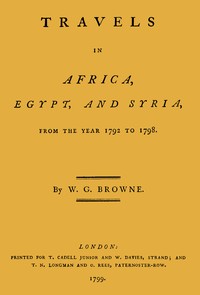
Travels in Africa, Egypt, and Syria, from the year 1792 to 1798
Language: en882 downloads on Project Gutenberg
Subjects
In: Travel Writing·History - Other
Public-domain ebook sourced from Project Gutenberg #72452.
Public-domain ebook
Language: en882 downloads on Project Gutenberg
Subjects
In: Travel Writing·History - Other
Public-domain ebook sourced from Project Gutenberg #72452.
The opening · free to read
IF the desire of literary fame were the chief motive for submitting to public notice the following sheets, the writer is not so far blinded by self-love, as not to be conscious of having failed of his object. The simple narrative of a journey is perhaps as little a proper source of reputation for elegance of composition, as a journey of the kind described is in itself of the pleasures of sense. But the present, from various circumstances, comprehends so small a portion of what might be expected from the observations of several years, that he has been often disposed to give it a different title.
The retrospect on the events of his life which are briefly mentioned in the ensuing pages, offers him a mixed sensation. The hopes with which he undertook the voyage, even without being very sanguine, contrasted with the disappointment with which he now sits down to relate its occurrences, allow him little satisfaction from what has been executed. He feels, however, some confidence of not experiencing severe censure when his design shall be understood. The work is not offered as elaborate or perfect. The account of Dar-Fûr fills up a vacancy in the geography of Africa; and of a country so little known, the information obtained should not be estimated by its quantity, but by its authenticity. Sitting in a chamber in Kahira or Tripoli, it is easy to give a plausible account of Northern Africa, from Sennaar and Gondar to Tombuctoo and Fez. It would not be difficult even to sanction it by the authority of the Jelabs. These people are never at a loss whatever question is asked them, and if they know not the name of the place inquired for, they recollect some other place of a name a little resembling it in sound, and describe what they never heard of by what they know. With regard to manners they are as little to be relied on. Ask but a leading question, and all the miracles of antiquity, of dogheaded nations, and men with tails, will be described, with their situation, habits, and pastimes.
But their descriptions, when given without the smallest appearance of interested views, if verified on the spot, are constantly found defective or erroneous.
The writer is aware, that when the length of the time he passed in Dar-Fûr is considered, the short account here given will appear, to persons accustomed to the busy scenes of Europe, but very imperfectly to fill up the void. Confiding, however, that those of more reflection and experience in travelling, will be better pleased with a short and clear narrative of what really happened, than by frivolous anecdotes or remarks, inserted merely to swell the size of the volume, he has contented himself with extracting from his journal the principal occurrences during his residence there, and giving them the connection required; at the same time omitting nothing that could any way contribute to throw light on the state of the country, or character of the inhabitants.
A more creative imagination would have drawn more animated pictures; a mind more disposed to observation would have collected more facts and incidents; and a more vigorous intellect would have converted those facts and incidents into materials of more interesting and more striking investigation. The descriptions would have been more impressive, and the deductions more profound.
The present work has the merit of being composed from observations made in the places and on the subjects described. But the praise of fidelity, the only one to which the writer lays claim, cannot be received till another shall have traced his footsteps.
With respect to Egypt a greater number of persons may be found who are qualified to decide, and there is not the same reason for suspension of judgment.
Without pretending to any extraordinary sources of information, the writer hopes, that what is here said will afford some little satisfaction to those who wish for the latest information concerning that country. He arrogates not to himself the praise of augmenting greatly the sum of knowlege already to be found in books; but very widely dispersed, and within the reach of comparatively few persons.
Innumerable books have been written on Egypt, but none of them, in our language, can pretend to a popular plan. Those of Pococke and Norden are most known to ourselves—valuable works for all that concerns the antiquities, and they are by no means superseded. The form and price, however, at this time keep them out of the hands of the greater number.
Niebuhr’s writings require not an additional testimony of their value; but the professed object of his voyage was Arabia; and the account of Egypt is only incidental.
Volney and Savary are in the public hands, and no attempt shall be made to influence its judgment of their works. The talents of the former are well known; but he saw the East with no favourable eye; and his manner in speaking of Egypt will be found materially different from that here adopted.
Of Syria the Author could expect to say little that is new, after the numberless descriptions which have already been published, and he has accordingly used great rapidity in his narrative.
In Kahira, the sources of information are few and scanty. A traveller may remain there many months, without finding his ideas of the country, or its inhabitants, much more clear or precise.
The Europeans, there immured as prisoners, may be reasonably excused for hastening their commercial advantages, and, whenever unengaged by that object, for amusing themselves in trying to forget the place in which their ill fortune has obliged them to reside. Those who are found there, with every disposition to accommodate strangers, and receiving them always with complacency and kindness, are yet, with few exceptions, not of the order of men most able to generalize their ideas, and avail themselves to the utmost of the information which accident throws in their way.
The Greeks, whose inquisitive turn, and more intimate connexion with the people at large and with the government, make them more familiar with characters and occurrences, rarely represent things as they really are, but as they feel them, or would have them to be. Where their report is not entirely imaginary, their portraits are like those of Lely, all adorned with nicely-combed locks and a fringed neckcloth. They mark no character, but as it appears to their prejudices; give no history that is not interlarded with their own fables; and describe no place but in the vague and superficial manner that satisfies their own ignorance.
The Copts who, it might be supposed, would be accurately informed of all that relates to the government and history of the country, have no sentiment of antient glory, and are wholly immersed in gain or pleasure.
Settled in the composure of ignorance, they cannot conceive the motive of minute inquiries; and timid and reserved, they fear to discover even what they know.
The more liberal among the Mohammedan ecclesiastics, may be safely consulted for what concerns literature and the laws, and some few of them are communicative; but in general they despise strangers, and do not readily answer questions not of the most ordinary occurrence. On the whole, the most intelligent and communicative among the people of Kahira are the Mohammedan merchants, of a certain rank, who have visited various parts of the empire, and who have learned to think that all wisdom is not confined to one country or one race of men; and who having been led to mix, first by necessity and then by choice, with various nations, preserve their attachment to their own persuasion, without thinking all the rest of mankind dogs and accursed.
The general design of the Writer, as will be seen in the sequel, was of such a nature, that, without being extremely sanguine, he might have hoped to execute a considerable part of it. His prospects the first year were darkened by an unexpected disappointment on his arrival at Assûan; concerning which he may say, without any disposition to complaint, that he felt it severely. Another winter furnished him with a little more information and more experience: but still, as he afterwards unfortunately discovered, by no means all that was necessary to his purpose.
He might have appeared in Dar-Fûr as a Mohammedan, if he had known that the character was necessary to his personal security, or to his unrestrained passage; but, from the accounts he received in Kahira, among the people of Soûdan no violent animosity was exhibited against Christians. The character of the converts to Mohammedism, among the black nations, was, according to the general voice of the Egyptians who travelled among them, mild and tolerant. A disposition so generally acknowleged, that the more zealous among the latter are little scrupulous in honouring them with the appellation of Caffre. His surprise therefore was not inconsiderable at finding, on his arrival, that an unbeliever in the infallibility of the Korân was more openly persecuted, and more frequently insulted, than in Kahira itself.
The information received, previously to his departure in 1793, taught the writer to expect, from having chosen the route of what is called the Soudân Caravan, the choice of a free passage to Sennaar, which would, without much doubt, have secured him an entrance into Habbesh, under the conduct of the Fungni, who trade there: for the Fûrian monarch, had his favour not been withdrawn in consequence of false insinuations, would readily have accorded a safe-conduct through Kordofân, which was all that circumstances required. The being removed a few weeks journey too far to the Westward, was no objection, when he reflected on the confusion then reigning at Sennaar, and that in proportion as the road he took was indirect, the less suspicion would be entertained of him as a Frank, the greater experience he must acquire among the people of the interior, and the more easily he might be suffered to pass as a mere trader.
He had been taught, that the expeditions in quest of slaves, undertaken by the people of Fûr and its neighbourhood, extended often forty or more days to the Southward. This, at the lowest computation, gave a distance of five degrees on a meridian, and the single hope of penetrating so much farther Southward than any preceding traveller, was worth an effort to realize. He owns, he did not then foresee all the inconveniences of being exposed, on the one hand, to the band of plunderers whom he was to accompany, and on the other, to the just resentment of the wretched victims whom they were to enthral. Perhaps those very evils were magnified greatly beyond their real value by the Fûrians to whom he applied, and who were predetermined not to allow him to pass.
Another inducement to this route was, that part of it was represented to lie along the banks of the Bahr-el-abiad, which he had always conceived to be the true Nile, and which apparently no European had ever seen. To have traced it to its source was rather to be wished than expected; but he promised himself to reach a part of it near enough to that source, to enable him to determine in what latitude and direction it was likely to exist. It is unnecessary to observe, that, had either of these objects been realized, much interesting matter must have occurred in the course of the route. He could not in the sequel discover that the armed expeditions of the Fûrians extend to any high reaches of the Bahr-el-abiad.
The book keeps going
Reading is free forever. Sign up and watch scenes appear while you read.



Scenes Storieta drew for other classics.
New illustrated classics
Once or twice a month: the latest books to get full character casts, scene art, and free comic editions. No account needed.