Public-domain ebook
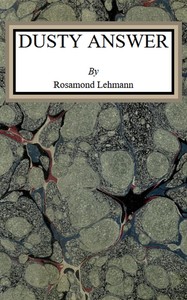
Dusty answer
Language: en438 downloads on Project Gutenberg
Subjects
Public-domain ebook sourced from Project Gutenberg #72642.
Public-domain ebook
Language: en438 downloads on Project Gutenberg
Subjects
Public-domain ebook sourced from Project Gutenberg #72642.
The opening · free to read
When Judith was eighteen, she saw that the house next door, empty for years, was getting ready again. Gardeners mowed and mowed, and rolled and rolled the tennis-court; and planted tulips and forget-me-nots in the stone urns that bordered the lawn at the river’s edge. The ivy’s long fingers were torn away from the windows, and the solid grey stone front made prim and trim. When the blinds went up and the familiar oval mirror-backs once more stared from the bedroom windows it seemed as if the long time of emptiness had never been, and that the next-door children must still be there with their grandmother,--mysterious and thrilling children who came and went, and were all cousins except two who were brothers, and all boys except one, who was a girl; and who dropped over the peach-tree wall into Judith’s garden with invitations to tea and hide-and-seek.
But in truth all was different now. The grandmother had died soon after she heard Charlie was killed. He had been her favourite, her darling one. He had, astoundingly, married the girl Mariella when they were both nineteen, and he just going to the front. He had been killed directly, and some months afterwards Mariella had had a baby.
Mariella was twenty-two years old now, Charlie’s widow with a child Charlie had begotten. It seemed fantastic when you looked back and remembered them both. The grandmother had left the house to Mariella, and she was coming back to live there and have a gay time now that the war was well over and Charlie (so you supposed) forgotten.
Would Mariella remember Judith next door, and how they used to share a governess and do the same lessons in spite of Mariella’s four years’ seniority? Miss Pim wrote: ‘Judith is an exceptionally clever child, especially about essays and botany. She laps up knowledge as a kitten laps milk’. The letter had been left on Mamma’s desk: unforgettable, shameful, triumphant day.
Mariella on the other hand--how she used to sit with her clear light eyes blank, and her polite cool little treble saying: ‘Yes, Miss Pim,’ ‘No, Miss Pim,’--and never be interested and never understand! She wrote like a child of six. She would not progress. And yet, as Miss Pim said, Mariella was by no means what you’d call a stupid girl.... By no means a stupid girl: thrilling to Judith. Apart from the thrill which her own queerness gave, she had upon her the reflected glory of the four boy-cousins who came for the holidays,--Julian, Charlie, Martin and Roddy.
Now they were all grown up. Would they come back when Mariella came? And would they remember Judith at all, and be glad to see her again? She knew that, anyway, they would not remember so meticulously, so achingly as herself: people never did remember her so hard as she remembered them,--their faces especially. In earliest childhood it was plain that nobody else realized the wonder, the portentous mystery of faces. Some patterns were so pure, so clear and lovely you could go on looking at them for ever. Charlie’s and Marietta’s were like that. It was odd that the same bits of face shaped and arranged a little differently gave such deplorable results. Julian was the ugly one. And sometimes the ugliest faces did things that were suddenly lovely. Julian’s did. You dared not take eyes off a stranger’s face for fear of missing a change in it.
‘My dear! How your funny little girl stares. She makes me quite uncomfortable.’
‘Don’t worry, my dear. She doesn’t even see you. Always in the clouds.’
The stupids went on stupidly chattering. They little knew about faces. They little knew what a fearful thing could happen to a familiar face--Miss Pim’s for instance--surprised off its guard and broken up utterly into grossness, withered into hatred or cunning; or what a mystery it was to see a face day after day and find it always strange and surprising. Roddy’s was that sort, though at first it had seemed quite dull and flat. It had some secret in it.
At night in bed she invented faces, putting the pieces together till suddenly there they were!--quite clear. They had names and vague sorts of bodies and lived independent lives inside her head. Often they turned out to have a likeness to Roddy. The truth was, Judith thought now, Roddy’s was a dream rather than a real face. She felt she had never seen it as it actually was, but always with that overstressed significance, that haunting quality of curiousness which a face in a dream bears.
Queer Roddy must be twenty-one now; and Martin twenty; and Julian twenty-four at least; and beautiful Charlie would have been Mariella’s age if such an incredible thing had not happened to him. They would not want anything to do with her. They would be grown up and smart, with friends from London; and she still had her hair down and wore black cotton stockings, and blushed wildly, hopelessly, eternally, when addressed in public. It would be appalling to meet them again, remembering so much they had certainly forgotten. She would be tongue-tied.
In the long spaces of being alone which they only, at rarer and rarer intervals, broke, she had turned them over, fingered them so lovingly, explored them so curiously that, melting into the darkly-shining enchanted shadow-stuff of remembered childhood, they had become well-nigh fantastic creatures. Presumably they had realised long ago that Charlie was dead. When they came back again, without him, she would have to believe it too. To see them again would be a deep wrenching sort of hurt. If only it could be supposed it would hurt them too!... But Charlie had of course been dead for years; and of course they did not know what it was to want to know and understand and absorb people to such a degree that it was a fever. Or if they did, it was not upon her, trifling female creature, that they applied their endeavours. Even Martin, the stupid and ever-devoted, had felt, for a certainty, no mysterious excitement about her.
When she looked backwards and thought about each of them separately, there were only a few odd poignant trivialities of actual fact to remember.
Mariella’s hair was cut short like a boy’s. It came over her forehead in a fringe, and beneath it her lucid mermaid’s eyes looked out in a blind transparent stare, as if she were dazzled. Her skin was milk-white, her lips a small pink bow, her neck very long on sloping shoulders, her body tall and graceful with thin snakey long limbs. Her face was without expression, composed and cool-looking. The only change it ever suffered was the perfect upward lift of the lips when they smiled their limited smile. Her voice was a small high flute, with few inflections, monotonous but soft and sweet-tempered. She spoke little. She was remote and unruffled, coolly friendly. She never told you things.
She had a great Dane and she went about alone with him for choice, her arm round his neck. One day he was sick and started groaning, and his stomach swelled and he went into the thickest part of the laurel bushes and died of poison in half an hour. Mariella came from a French lesson in time to receive his dying look. She thought he reproached her, and her head, fainting in anguish, fell over his, and she said to him: ‘It wasn’t my fault.’ She lay beside him and would not move. The gardener buried him in the evening and she lay on the grave, pale, extinguished and silent. When Judith went home to supper she was still lying there. Nobody saw her cry, and no one ever heard her speak of him again.
She was the one who always picked up naked baby-birds, and worms and frogs and caterpillars. She had a toad which she loved, and she wanted to keep a pet snake. One day she brought one home from the long-grass meadow; but Miss Pim had a faint turn and the grandmother instructed Julian to kill it in the back yard.
Charlie dared her to go three times running through the field with the bull in it, and she did. Charlie wouldn’t. She could walk without a tremor on the bit of the roof that made everyone else feel watery inside; and she delighted in thunderstorms. Her hair crackled with electricity, and if she put her fingers on you you felt a tiny tingling of shock. She was elated and terrifying, standing at the window and smiling among all the flashes and thunder-cracks.
Julian was the one she seemed to like best; but you never knew. She moved among them all with detached undemanding good-humour. Sometimes Judith thought Mariella despised her.
But she was kind too: she made funny jokes to cheer you up after tears. Once Judith heard them whisper: ‘Let’s all run away from Judy’--and they all did. They climbed up the poplar tree at the bottom of the garden and made noises out of it at her, when she came by, pretending not to be looking for them.
She went away and cried under the nursery sofa, hoping to die there before discovery. The darkness had a thick dusty acrid smell, and breathing was difficult. After hours, there were steps in the room; and then Mariella lifted the sofa frill and looked in.
‘Judy, come out. There’s chocolate biscuits for tea.’
With a fresh burst of tears, Judith came.
‘Oo! You do look cry-ey.’ She was dismayed. ‘Shall I try to make you laugh?’
Mariella unbuttoned her frock, stepped out of it and danced grotesquely in her holland knickers. Judith began to giggle and sob at the same time.
‘I’m the fat man,’ said Mariella.
She blew out her cheeks, stuffed a cushion in her knickers and strutted coarsely. That was irresistible. You had to squeal with laughter. After that the others came in rather quietly and were very polite, not looking till her face had stopped being blotched and covering her hiccups with cheerful conversation. And after tea they asked her to choose the game. So everything was all right.
It was autumn, and soon the lawn had a chill smoke-blue mist on it. All the blurred heavy garden was as still as glass, bowed down, folded up into itself, deaf, dumb and blind with secrets. Under the mist the silky river lay flat and flawless, wanly shining. All the colours of sky and earth were thin ghosts of themselves: and on the air were the troubling bitter-sweet odours of decay.
When the children came from hiding in the bushes they looked all damp and tender, with a delicate glow in their faces, and wet lashes, and drops of wet on their hair. Their breath made mist in front of them. They were beautiful and mysterious like the evening.
The happiness was a swelling pressure in the head and chest, too exciting to bear. Going home under the willows in the little connecting pathway between the two gardens Judith suddenly made up some poetry.
Stupid funny serious Martin had red cheeks and brown eyes and dirty knees. His legs were very hairy for his age. He had an extremely kind nature. He was the one they always teased and scored off. Charlie used to say: ‘Let’s think of a sell for Martin,’ and when he had been sold, as he always was, they danced in front of him shouting: ‘Sold again! Sold again!’ He never minded. Sometimes it was Judith who thought of the best sells, which made her proud. She was very cruel to him, but he remained faithful and loving, and occasionally sent her chaotic sheets of dirt and ink from school, signing them: ‘Yrs truly, M. Fyfe.’
The book keeps going
Reading is free forever. Sign up and watch scenes appear while you read.



Scenes Storieta drew for other classics.
New illustrated classics
Once or twice a month: the latest books to get full character casts, scene art, and free comic editions. No account needed.