About this book
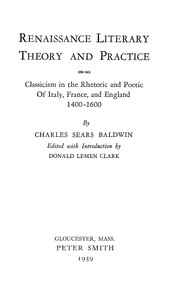
Charles Sears Baldwin’s posthumously published manuscript continues the scholarly trajectory begun in his earlier works on ancient and medieval rhetoric, extending the analysis from 1400 to 1600. The opening pages explain that Baldwin, a Columbia professor, prepared the study as a direct response to his own earlier investigations, grounding his arguments in Aristotelian principles of composition. He distinguishes “sound rhetoric,” which serves the subject, from sophistic rhetoric that serves the speaker, and applies this framework to the literary forms of lyric, pastoral, romance, drama, and essay across Italian, French, and English traditions. The book is not a comprehensive literary history; rather, it samples texts to evaluate how faithfully Renaissance writers adhered to classical theory and where misapplications produced “disastrous results.” Baldwin’s method relies on primary sources and his own translations, deliberately eschewing secondary commentary.
The work reads as a rigorous, nineteenth‑century‑style academic treatise, dense with detailed argumentation and extensive footnotes. Its voice is that of a seasoned rhetorician, combining careful textual analysis with a moral stance on the proper use of classical models. Scholars of Renaissance literature, historians of poetics, and students of comparative literary theory will find it especially rewarding, as will teachers interested in the evolution of composition from antiquity through the early modern period.