Public-domain ebook
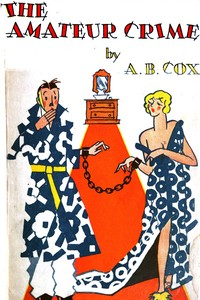
The amateur crime
Language: en366 downloads on Project Gutenberg
Subjects
In: Crime, Thrillers and Mystery·Humour·Novels
Public-domain ebook sourced from Project Gutenberg #72675.
Public-domain ebook
Language: en366 downloads on Project Gutenberg
Subjects
In: Crime, Thrillers and Mystery·Humour·Novels
Public-domain ebook sourced from Project Gutenberg #72675.
The opening · free to read
The young man waved his arms violently. “You’re a cabbage!” he shouted. “A turnip! A vegetable marrow! A—” He paused. “A snail!” he concluded, relinquishing this horticultural catalogue.
Mr. Matthew Priestley blinked at him mildly through his glasses. “Am I, Pat?” he asked, not without surprise.
“Yes, you are.” From his stand upon the hearthrug the young man contemplated his host with extreme severity. “How old are you, Priestley?” he demanded at length.
“Thirty-six,” apologised Mr. Priestley.
“Thirty-six!” repeated the young man with remarkable scorn. “And what do you think people would take you for?”
“Thirty-five?” hazarded Mr. Priestley optimistically.
“Certainly not!” said the young man sharply. “Sixty-five, more like.”
“Oh, no, Pat,” protested Mr. Priestley, pained.
“At least sixty-five,” rejoined the young man firmly. “And no wonder. Do you know what you are, Priestley?”
“Well, yes,” said Mr. Priestley, a little doubtfully, “I’m a cabbage, and a vegetable-marrow, and a snail, and——”
“You’re a limpet!”
“A limpet as well?” said Mr. Priestley, with distress. “Now, what makes you say that, Pat?”
“Well, look at you!” observed the young man shortly.
Mr. Priestley obeyed. “I seem much the same as usual,” he ventured.
“That’s the whole point!” the young man said with force. “You’re always much the same as usual. Always!”
“I wear a different suit nearly every day,” Mr. Priestley protested wistfully.
“You know what I mean. Look at you—thirty-six, and as set and unenterprising as a man of sixty! Why don’t you move out of your rotten little rut, man? Move about! See life! Have adventures!” The young man ran a sensitive hand through his rather long black hair.
Mr. Priestley looked round the cosy bachelor room in the cosy bachelor flat; if it was a rut, it was a remarkably pleasant one. “It’s curious how restless love seems to make a man,” he observed mildly.
The young man stamped violently several times up and down the room. “I’m not restless!” he exclaimed loudly. “I’m happy!”
“I see,” replied Mr. Priestley with humility. “Have another drink, won’t you?”
The young man manipulated the decanter and siphon. “I do hate to see a man vegetating,” he growled into his glass.
“I suppose it’s the result of getting engaged,” Mr. Priestley meditated. “That sort of thing must be upsetting, no doubt.”
“It makes a fellow so happy, he wants to make his friends happy, too,” the young man condescended to explain.
“But I am happy, Pat! Remarkably happy.”
“You’re nothing of the sort,” snapped the young man.
“Aren’t I?” queried Mr. Priestley in surprise. “Well, I certainly thought I was.”
“Oh, yes,” said the young man with remarkable bitterness. “You think you are, of course. But you’re nothing of the sort. How can you be? Is a cabbage happy? Why don’t you live, man? Get about! Fall in love! Have adventures!”
“But adventures don’t happen to me.”
“Of course they don’t. Because you never let them. If you saw an adventure coming, you’d shut both eyes and wrap your head up in a rug. You’re turning into a regular hermit, Priestley: that’s what’s the matter with you. And hermits have a habit of becoming most confoundedly dull.”
Soon after that the young man took his leave; and quite time, too.
After his departure Mr. Priestley sat for a few moments turning over in his mind what had been said. Was it true that he was getting into a rut? Was he a turnip? Was he in danger of becoming a hermit, and a confoundedly dull hermit at that? He looked round his comfortable room again and sighed gently. Certainly most of his interests were concentrated in the flat—his books, for instance, and his china, and his collection of snuff-boxes. It was equally certain that, with a comfortable income which precluded his having to work for his living, and a valet who looked after him better than a nurse, he found himself very much more comfortable in his home than out of it. But did that necessarily mean that he was a snail?
“Poof!” observed Mr. Priestley with mild decision. “Ridiculous! Pat has just become engaged, to, as I understand, a charming and beautiful girl, and his whole world is upset. Out of the exuberance of his spirits he wants to upset everybody else’s world as well. Hermit, indeed.”
And he reached happily for his Theocritus.
Thus, regardless of his doom, the little victim played.
On a certain soft evening in early April, Guy Nesbitt of Dell Cottage, Duffley, Oxfordshire, was engaged in wrestling with his dress-tie.
Dress-ties did not take kindly to Guy. When a dress-tie found itself encircling a collar belonging to Guy a devil entered into it. All dress-ties were like this with Guy. They knew he had met his master, and they became as wax in his hands. They melted, they drooped, they languished, they slid, and the means they employed to prevent the ends of their bows from ever coming even were a manifestation of the triumph of matter over mind. A South African negro, seeing a dress-tie pursuing its eel-like antics in Guy’s impotent hands would have had no hesitation in falling down on his knees and worshipping it on the spot, and quite rightly; one of Guy’s dress-ties could have given pounds to any of the ju-ju’s of his native land and disposed of him in half a round.
Giving up the unequal struggle, Guy dashed the victorious excrescence to the floor, where it lay chortling gently, whipped another out of the open drawer in front of him and strode to the door which separated his dressing-room from his wife’s bedroom, muttering naughtily to himself as he went. At the risk of becoming tedious, he must try to give some idea of his appearance during the second-and-a-half occupied by his journey.
Guy Nesbitt was a thin, tall man, almost an attenuated tall man, and he carried himself just about as badly as a man can. His rather narrow shoulders were invariably bowed like those of Atlas, and between them his small, half-bald head shot forward at such an angle that, although he was nearly always taller than his interlocutor, he gave the impression of peering up at anybody he happened to be addressing over his rimless pince-nez. In spite of the ribald observations of one of his wife’s friends, Guy was not old; a mere thirty-one. But he had looked exactly as he did now (which was forty-five) for the last five years, and would probably continue to do so for the next twenty. The other part of the candid friend’s remark was not inapt; he did look exactly like a vulture, but a thoroughly benign and good-tempered old vulture at that. Guy had never lost his temper in his life, a matter which had caused his parents (he was an only son) considerable satisfaction —for parents are notoriously short-sighted folk—and his old nurse an equal perturbation.
For the rest he was delicate, but refused to admit it; possessed of a private income with which he was generous beyond reason or logic; not so much of a recluse as might have been expected, considering the scholarly nature of his chief hobby, which was the minor poets of the seventeenth century; and he wielded a nifty brassie and a surprisingly ferocious tennis-racket. His manner was as much of a contradiction as most of his other attributes; at times he was as prim and precise as the maiden aunt of a Dean, at others he verged on the Rabelaisian. He had a pretty wit, and he could make up his mind quickly.
“Blessed were the Picts and Scots, Cynthia,” he observed wistfully, closing the door meticulously behind him. “They may have had trouble at times with their sporrans, perhaps, but what is a mere sporran?”
The book keeps going
Reading is free forever. Sign up and watch scenes appear while you read.



Scenes Storieta drew for other classics.
New illustrated classics
Once or twice a month: the latest books to get full character casts, scene art, and free comic editions. No account needed.