Public-domain ebook
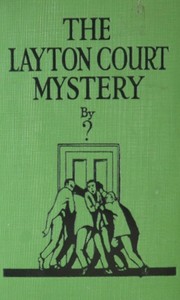
The Layton Court mystery
Language: en419 downloads on Project Gutenberg
Subjects
In: Crime, Thrillers and Mystery·Novels·British Literature
Public-domain ebook sourced from Project Gutenberg #72883.
Public-domain ebook
Language: en419 downloads on Project Gutenberg
Subjects
In: Crime, Thrillers and Mystery·Novels·British Literature
Public-domain ebook sourced from Project Gutenberg #72883.
The opening · free to read
I know of nobody who likes a detective story more than you do, with the possible exception of myself. So if I write one and you read it, we ought to be able to amuse ourselves at any rate.
I hope you will notice that I have tried to make the gentleman who eventually solves the mystery behave as nearly as possible as he might be expected to do in real life. That is to say, he is very far removed from a sphinx and he does make a mistake or two occasionally. I have never believed very much in those hawk-eyed, tight-lipped gentry, who pursue their silent and inexorable way straight to the heart of things without ever once overbalancing or turning aside after false goals; and I cannot see why even a detective story should not aim at the creation of a natural atmosphere, just as much as any other work of the lighter fiction.
In the same way I should like you to observe that I have set down quite plainly every scrap of evidence just as it is discovered, so that the reader has precisely the same data at his disposal as has the detective. This seems to me the only fair way of doing things. To hold up till the last chapter some vital piece of evidence (which, by the way, usually renders the solution of the puzzle perfectly simple), and to achieve your surprise by allowing the detective to arrest his man before the evidence on which he is doing so is ever so much as hinted to the reader at all, is, to my mind, most decidedly not playing the game.
With which short homily, I hand the book over to you by way of some very slight return for all that you have done for me.
It did not pay, William held, to rush things; especially the important things of life, such as the removal of greenfly from roses. Before action was taken, the matter should be studied, carefully and unhappily, from every possible point of view, particularly the worst.
On this summer’s morning William had been gazing despondently at the roses for just over three quarters of an hour. Pretty soon now he would feel himself sufficiently fortified to begin operations on them.
“Do you always count the greenfly before you slaughter them, friend William?” asked a sudden voice behind him.
William, who had been bending forward to peer gloomily into the greenfly-blown intricacies of a Caroline Testout, slewed hastily about. He hated being accosted at the best of times, but there was a spontaneous heartiness about this voice which grated intolerably on all his finer feelings. The added fact that the act of slewing hastily about had brought a portion of his person into sharp and painful contact with another rose bush did not tend to make life any more cheerful for William at that moment.
“Weren’t a-countin’ em,” he observed curtly; and added naughtily under his breath, “Drat that there Mr. Sheringham!”
“Oh! I thought you must be totting up the bag in advance,” remarked the newcomer gravely from behind an enormous pipe. “What’s your record bag of greenfly, William? Runs into thousands of brace, I suppose. Well, no doubt it’s an interesting enough sport for people of quiet tastes. Like stamp-collecting. You ever collect stamps, William?”
“Noa,” said William, gazing sombrely at a worm. William was not one of your chatty conversationalists.
“Really?” replied his interlocutor with interest. “Mad on it myself once. As a boy, of course. Silly game though, really, I agree with you.” He followed the direction of William’s eyes. “Ah, the early morning worm!” he continued brightly. “And defying all the rules of its calling by refusing to act as provender for the early bird. Highly unprofessional conduct! There’s a lesson for all of us in that worm, William, if I could only think what it is. I’ll come back and tell you when I’ve had time to go into the matter properly.”
William grunted moodily. There were many things in this world of which William disapproved; but Mr. Roger Sheringham had a class all to himself. The gospel of laughter held no attractions for that stern materialist and executioner of greenfly.
Roger Sheringham remained singularly unperturbed by the sublime heights of William’s disapproval. With hands thrust deep into the pockets of a perfectly incredible pair of gray flannel trousers he sauntered off among the rose beds, cheerfully poisoning the fragrant atmosphere with clouds of evil smoke from the peculiarly unsavoury pipe which he wore in the corner of his rather wide mouth. William’s eloquent snorts followed him unheeded; Roger had already forgotten William’s existence.
There are many who hold that eight o’clock in the morning is the most perfect time of a summer’s day. The air, they advance, is by that time only pleasantly warmed through, without being burned to a cinder as it is an hour or two later. And there is still quite enough dew sparkling upon leaf and flower to give the poets plenty to talk about without forcing them to rise at six o’clock for their inspiration. The theory is certainly one well worth examination.
At the moment when this story opens Mr. Roger Sheringham was engaged in examining it.
Not that Roger Sheringham was a poet. By no means. But he was the next worst thing to it—an author. And it is part of an author’s stock-in-trade to know exactly what a rose garden looks like at eight o’clock on a summer morning—that and everything else in the world besides. Roger Sheringham was refreshing his mental notes on the subject.
While he is doing so let us turn the tables by examining him. We are going to see quite a lot of him in the near future, and first impressions are always important.
Perhaps the first thing we notice about him, even before we have had time to take in his physical characteristics, is an atmosphere of unbounded, exuberant energy; Roger Sheringham is evidently one of those dynamic persons who seem somehow to live two minutes to everybody else’s one. Whatever he happens to be doing, he does it as if it were the only thing that he had ever really intended to do in life at all. To see him now, looking over this rose garden, you would think that he is actually learning it by heart, so absorbedly is he gazing at it. At least you would be ready to bet that he could tell you afterwards just how many plants there are in each bed, how many roses on each plant, and how many greenfly on each rose. Whether this habit of observation is natural, or whether it is part of the training of his craft, there can be no doubt that Roger possesses it in a very high degree.
In appearance he is somewhat below the average height, and stockily built; with a round rather than a long face, and two shrewd, twinkling gray eyes. The shapeless trousers and the disreputable old Norfolk jacket he is wearing argue a certain eccentricity and contempt for convention that is just a little too self-conscious to be quite natural without going so far as to degenerate into a pose. The short-stemmed, big-bowled pipe in the corner of his mouth seems a very part of the man himself. Add that his age is over thirty and under forty; that his school had been Winchester and his university Oxford; and that he had (or at any rate professed) the profoundest contempt for his reading public, which was estimated by his publishers at a surprisingly large figure—and you have Roger Sheringham, Esq., at your service.
The sound of footsteps approaching along the broad gravel path, which separated the rose garden from the lawn at the back of the house, roused him from his studious contemplation of early morning phenomena. The next moment a large, broad-shouldered young man, with a pleasing and cheerful face, came into sight round the bend.
“Good heavens!” Roger exclaimed, in tones of the liveliest consternation. “Alec! And an hour and a half before it need be! What’s wrong with you this morning, Alec?”
“I might ask the same of you,” grinned the young man. “It’s the first time I’ve seen you down before ten o’clock since we came here.”
“That only gives us three mornings. Still, a palpable point. By the way, where’s our worthy host? I thought it was a distressing habit of his to spend an hour in the garden every morning before breakfast; at least, so he was telling me at great length yesterday afternoon.”
“I don’t know,” said Alec indifferently. “But what brings you here anyway, Roger?”
“Me? Oh, I’ve been working. Studying the local flora and fauna, the latter ably represented by William. You know, you ought to cultivate William, Alec. You’d have a lot in common, I feel sure.”
They fell into step and strolled among the scattered beds.
“You working at this hour?” Alec remarked. “I thought you wrote all your tripe between midnight and dawn.”
“You’re a young man of singular literary acuteness,” sighed Roger. “Hardly anybody would dare to call my work tripe. Yet you and I know that it is, don’t we? But for goodness’ sake don’t tell anyone else your opinion. My income depends on my circulation, you know; and if it once got noised about that Alexander Grierson considered——”
Alec landed a punch on the literary thorax. “Oh, for heaven’s sake, shut up!” he grunted. “Don’t you ever stop talking, Roger?”
“Yes,” Roger admitted regretfully. “When I’m asleep. It’s a great trial to me. That’s why I so much hate going to bed. But you haven’t told me why you’re up and about so early?”
“Couldn’t sleep,” responded Alec, a trifle sheepishly.
“Ah!” Roger stopped and scrutinised his companion’s face closely. “I shall have to study you, Alec, you know. Awfully sorry if it’s going to inconvenience you; but there’s my duty to the great British public, and that’s plain enough, my interesting young lover. So now perhaps you’ll tell me the real reason why you’re polluting this excellent garden with your unseemly presence at this unnecessary hour?”
“Oh, stow it, you blighter!” growled the interesting young lover, blushing hotly.
Roger regarded him with close attention.
“Notes on the habits of the newly engaged animal, male genus,” he murmured softly. “One—reverses all its habits and instincts by getting up and seeking fresh air when it might still be frowsting in bed. Two—assaults its closest friends without the least provocation. Three—turns a bright brick-red when asked the simplest question. Four——”
“Will you shut up, or have I got to throw you into a rose bed?” shouted the harassed Alec.
“I’ll shut up,” said Roger promptly. “But only on William’s account; please understand that. I feel that William would simply hate to see me land on one of his cherished rose bushes. It would depress him more than ever, and I shrink from contemplating what that might mean. In passing, how is it that you were coming from the direction of the lodge just now and not from the house?”
“You’re infernally curious this morning,” Alec smiled. “If you want to know, I’ve been down to the village.”
“So early? Alec, there must be something wrong with you, after all. And why on earth have you been down to the village?”
The book keeps going
Reading is free forever. Sign up and watch scenes appear while you read.



Scenes Storieta drew for other classics.
New illustrated classics
Once or twice a month: the latest books to get full character casts, scene art, and free comic editions. No account needed.