Public-domain ebook
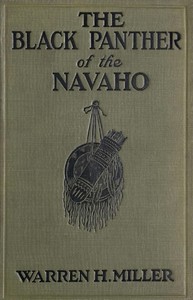
The Black Panther of the Navaho
Language: en358 downloads on Project Gutenberg
Subjects
In: Adventure·Novels·American Literature
Public-domain ebook sourced from Project Gutenberg #73125.
Public-domain ebook
Language: en358 downloads on Project Gutenberg
Subjects
In: Adventure·Novels·American Literature
Public-domain ebook sourced from Project Gutenberg #73125.
The opening · free to read
Colonel Colvin sat in a great roomy armchair in the Colvin Trophy Den, puffing reminiscently at a short black pipe and gazing abstractedly into the flickering flames of glowing logs in the rugged stone fireplace that was the heart of the Den. Sid, his son, and Sid’s chum, Scotty, were patching their cruiser moccasins with hand sewing-awls, the former now and then glancing over at his father anxiously.
The Colonel looked peaked and worn,--a thin, gray ghost of his former robust self,--for his duty during the War had been onerous in the extreme, as head of the Army Detail Office at Washington. Sid feared a total collapse of the old Indian fighter, for nothing is harder on the system of a man raised to years of violent outdoor life than a long period of desk work. Sid knew the only road back to health. His father knew it too, but, so far, he had not made the first move toward hitting the trail again. However, a certain expectant look in the Colonel’s eyes, certain mysterious telegrams which the boy had been detailed to send, addressed to an old Army friend out in Arkansas, had distilled the air of big events to come which hovered persistently in the atmosphere of the Den.
Sid himself was heavier and even more bronzed than when we saw him last, on his hunt for the Ring-Necked Grizzly out in Montana. The War, he realized, had been but an episode,--a tremendous episode, it is true--but still only an episode in his life. For some mysterious reason both he and Scotty had been transferred to the artillery, where he had risen to sergeant and had been the little king over two six-inch howitzers. His memories of the War had been of miles and miles of muddy roads and ceaseless rain; of tractors and tanks that had hauled his howitzers always forward behind the Front; of dog-tired days and weeks when they had crept toward the Vesle, ditched for passing staff cars and corduroyed out of mud sinks around shell holes. And then there had been glorious, stunning, vivid moments when he had stood between his two guns, telephone receivers over ears, shaken off his feet by the blinding yellow flashes all around him, watching the timing, correcting the ranges and deflections coming in from his spotter, or rushing to the gun shields when a Boche H. E. seemed about to register a direct hit. It was a man’s job, while it lasted; almost unnoticed, Nature had put on his upper lip a fine black fuzz that told the world that Sid was no longer a boy.
To Scotty the War had been more than an episode. It had introduced a great change in the red-haired boy’s life, for he now wore a black bandage on his arm, and the Henderson service flag bore a gold star. Of them all, the good old Doctor had not returned. A Fokker ’plane bomb had found out the first-aid dressing station where the grizzled old physician had stood, bathed to his shoulders in gore, working without rest or sleep for the thirty-six hours of a major engagement. That was all; there was nothing left of the dugout after that shell had crashed through its roof and exploded. But there were aching hearts in the Henderson home because of it, and Scotty looked older and sadder. The worry of measuring his earning power against this new and hectic America that had emerged from the War had cast a settled sternness on his youthful face. Days in the open would now be a matter of precarious vacations for him!
As the boys mended camp gear the rumble of a big automobile express sounded out in the street, its brake shrieking as it stopped before the house. Colonel Colvin moved in his chair and listened expectantly. They heard the grunt of men struggling under some heavy load, and then the stamp of their feet as they came around the yard path and stopped before the outside door of the Den. A thunderous knock brought all inside to their feet.
“Come in!” shouted the Colonel, springing up to open the door. Two expressmen stood grinning out in the snow, holding between them a long, heavy crate. The leader proffered a thumbed and dogeared book for the Colonel to sign.
“Bring ’em right in and set her down, men,” ordered the Colonel, after paying out a bill and some change. The expressmen crowded into the Den, setting down the crate with a big sigh of relief. “I think you’ll find ’em all right, sir,” grinned the man of the official cap. “Nice pups, eh?”
Sid jumped for the crate, and a tingle of joy thrilled through him. Pups, eh! Why, then----
“Beauties!” chortled the Colonel, replying to the man. “Three Redbone pups, by Ruler out of Music, sir. Reg’lar old-fashioned Southern cold-trailers from Arkansas.”
The expressman evidently owned some rabbit beagles himself, for he looked over the dogs with renewed interest. “What breed of houn’ dogs might these be, Colonel, if I might ask?”
“Coon hounds, man! The old pioneer’s hound--best bear and lion dogs in the world,” explained the Colonel enthusiastically, while Sid winked blissfully over at Scotty.
The very smell of their lithe, active bodies seemed to bring the tang of mighty mountain ranges into the Den again. Watching the dogs, the Colonel’s age fell away from him as a mantle; his eyes sparkled, he moved about the crate, eying the pups like a boy, and then sent Sid into the main house for tools. The log-walled Den, hung with game heads, rifles and saddles, was a replica of the Colonel’s western log cabin of his younger days. Built as a wing on to their great town house, there was an entrance direct into the house from it. The expressmen departed, with many a comradely grin, while the Colonel and Scotty waited impatiently for Sid to return with his hammer and cold chisel. Then two upper slats of the crate were lifted, and out jumped the pups, one after another, to range about the room on long, skinny legs. Never were such long-eared, rat-tailed smell-dogs, it seemed to Sid and Scotty, as they watched them delightedly, while the Colonel dug up a set of new collars and chains out of a drawer in his desk. Evidently he had known all about those dogs in advance, reasoned Sid, as he watched this proceeding. And, as they could not possibly be used anywhere in the eastern states, there was more to this than appeared on the surface!
They took them out into the snow for a brief airing. Once back in the Den again, Sid nailed the Colonel imperatively.
“You’ve got something up your sleeve, Father,--don’t tell me!” he laughed, “Where are we going, and when is it coming off?”
The Colonel grinned indulgently. “I tried my level best to buy Ruler, the father of these pups; but Judge Hawkes would rather part with his own right hand than with Ruler!” he remarked, irrelevantly.
“Answer me, sir--please!” begged Sid. “When--oh, when, Father?--and where?”
“The big problem is how to give them a bit of training,” grinned the Colonel, imperturbably. “None of the states around here allow deer running with hounds----”
“Scats cats!--That means the West, anyhow!” whooped Sid, triumphantly. “How about it, Scotty, eh?”
“’Fraid it lets me out,” remarked the sandy-haired boy, quietly. “I’ve got to be looking for a job these days.”
Sid looked his sympathy and put his arm about Scotty’s shoulders. “We’ll manage it, somehow, old bunkie--never fear!” he said, consolingly. “It may be your last,--but we just got to have this one together!”
The Colonel smiled enigmatically. “Sure you’re going, Lester--job and all!” he assured him. “And how about training these pups, boys?”
Scotty couldn’t see it, but at least he would be glad to help train the dogs, anyhow, he reflected. It would give him some precious days in the mountains under tent cloth. How such vacations were to be treasured--now!
The Colonel took three pedigree certificates out of his desk drawer. “Pepper, Bourbon and Lee,” he read, naming the pups, “the markings will tell which is which.” Then he looked toward the house door of the Den like a guilty boy. “Boys--how will we--how dare we lead ’em in?” he whispered. “Your mother, Sid, knows nothing of this--and you know how she hates dogs!”
The boy chuckled. The Colonel was in a worse fix than he ever had been facing Apache Geronimo! “Looks like they would have to live right here, sir!” laughed Sid, looking up from making friends with the first puppy. “Couldn’t wish for better den mates, I’ll say!”
The Colonel knew more than either of the boys about the trouble he was getting into. That haunting, houndy look in the pups’ eyes, as their long, silken ears drooped from high, pointed crowns, told him of a diabolical persistence and a wild, ineradicable thievishness that would play havoc with Mrs. Colvin’s domestic arrangements! You could feed them with a shovel and still there would be room for more. And, as to the neighbors’ cats and chickens--he shuddered at the thought.
“Well--we might as well have it out now!” he remarked, grimly, seizing the chains and pushing open the house door.
A feminine shriek greeted him. “_Where_ did you get those horrid dogs?--Send them away at once--I won’t have them!” came Mrs. Colvin’s indignant protest. Pepper, the biggest of the trio, jumped and broke away at that moment, darting for the pantry door with the boys in hot pursuit. A wild African yell came from the kitchen where Aunty Sally was preparing supper. Then there was a crash of broken china, another war whoop, and Pepper came yelping, booted through the door to dash under the dining-table legs.
Aunty Sally charged wheezily after him. “He done broke de Dresden china bowl!--Dat ornery houn’ dawg he done broke de Missus’ china oyster dish!” she yelled.--“Whar he at!--Let me beat him black an’ blue!”
A wail of anguish went up from Mrs. Colvin. The Colonel stood, thunderstruck and unhappy, yanking back on the chains of his other two leaping pups. Just then Pepper darted kiyi-ing from under the table and raced for the upstairs stairway. Aunty couldn’t reach him with her broom, but she whipped off a huge boot and hurled it after him, just missing a Vernis-Martin glass cabinet by inches as Pep bolted up the stairs to hide under a bed, where the boys followed, howling with glee, to recapture him.
Aunty Sally stopped and glared at the Colonel reprovingly.
“Marse Colvin, you done got three of them thievin’, potlicker smell-dawgs?” she accused,--“I’se shore ’shamed of you-all!--There, there, honey, don’t cry!” she soothed, taking Mrs. Colvin in her arms while the boys came back with Pepper, yelling with ungodly joy.
“He’s gwine take them right out’n yeah, Missus,--or I don’t cook him another waffle--so there, Kuhn-nel, ’deed I isn’t!” she flared at him.
Colonel Colvin’s jaw dropped as he stood irresolutely, with the pups winding their chains about and about his legs. Aunty Sally was an ancient institution in the Colvin household. She had raised Sid from a baby, and had grown up with the Colvins since they had settled east. A power in the household, he could not conceive how they were to get along without her, for no one else could cook any such waffles!
Then he beat a masterly and strategic retreat. “I guess it’s outdoors for them!” he surrendered, at discretion. “We’ll build a kennel for them, right away--look out, Scotty!--there goes Bourbon!--Catch him, boys!”
The book keeps going
Reading is free forever. Sign up and watch scenes appear while you read.



Scenes Storieta drew for other classics.
New illustrated classics
Once or twice a month: the latest books to get full character casts, scene art, and free comic editions. No account needed.