Public-domain ebook
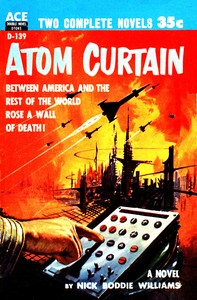
The atom curtain
Language: en402 downloads on Project Gutenberg
Subjects
In: Science-Fiction & Fantasy·Adventure·Novels
Public-domain ebook sourced from Project Gutenberg #73135.
Public-domain ebook
Language: en402 downloads on Project Gutenberg
Subjects
In: Science-Fiction & Fantasy·Adventure·Novels
Public-domain ebook sourced from Project Gutenberg #73135.
The opening · free to read
I make it with the hard realization of the dangers that are inherent for us all. I make it knowing that these risks have terrified those whom we chose to govern us, and I make it only because their terror has paralyzed their minds. And you and I--the world as we know it--cannot wait any longer.
We must not underestimate these risks. We take the chance of losing everything that mankind has accomplished in the tens of thousands of years since our first ancestor shed his tail and rose erect and walked in the full consciousness that he, alone of all God's creatures, had a soul.
But it is a risk we must take. We must take it now, while there is still time, or we condemn our world--the countless billions of Europe and Asia and Africa--forever to our chronic agonies of hunger and disease, which I now know are needless.
Between what we stand to lose and what it is possible to achieve, if we act wisely and in time, there is a middle course which means freedom from starvation and pestilence. The truth is that we need fear only our greed. If we can content ourselves with enough, and not insist upon too much, if we act with iron resolution in this immediate future, we can revivify our static history. The facts as I know them convince me of this, and more to the point, they have convinced far abler minds, although not those of the World Council of Nations, which in the final analysis means the Twelve Old Men of Geneva. It is their minds which you and I must now convince. Or we must set the Twelve Old Men aside.
And so I am compelled before the bar of public opinion to accuse these Twelve Old Men. It was they alone, acting in secrecy, who ordered that the sensational O'Hara Report be buried deep within the archives of the International Patrol at Geneva, never--they thought--to be made public. They have buried the Report and they have attempted to blot out even the vague rumor that it did exist. Those few who actually read it, the officials at Croydon Airport here in London who first received it and sent it sealed upon its way to Geneva, have been transferred to the more remote corners of the earth, never two of them together and none of them knowing where the other is. Not more than a fraction of the upper hierarchy in government has even heard of the Report and that fraction has gone and will continue to go to extreme lengths to prevent inquiries concerning it. It is the greatest hush-hush document of all time.
But within hours of its receipt at Croydon, I, Arthur Blair, obtained a first-hand summary of the Report. For reasons which will become obvious I was ordered by my paper, the Observer, to obtain the text of it, and for reasons which were even more imperative to me I sought to do it. I went at once to Croydon, where I was rewarded only by blank and noncommittal stares, as if I were inquiring after the secrets of the fourth dimension or the precise geographical location of the lost continent of Mu.
I did not resent that attitude. I had expected it. But what I did not anticipate was the reaction of the Twelve Old Men. I was in Paris, on my way to Geneva, before I realized how far they meant to go to silence me. The warning was delivered by a small, clean-shaven little man in a business suit who called while I was absent from my hotel room. When I returned, he smilingly assured me that he had no interest in me--the condition of my luggage proved him a liar--and in the next breath told me that my chance of leaving Paris alive, if my direction was Geneva, was less than zero.
The little man in the business suit impressed me. A more oblique approach and possibly some short cuts were indicated. In consequence I went from Paris quite openly to the resort of Trieste. I spent three weeks there, as obviously "resorting" as I could, until the night I chose for departing aboard a chartered fishing boat that landed me eventually at Salonika.
An old acquaintance of mine at Salonika, an incurable romantic, suspecting me of extraordinary journalism--a missing blonde, perhaps--provided me with what I asked, a private plane for the Prefecture of Turkey.
That plane was shot down two minutes after leaving Salonika. I happened not to be aboard it, although my labeled luggage was. I had the satisfaction of reading an account of my accidental death in the Istanbul press when I arrived there two days later.
I felt certain that I had thrown off any pursuit and that I could now proceed safely direct to Geneva. You may imagine my concern when my host in Istanbul, who knew me only by a pen name I had used obscurely years before, offered me my morning coffee and then sipped his own, and immediately keeled over.
A charge of murdering my host was subsequently filed against me. That charge is outstanding today. I do not doubt the evidence is there to convict me, manufactured evidence, were I located and returned to the Prefecture of Turkey.
But I have no intention of being located until the world knows what I have to tell. I had no such intention from the moment I saw my host's complexion changing to that ugly blue that goes with cyanic poisoning. And before the spittle upon his writhing lips was dry--it was intended that they should have been my lips--I had disappeared again.
All this scrambling is a personal matter, an adventure I suppose, of no importance save to those who befriended me. Some of them are dead and beyond the dangerously long arm of the World Council's Bureau of Security. Some of them are not dead or aware that they ran the risk of death, for I did not share the purpose of my frantic journey home. Yet I cannot--I dare not--trace any further the slow zigzagging pattern by which I returned to London.
My journey was a failure. I did not get the text of the O'Hara Report. I am never going to get it, for the august authority which decreed my persecution has consigned it to oblivion. That authority was unquestionably the Twelve Old Men.
Yes, theirs must be this terrible responsibility. Theirs alone must be the blame if future generations of our world are doomed so needlessly to subhuman levels. It is they who have decided--unless we can break through the lethargy of hypercautious minds--that in this year of A.D. 2230, more than two hundred and eighty-five years after the first splitting of the atom, the Sahara must still remain the Sahara, a vast wasteland capable of feeding all our starving and multiplying billions were only water made available. It is they who decree by their conspiracy of silence that the deserts of Australia and Arabia and China are as parched today, and the tundras of Siberia as utterly fruitless, as they were in the years before the miracle of Los Alamos. It is they, these dread-chilled Twelve Old Men, who are insisting that the Western Hemisphere, which at one time seemed destined to redeem us all from want, must remain for further centuries a whispered mystery behind its impenetrable Atomic Curtain.
Why are they doing this to us? Why were they so determined that I must be silenced? Are they brutal men, incapable of understanding how our billions suffer? No, the answers are not so simple. Their minds grope vague through the twilight world of doubt and fear, for they do not trust us--by their very natures they cannot trust us--to guide ourselves according to the facts laid down in the O'Hara Report.
But I insist that the people must know these facts. The people must get the truth--as I got the truth--from Emmett O'Hara himself.
Yes, I got the truth from Emmett O'Hara himself, soon after he filed at Croydon the text of his astonishing Report. That is why my life is at forfeit--not that the Twelve Old Men are sure I know, but they suspect it. They are capable at least of decision in one respect, they will do anything to preserve the status quo. But they are panicked at the possibilities that Emmett O'Hara has brought back to us. They cannot bring themselves, these doubting old men, to believe that he is acting in the interests of both our world and that which lies behind the Atomic Curtain, the fabled Western Hemisphere. And they will never accept, unless we force them--and there is almost no time left to do it now--the offer that O'Hara brought to us.
That offer will come to us formally, and we will have to act on it at once, at any moment in these next few days. And I pledge you this, that if we accept, our world begins to live again. And theirs.
I wish for your peace of mind that I could tell you precisely what has happened to O'Hara and that magnificent creature whom he introduced to me as his wife. And she was his wife, I think. Certainly she was his woman, bound to him by all the custom of that strange society from which she came. And if O'Hara had the time, in the brief interval between the filing of his Report and his abrupt and traceless disappearance, I would like to think that he further complied with the laws under which he was born and reared, although I know it would not have mattered to anyone except myself--O'Hara would not have cared. And she would not have given a snap of her exquisite and completely capable fingers. What could possibly have seemed of value in our conventions to those two? When you know what they knew--or at least what O'Hara knew--when you have experienced the nadir of disillusion and the zenith of human living, what could seem of essential value except the savor of the next moment's breath?
As I say, O'Hara vanished. He filed this Report of his in London at four o'clock on the afternoon of his return, which was the day after Christmas. He immediately went to his old flat in Bloomsbury from which he telephoned to me at the Observer, and at six o'clock I dined with him. By eight o'clock I had heard from him the substance of his Report. It was then that I met his wife, if wife she was.
At eight-fifteen I left them, and went immediately to the Observer, where for two hours I was in conference with the Editorial Director, Edgar Soames, who told me that the story could not be published without the complete documentation of the text. The Observer, as Soames pointed out, had its reputation as a journal of fact to remember and not even the paramount importance of my story could be permitted to override that.
Very well, documentation. I returned to O'Hara's flat in Bloomsbury by eleven o'clock. O'Hara was not there, or was that splendid red-haired creature who--well, they were gone, and their few belongings were gone, and the flat itself, so I was told repeatedly by the manager of the properties, had not been occupied at all for the past three years. Surely I was mistaken--O'Hara? Never heard of an Emmett O'Hara!
No, the manager had never heard of an Emmett O'Hara. And neither, I soon discovered, had anyone else. He seemed to be a delusion I had suffered. I had spent those two hours listening to his amazing Report, and there had never been such an O'Hara in the International Patrol and the letters that I had earlier received from him had never been written. Or they were forgeries, perhaps--yellow journalism!
The book keeps going
Reading is free forever. Sign up and watch scenes appear while you read.



Scenes Storieta drew for other classics.
New illustrated classics
Once or twice a month: the latest books to get full character casts, scene art, and free comic editions. No account needed.