Public-domain ebook
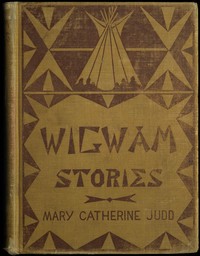
Wigwam stories told by North American Indians
Language: en1,408 downloads on Project Gutenberg
Subjects
In: Mythology, Legends & Folklore·History - Other
Public-domain ebook sourced from Project Gutenberg #73136.
Public-domain ebook
Language: en1,408 downloads on Project Gutenberg
Subjects
In: Mythology, Legends & Folklore·History - Other
Public-domain ebook sourced from Project Gutenberg #73136.
The volume is a nineteenth‑century anthology that gathers together a wide range of Native American material, from ethnographic sketches of tribal customs to a long series of legends and myths. It opens with a scholarly note explaining that the compiler has drawn directly on Henry Rowe Schoolcraft’s journals rather than on Longfellow’s poetic retelling of Hiawatha, and it outlines the contested identification of Menabozho with the legendary hero. The introductory pages then list a detailed contents structure, dividing the work into three parts: descriptive essays on tribal life, a collection of traditional stories, and more recent narratives about Hiawatha and other figures. Interspersed throughout are photographs by George Wharton James and illustrations by Angel de Cora, providing visual context for the textual material.
The book’s voice is that of an early‑1900s ethnographer, combining factual reportage with a reverent tone toward the oral traditions it records. Its style is formal and descriptive, reflecting the period’s interest in documenting “exotic” cultures for a largely educated readership. Readers who enjoy historical anthropology, folklore studies, or anyone seeking a primary‑source glimpse of Native American storytelling and material culture from the turn of the century will find this compilation rewarding.
The opening · free to read
There are no adaptations from Longfellow’s poem of Hiawatha, but the compiler has gone directly to the works of Schoolcraft, whose writings were Longfellow’s inspiration. Schoolcraft’s Journal states his belief that Menabozho and Hiawatha were one and the same person, the latter name being preferred as more musical. Hence, Longfellow chose it as the name of his Indian hero.
Horatio Hale and other authorities on Iroquois history differ strongly from Schoolcraft on this point, and maintain that the name of Hiawatha, or Heyanwatha, refers only to an Iroquois statesman or deity.
Menabozho, or The Foolish One, is very real to the Chippewa or Ojibway Indian of Minnesota. The various names of Missaba, Mesaba, Michabo are merely English or French renderings of the same Algonquin word.
The later stories herein told, that were gathered from the Chippewas in 1895, 1896, and 1900, prove their unchanging love for the tales of this imaginary hero.
Attention is called to the very interesting pictures on pages 17, 43, 53, 55, 89, 100, 173, and 188, which are from photographs taken by George Wharton James, of Pasadena, Cal., the noted authority upon Indian life and basketry. The copyrighted pictures on pages 43 and 55 are used in this book with his special permission.
In addition to the numerous illustrations from photographs, Miss Angel de Cora, a young Indian artist of great promise, has contributed three full-page sketches, the cover design, and numerous initials and designs. The pictorial features, therefore, reproduce with unusual fidelity the atmosphere of Indian life.
MARY CATHERINE JUDD.
Note. In answer to inquiries the compiler desires to state that according to the census reports of 1900 there are fifteen American cities any one of which contains more inhabitants than the total number, 266,760, of our taxed and untaxed American Indians; of these nearly one half are in Indian Territory, Alaska, and Arizona.
M. C. J.
Minneapolis, Minn., January, 1904.
The book keeps going
Reading is free forever. Sign up and watch scenes appear while you read.



Scenes Storieta drew for other classics.
New illustrated classics
Once or twice a month: the latest books to get full character casts, scene art, and free comic editions. No account needed.