Public-domain ebook
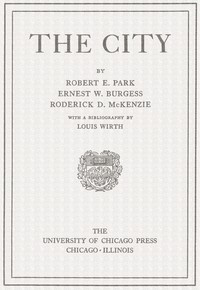
The city
by Park, Robert Ezra; Burgess, E. W. (Ernest Watson); McKenzie, Roderick Duncan
Language: en1,415 downloads on Project Gutenberg
Subjects
In: Sociology
Public-domain ebook sourced from Project Gutenberg #73285.
Public-domain ebook
by Park, Robert Ezra; Burgess, E. W. (Ernest Watson); McKenzie, Roderick Duncan
Language: en1,415 downloads on Project Gutenberg
Subjects
In: Sociology
Public-domain ebook sourced from Project Gutenberg #73285.
The volume is a collaborative sociological study of urban life, assembled from a series of papers first presented to professional societies and published in early‑twentieth‑century journals. It opens with Robert E. Park’s introductory essay, which frames the city not merely as a collection of streets, buildings, and institutions, but as a “state of mind” shaped by customs, traditions, and the ecological forces that organize human populations. The authors then lay out a program for investigating the city’s physical layout, its economic division of labor, and its cultural patterns, drawing on examples from Chicago, New York, and contemporary research on transportation, communication, and real‑estate development. The opening establishes the book’s purpose as a guide for further inquiry into the social psychology of urban environments.
Written in the formal, lecture‑style prose of early American sociology, the text reflects the intellectual climate of the 1910s and 1920s, when scholars like Park, Burgess, and McKenzie were pioneering ecological and anthropological approaches to the city. Its tone is analytical rather than narrative, with frequent references to contemporary journals and conferences. Readers interested in the historical foundations of urban sociology, the development of ecological theory, or the early academic treatment of topics such as neighborhood organization, juvenile delinquency, and the social dimensions of the press will find this collection a valuable, if dense, window into the discipline’s formative years.
The opening · free to read
Some years ago I was asked to outline a program of studies of human nature and social life under modern city conditions. The first paper in this volume was written in response to that request. The other chapters are by-products of the more detailed monographic studies suggested in that paper and already measurably carried to completion. They have arisen naturally as a commentary upon and interpretation of these larger studies, exploring and delimiting the field of observation and research in which these subjects lie. It has seemed, therefore, that although they were written at different times and by different hands, they might serve as a general introduction to further studies in the field. Some of the larger monographs referred to above are nearly ready for the press and when published will constitute, with this volume, a series in the sociology of urban life.
Most of the papers in this volume have already found their way into print, in whole or in part, either in the Proceedings of the American Sociological Society or in the pages of other sociological publications.
The chapter “The City,” which gives the title to this volume, was first published in the American Journal of Sociology for March, 1915. It has been revised and to some extent rewritten for publication in this volume. No attempt has been made, however, to redefine the point of view or the project as originally outlined.
The chapter “The Growth of the City” was presented first as a paper at the meeting of the Sociological Society in Washington, in 1923. It was subsequently printed in the Proceedings of the Society for that year. It is intended to sketch a point of view for the study of the expansion of the urban area and the growth of the urban community, particularly as they are related to the recognized problems, communal and personal, of the city.
Professor McKenzie’s paper, “The Ecological Approach to the Study of the Human Community,” was first published in the American Journal of Sociology for November, 1925. It is intended to emphasize the fact that the conceptions and methods of study of plant and animal ecology may be profitably applied to the analysis and description of certain aspects of human society. These three papers, with the classified bibliography by Louis Wirth, represent whatever is novel in the point of view and the methods of study of the urban community, to which this volume is intended as an introduction.
Certain of the remaining chapters, including the paper “The Natural History of the Newspaper,” first published in the American Journal of Sociology, November, 1923; the paper “Magic, Mentality, and City Life,” presented at the annual meeting of the American Sociological Society, in Washington, D.C., December, 1923; and the brief paper on the “Mind of the Hobo,” first printed under the title “The Mind of the Rover,” in the World Tomorrow, September, 1923, will no doubt seem rather remote from the theme of this volume. The justification for including them here is that they suggest lines of observation in a field that students are just now beginning to explore. It seems evident that there is a very definite relation between human intelligence and community organization. Although no specific studies have been made in this field, they should be included, at least prospectively, in the list of problems for further study.
The substance of the chapter “Community Organization and Juvenile Delinquency” was presented at the annual meeting of the Recreation Congress, in Springfield, Illinois, October 8–12, 1923, but has not been previously published. The paper “Community Organization and the Romantic Temper” was read at the meeting of the American Sociological Society in Washington, D.C., in 1923, in the section on Community Organization. It was published in the Journal of Social Forces, May, 1925.
Professor Burgess’ paper, “Can Neighborhood Work Have a Scientific Basis?” was presented at the annual meeting of the National Conference of Social Work, in Toronto, May 1924. An abstract of this paper was published in the Proceedings of the conference for that year.
In conclusion, the authors wish to take this occasion to acknowledge their indebtedness to the publishers for using here the papers in the journals mentioned.
The book keeps going
Reading is free forever. Sign up and watch scenes appear while you read.



Scenes Storieta drew for other classics.
New illustrated classics
Once or twice a month: the latest books to get full character casts, scene art, and free comic editions. No account needed.