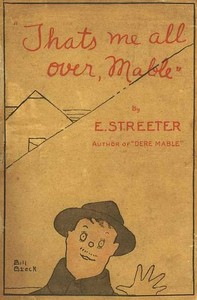
The writer of these letters and maker of these drawings went overseas with the first Technology unit; landed in France on the Fourth of July, 1917; began his service as a member of the Reserve Mallet, and was mustered into the American Army on October 1, 1917. In preparing the letters and cartoons for the press, it was thought best to begin where rumors of impending German surrender first appear in the correspondence, thus confining the humorously illustrated story to the last weeks of the war. Mr. Day wrote his letters with no intention or expectation of having them published; that is entirely the work of his friends, who believe that his impromptu sketches will be found to furnish ample justification for the existence of this book.
Mr. Day served in the Reserve Mallet, a camion unit to whose spirit and efficiency Stars and Stripes has paid the following unaffected and authentic tribute:
“In a summer when again and again the historic phrase ‘Franco-American troops’ makes its appearance in the communiqués, the distinction of being the complete amalgam of the two armies belongs to the flying squadron of emergency transportation, that trundling troop of trucks, that charging company of camions, the Mallet Reserve.
“This organization consists of 700 five-ton trucks—American trucks driven over French roads, driven now by French now by American drivers, officered by French and American officers, carrying French and American troops, French and American ammunition.
“The Mallet Reserve is so named because its commanding officer is Major Mallet of the French Cavalry, and is called a Reserve because it is attached to no Army Corps, but rather is held in reserve for emergency duty whenever a crisis in the war brings a crisis in transportation.
“This means that the interminable line of camions bearing the Mallet mark will invariably appear wherever things are hottest, that the trucks and their drivers know no rest from one year’s end to the other.
“Thus you saw them along the roads up Cambrai way last fall. When French troops were rushed into the gap that opened during the German drive of March, Mallet trucks carried them, and they were Mallet trucks which bore northward the French soldiers who made their sudden and startling appearance among the British in Flanders during the April fighting. The American troops and ammunition that were moved with a rush to the lines of the Chateau-Thierry front were transported, many of them, in the home grown camions of the Mallet Reserve.
“The trucks themselves, if you examine them, tell many a story of transport under shell-fire, tell of machine gunners borne to the very rim of the battle so that gunners need only drop from the camion, run down a field and start firing.”
When this book went to press, Mr. Day was still in service, with the American Army of Occupation.
Dear Mother—
Today the war ended!—at least, one of the buck privates read it so. He got hold of a French newspaper, and caused some excitement until one of the boys, who could read the Lingo, commandeered the sheet. At any rate, the Huns are beginning to squeal. Just wait until a few Boche villages begin to get theirs, and peace notes will begin to come over....
Well! I arrived back in camp again after some jumping about France. We got away from Aix without any trouble, but from then on we began to wonder if we would get back into camp for Christmas. The trains over here hate to get anywhere.
It was night when we arrived in Paris, late as usual, and so dark we had to hang on to each other to keep from getting lost. Having been there before, I was elected guide, and I got the gang to the Provost Marshal O. K., where we got our passes stamped, and then I left them for the University Union. Coming back from permission, I was not loaded down with money, but did have enough to see me through one night. The Union was crowded, but I found a place at a nearby hotel—a dandy room on the ground floor, which rather surprised me. During the bombing season, ground floor rooms are the first to be taken.
The next afternoon I went, with a lieutenant I had met at the Union, to take a look at Napoleon’s tomb. We walked over—the lieutenant’s pocketbook must have been as flat as mine. I will never regret going, and I shall never forget the thrill I got when standing in the doorway of the chapel and seeing that golden light flooding the cross.
That golden light, that living cross, and the pale blue-gray rays falling from the side windows, made me feel miles from any one.
The tomb itself was covered with sandbags. I remember going to the tomb when I was here with you, before the war; but how I could have forgotten that inspiring sight is beyond me.
There was no more time for sightseeing, as I could not take a chance on missing my train.
AN’ I’LL BET FIFTY FRANCS IT’S OVER BY CHRISTMAS!
SAVE YOUR MONEY. THE BOCHE AINT GOT BRAINS ENOUGH TO KNOW THEY’RE LICKED!]
Since my return I have heard the news that our company clerk is leaving, and that I am to take on his job as well as have charge of the mess. It will be pretty nice in the winter, but I hate inside work and would much rather ride a camion.
Dear Mother—
Today has been another rumor day. Those coming back from convois sure have one hot line from the front. “William the Hun” has agreed, and the Boche have stacked arms and are doing the goose-step back to Germany. Would that it were true! Still, the way the Huns are going now, they haven’t time to goose-step, it’s more of a fox-trot.
I’m enclosing one ticket good for a visit from Santa Claus. Tell him to pack the cigarettes and gum with care. Don’t chase around to get stuff to fill the box—just pack it full of cigarettes and send it along. Don’t put in a Christmas card, it takes up room.
Dear Mother—
Once upon a time I went to church and they sang a song about “Rest, rest, for the weary.” When I get home, I’m going to climb into bed and let them sing me to sleep with that song. Weary! Sleep! I could make a hibernating bear look as though it had insomnia.
Did I ever write a letter in which I didn’t say “We have moved.” If so it must have been when little apples were made. We have moved! The way the Huns are going backwards, my next letter should be headed “Somewhere in Germany.” This move has been one for the better in regard to quarters. The Germans didn’t do much hating in this village. No doubt they didn’t have time. At any rate the houses are standing on their own feet and the roofs are pretty much all together.
Kirk. Day ’18]
Germany is down and out. Everywhere you notice and see it. The French are rubbing the defeat in. Before this wonderful drive you never saw a light anywhere. Now everywhere you see them. Autos go by with their head lights thumbing their noses. In the woods, in the field, in houses, and barracks, there is no attempt to conceal lights.
WHAT SEEMS TO BE THE TROUBLE KID?
TROUBLE!!? I’M WONDERING IF I’LL OUT GROW THAT NEW DRESS SUIT I LEFT BEHIND.
Dear Mother—
I have just finished up with the “Flu.” Believe me, eight days with it is enough for me and I don’t want to see it again. Feel about as useful as a pair of pajamas in the army. The Flu hit me when I wasn’t looking and got me down before I knew what struck me. They took me over to the camp infirmary and put me to bed. When you are once in bed you have no desire to leave. If you do get up you find that your legs are no longer mates, and refuse to work together.
SPANISH FLU.]
Just now I’m back in my old room wondering what it has all been about. I slept most of the time at the infirmary and had some fine dreams. Pushing logs about and driving over cliffs in camions were my favorites. Once in a while I would dream that I was at home again, but every time I was to see you they would make me crank up my camion and go somewhere else. I hope some day I’ll be able to dream without having a camion enter into it. I still don’t feel much like sitting down to any kind of a meal. The first shave I had since I was taken was yesterday. It nearly killed me, and I left my moustache on until my arm gets a little stronger. The camp is shy a barber or I would have let someone else do the job. If we don’t get a barber soon I’m going to start braiding my hair....
SYSTÈME D!
AFTER THE WAR.]
Over here nothing is ever stolen, swiped or pinched. It is always “Système D.” As I understand it there are three right ways of getting things in the French army. Either by Système A, B, or C. If you can’t get what you want through these three channels, you “Système D” it. All sorts of things from coal to pianos have been obtained through this “let not your left hand see what your right is doing” method. Some one said that by the end of the war we would all be first class crooks. There may be more truth than poetry in that. At any rate it’s a safe bet that we won’t starve to death while the war is going on. You would think that “Gott Mit Uns” was made in the United States instead of Germany, if you were to look at the belts. I thought, until I went on permission, that only the boys in the Reserve Mallet wore the Hun belt. As far as I’ve seen practically every “Yank” has and wears one of these belts. Fully as many pants in the United States Army in France are held up by “Gott Mit Uns” as are held up by the regulation belt.
NOTE. THE RED HATS WORN BY THE SENEGALESE ARE GOING TO MAKE OUR COONS GREEN WITH ENVY.]
Dear Mother—
Isn’t the news wonderful! One of the boys drifted in with a French newspaper and translated the armistice terms laid down to Austria. The Allies certainly left out the silver platter when they handed them over. Wouldn’t I like to be there when the Hun comes running out with the white flag to call on General Foch. We are all saying, “When we move let’s take a trip to Austria.” It may be a case like the fellow who said, “Why learn French when we will be talking German in Berlin soon.” Only it will be Vienna if we should roll to Austria. Just think of their being eighty minutes from Berlin by air. Soon the aviation report will be, “So many tons of bombs dropped on ‘Unter den Linden.’” Won’t the Huns yell!
Broadway]
One of the boys that has come in since I started this letter has just gone out to get a bottle of wine so that we can celebrate the glorious reports. If we start in celebrating all such news, it will be—“Vin tous les jours.” Italy showed that she had a punch in each hand. Sad news from the front—“No wine.” Some one else must have decided to celebrate....
All the talk these days is, “When I get home.” I’ve heard what every man is going to eat, wear, and do, when he gets to the other side. Each one has his own taste in regard to food. In the clothing line, anything but a uniform is popular. As for doing—I am afraid the wheels of progress are not going to move very fast. All the boys are going to just sit or sleep.
DON’ WORRY! FOR THE LOVE OF MUD SIT STILL OR THEY’LL THINK THE BOCHE BIT ONE OF YOUR EARS OFF!]
There is now a barber in town—A French one. Although I need a hair cut pretty badly, I think I’ll stay away. From the work he has done on a few of the boys, I have come to the conclusion that I can do as good a job myself. Over here a bald headed man has the advantage. Nothing doing with the clippers, however, once was enough for me with a convict head....