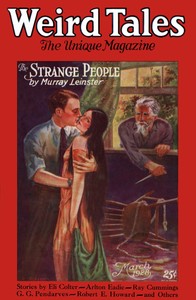
Public-domain ebook
The strange people
Language: en408 downloads on Project Gutenberg
Subjects
In: Science-Fiction & Fantasy·Romance·Crime, Thrillers and Mystery
Public-domain ebook sourced from Project Gutenberg #73515.
Public-domain ebook
Language: en408 downloads on Project Gutenberg
Subjects
In: Science-Fiction & Fantasy·Romance·Crime, Thrillers and Mystery
Public-domain ebook sourced from Project Gutenberg #73515.
The opening · free to read
According to Cunningham’s schedule there was a perfectly feasible route to romance and to high adventure. It began wherever you happened to be and led to Boston. There you took a train to Hatton Junction and changed to an accomodation train of one passenger coach and one baggage car. That led you to Bendale, New Hampshire, and there you hired a team. Both romance and adventure were to be found somewhere around Coulters, which was eight miles from Bendale. Cunningham was sure nobody else knew this secret because he had found it in a highly unlikely place and almost anybody else who happened to look there would find only dry statistics and descriptions.
However, as he boarded the accomodation train he inspected his fellow passengers carefully. One upon a quest like Cunningham’s likes to feel that his secret is his alone.
At first glance the passenger coach was reassuring. There were a dozen or more passengers, but with two exceptions they were plainly people of the countryside. New England farmers. Two women who had been shopping at the Junction and were comparing their bargains. A swarthy French-Canadian mill-hand with his dark-eyed sweetheart. Odds and ends of humanity; the “characters” one finds in any New England village.
But even the two men Cunningham recognized as outsiders like himself were wholly unlikely to be upon the same quest. One had the solid, pleasant expression of a safe-and-sane man of business on his vacation, perhaps in search of a good fishing-stream. The other was a foreigner, immaculately dressed and with waxed mustaches, who was reading something that Cunningham could not see and exhibiting all the signs of mounting rage. Cunningham might have become curious about the foreigner at another time. He might have tried to guess at his race and wonder what reading-matter could fill any man with such evident fury.
But being upon the last stages of the route to romance, Cunningham thought of nothing else. As to whether the girl would be as attractive as her picture, he had no idea. Whether or not she had been married since it was taken, he could not tell. What reception he would receive at the end of his journey was highly problematical. He might be regarded as insane. He might--and he hugged the knowledge to him tightly--he might run a very excellent chance of being killed.
This was folly, of course, but Cunningham had an ample excuse. For ten years he had toiled at a desk. He had worn a green celluloid eye-shade and added up figures in a tall ledger, or made notes in a day-book, or duly pounded out, “Yours of the fifteenth instant received and in reply would state...” at the dictation of his employer. For eight hours out of the twenty-four, for eleven and a half months out of the twelve, he made memos or orders and payments and violations imposed and repairs made, and all connected with the business of a firm which installed and repaired elevators.
And now he was free. An uncle, dimly remembered, had died without any heirs but Cunningham. Cunningham had inherited fifty thousand dollars and within ten minutes after receiving the news had resigned his job and punched his employer’s rather bulbous nose.
Now he was in quest of adventure and romance. He considered that he had earned them both. Ten years of law-abiding citizenship in New York entitled him to all of adventure he could gather, and ten years in a boarding-house earned him at least one authentic romance.
Cunningham had in his pocket the picture of a girl who lived a mile and a half from Coulters, New Hampshire. The picture had been taken four months before and her name was Maria. She was a pretty girl and had smiled at the camera without self-consciousness. That was all that Cunningham knew about her, but he had built up dreams to supply the rest. And he was quite insanely confident that where she was, there would be romance.
But romance alone would not do. There must be adventure as well. And adventure was duly promised. The picture was in the Geographic Magazine which travel- and adventure-hungry folk devour. It was one of the illustrations of an article prosaically entitled Ethnological Studies in New Hampshire, which very soberly outlined the radical traits of New Englanders and the immigrants who are supplanting them. And Maria was a Stranger--one of a group of people who were a mystery and an enigma to all those around them.
They were two hundred people of unknown origin who spoke English far purer than the New Hampshireites around them and avoided contact with their neighbors with a passionate sincerity. They could not be classified even by the expert on races of men who had written the article. They were not Americans or Anglo-Saxons. They were not any known people. But whatever they were, they were splendid specimens, and they were hated by their neighbors, and they kept strictly away from all contact with all other folk. The New Englanders charitably retailed rumors that more than one inquisitive visitor among them had mysteriously disappeared. Strangest of all, they had appeared from nowhere just two years before. They had bought ground and paid for it in new, rough gold. And they refused violently to give any account of themselves.
This was where Cunningham was going. Where the prettiest girl in the world had smiled unconsciously at a camera just four months before. Where a magnificent unknown race was represented in the hodgepodge of New England’s later day. Where inquisitive strangers might mysteriously disappear, where certain hostility awaited too much questioning--and where the prettiest girl in the world might possibly be induced to smile.
Cunningham knew it was foolish, but he considered that he had earned the right to be a fool.
Then he looked up. The solid-looking man just opposite him had unfastened his suit-case and taken out a sheaf of magazine pages, neatly clipped together. He began to go through them as if they were totally familiar. Cunningham caught a glimpse of a picture among them, and started. It was the same article from the same magazine that had sent him here.
Then he heard a snarl, as of one who has contained himself until he can do so no longer. His head jerked around and he found himself staring at the foreigner who had seemed so angry. The man had the Geographic Magazine in his hand. It was open at the page--the very page--on which the girl was pictured. But the foreigner was looking at the type. Otherwise Cunningham as one in quest of romance and adventure would have felt it necessary to interfere an instant later. Because the foreigner glared at the page as if he had read something that infuriated him past all possible control and suddenly ripped the sheet across and across again, and threw the magazine upon the floor and stamped upon it in a frenzy of rage.
He saw eyes fixed upon him, some startled and some slyly amused. He sat down quivering with wrath and pretended to stare out of the window. But Cunningham saw that his hands were clenching and unclenching as if he imagined that he had something in his grasp which he would rend to bits.
The accommodation train made innumerable stops. It stopped at “South Upton.” It puffed into motion and paused at “East Upton.” A little later it drew up grandly at “Upton.” Then it passed through “North Upton.”
The comfortable-looking man opposite Cunningham looked across and smiled.
“Now, if we stop at West Upton,” he suggested, “we can go on to a new name.”
Cunningham nodded and on impulse pulled the Geographic Magazine out of his pocket and held it up.
“Same trail?” he asked.
The other man frowned and looked keenly at him. Then his face relaxed.
“I belong to the lodge,” he admitted. “Here’s my copy.”
Cunningham jerked his head at the third man.
“He had one too. He just tore it up. It seemed to make him mad.”
“That so?” The other looked steadily back at the foreign-seeming man, who was staring out of the window with his face pale with fury. “Let’s ask him.”
He caught the foreigner’s eye an instant later and held up the magazine, opened at the article on the Strange People.
“How about it? You going there too?” he asked pleasantly.
The foreigner went purple with fury.
“No!” he gasped, half-strangled with his own wrath. “I do not know what you are talking about!”
He jerked himself around in his seat until they could see only his profile. But they could see his lips moving as if he were muttering savagely to himself.
“My name’s Cunningham,” said Cunningham. “I want to see those people. They sound sort of interesting.”
“And my name’s Gray,” said the other, shifting to a seat beside Cunningham. “I’m interested, too. I want to hear them talk. Dialect, you know. It’s my hobby.”
“But they’re supposed to talk perfectly good English----” began Cunningham, when he stopped short.
The train had halted leisurely at a tiny station and the conductor was gossiping with an ancient worthy on the station platform. A single passenger had boarded the coach and entered the door. He looked unmistakably unlike the other natives in the car, though he was dressed precisely in the fashion of the average New Englander. But as he came into full view at the end of the aisle he caught sight of the foreign passenger Cunningham had puzzled over.
The newcomer turned a sickly gray in color. He gave a gasp, and then a yell of fear. He turned and bolted from the train, while the foreign passenger started from his seat and with the expression of a devil raced after him. The newcomer darted into a clump of trees and brushwood and vanished. The well-dressed passenger stood quivering on the platform of the day-coach. The conductor gaped at him. The other passengers stared.
Then the well-dressed man came quietly back inside and to his seat. Veins were standing out on his forehead from fury and his hands were shaking with rage. He sat down and stared woodenly out of the window, holding himself still by a terrific effort of will.
Gray glanced sidewise at Cunningham.
“It looks,” he observed in a low tone, “as if our trail will have some interesting developments. That man who just ran away was one of the Strange People. He looks like the pictures of them. It ought to be lively up in the hills when our friend yonder arrives. Eh?”
“I--I’ll say so,” said Cunningham joyously.
The book keeps going
Reading is free forever. Sign up and watch scenes appear while you read.



Scenes Storieta drew for other classics.
New illustrated classics
Once or twice a month: the latest books to get full character casts, scene art, and free comic editions. No account needed.