Public-domain ebook
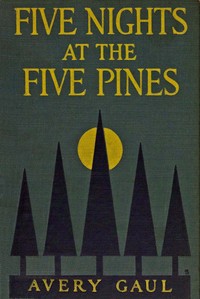
Five nights at the Five Pines
Language: en468 downloads on Project Gutenberg
Subjects
In: Novels
Public-domain ebook sourced from Project Gutenberg #73520.
Public-domain ebook
Language: en468 downloads on Project Gutenberg
Subjects
In: Novels
Public-domain ebook sourced from Project Gutenberg #73520.
The opening · free to read
A sea of yellow sand rose, wave on wave, around us. High hills, carved by the bitter salt winds into tawny breakers, reared towering heads, peak upon peak. Like combers that never burst into spray, their static curves remained suspended above us, their tops bent back upon the leeward side, menacing, but never engulfing, the deep pools of purple shadows that lay beneath them. The sand was mauve in the hollows, and black upon white were the cupped dunes hung over their own heights. They were like water that did not move, or mountains with no vegetation. They did not support as much life upon their surface as that which crawls upon the floor of the ocean. They were naked and unashamed as the day when they were tossed up out of the bed of the sea. Only tufts of sharp green grass clung to some of the slopes, their silhouettes flattened out before them like the pin-feathers of a young bird, inadequate and scant, accentuating the barrenness of the saffron sand.
Centuries ago some gigantic upheaval of Neptune had forced this long ridge out of the shielding water, to lie prone in the sight of the sun, like a prehistoric sea-monster forever drying its hide. More isolated than an island, the head of the cape, with the town in its jaws, fought the encroaching sea, which thundered upon it in constant endeavor to separate it from the tail, extending a hundred miles to the mainland. From the height on which we stood, the line of ocean far away was dark blue, following in a frothy scallop the indentations of the coast. The sound of the surf came to us like a repeated threat. It could bend the cape, but never break it, twist and turn it, change the currents and the sand-bars, and toss back upon its shore the wreckage of such vessels as men essayed to sail in, but the sand-dunes continued to bask blandly. Sometimes they shifted, but so silently and gradually that they seemed not so much to move as to vanish. To-day there would be a dune in the way of our path to the sea, so steep as to make a barrier, impossible to scale. To-morrow the force of the wind upon its surface, and the strength of the far-away tide which continually seeped its roots, would have leveled it. The very footsteps one followed, trying to trace a track across the waste, would have melted away.
On this desert each traveler must be his own guide and climb to some eminence which topped all others, to get his bearings from the strip of deep blue that marked the ocean’s rim. Nor could he say to himself, securely, “Here is east,” although he looked out on the Atlantic. Land played a trick upon the wayfarer who trusted it, and turned its back upon the sea, and curled up like a snail, so that the inside of the cape, where the town lay behind us in its green verdure, faced south, and the outside sea, where the sun set, curved west and north. The glory of light in the afternoon struck first upon the hills and was reflected back from the sheltered bay to the little fishing-village.
The path from the woods, by which you entered the dunes, lost itself to sight under the foliage of the scrub-oak trees, and unless you had tied a white rag to the last branch, marking the point where you climbed up out of the forest, you would never find it again. There were many foot-paths through the thicket which separated the hamlet on the inside of the horn from the immense dry sea-bed, but none of them were visible, once you had left them. By day you must mark the entrance to the desert of your own footsteps, by night it was useless to look for them.
This must have been the place, I thought, where Dorothy Bradford was lost. Brave as the Pilgrim Fathers were, they had not loitered here after dark to look for William’s young wife! They had conscientiously attended to their laundry work, on that first November day when the Mayflower landed, and, having finished their domestic duties, waited no longer for any scatterbrain of the party who had been foolish enough to venture from the fold, but weighed anchor without finding her and put off for Plymouth Rock!
As I looked about me at the profound grandeur of space, it seemed to me that I understood why Dorothy had not hurried back to the boat. She had embarked upon the Mayflower, a bride, strange to the ways of men and of marriage, and for sixty-three days the stern-faced Puritans had been her only companions and the rolling sea her entire horizon. Her quarters must have become a prison to her before the voyage was over. When at last this finger of land, reaching into the Atlantic, had beckoned to the mariners, her heart must have sung like a caged canary, even as mine responded when first I saw the cape. Did she linger with the other virtuous housewives at the first spring, to wash her husband’s dirty linen? Not she! I liked to think that in glad escape she ran from all those stuff gowns and starched kerchiefs, through the woods, chasing the scarlet-winged blackbirds on and on, picking the wintergreen berries and ravenously eating them, gathering her arms full of bright autumn leaves, feeding her hungry eyes on the vivid color of growing things and her starved soul, at last, upon the dunes. It was not the Indians who prevented Dorothy Bradford from returning to the ship; it was her own heart. If Indians saw her, they must have fallen on their red knees in the sand and worshiped her for a sprite of limitless space, running past them with gay branches clasped to her gray dress and a wreath of waxy bayberries on her fair young head. It was her wayward feet that forbade her from following further the fortunes of the Pilgrims. No doubt, from some high point on the dunes she watched them sail away, and laughed, taking off her shoes upon the sand and dancing, fleeing further. That is what I would have done. That is what I wanted to do now. Something starving in my heart found food here; a hardness that had been growing within me for two years dissolved, as my mind relaxed, and the troubles that had driven me here appeared insignificant. The tired spirit of hope that had been driven deeper and deeper down beneath the weight of disillusion began to bubble up. There might be a way of regaining the nice balance of life, after all, if one could weigh it every afternoon upon the sand-dunes!
Ruth and I were sitting on a pyramid, where we had brought a picnic lunch, and were watching her children play in the hollows.
“Do people get lost here nowadays?” I asked her.
“The natives never come here,” she answered; “at least, not for fun. They only follow the wagon-track to the coast-guard station on ‘the outside,’ and that is about all the summer people do. It is three miles across the soft sand to the sea, and most people get discouraged and turn back before they reach the further shore. But enough children and strangers have been lost here in recent years to scare away the others! The townspeople say the dunes are haunted, and that at night strange shapes flit across the sand, spirits of those who have never been found. They will not come near the white fields at moonlight, when they are wrapped in mystery. The landmarks are not permanent. Every storm changes them, just as it changes the shoals on ‘the outside.’ The sailors are more afraid of this neck of land than any one else. Do you see how far distant the big steamers keep?” She pointed out to me a thin line of smoke on the horizon. “Hundreds of ships have run aground off here in less than that many years. There are lighthouses at every point now, but the bed of the sea moves constantly. That is why they call this coast the ‘Graveyard of the Cape.’”
“Have there been any wrecks since you have lived here?”
Ruth’s eyes darkened. “A year ago a fleet of fishing-vessels were caught in a sudden tempest and half of them were lost. Eleven men were drowned, all from this town! Star Harbor raises her sons upon the sandy flats of the bay at her doorway, and when they grow old enough they sail away from her, and she knows that one day, sooner or later, they will fail to return. In the meantime the mothers do not bring their boys out here on the dunes to play, as we do our children from the cities. It is too much like dancing on their own graves! They try to forget the dunes are here, and walk up and down the front street of the village.”
“I do not want to forget them,” said I. “They mean something to me, Ruth, something that I have needed for a long time.”
Ruth smiled at me fondly, without replying. We had known each other for a long time.
“It is like the touch of a hand on the heart,” I tried to explain, “or like a song heard outside a window in the dark--or a flaming embroidery on a stucco wall.”
The sun shone down upon the tawny sand, illuminating the dunes with so blinding a radiance that description was futile. The effect of so much heat and light was soothing and restful, and at the same time stimulating. The body drank up enough electricity, through contact with the sand, to renew its youth and send the worn years reeling backward. The children were shouting and sliding down the inside of a crater below us, transposing their winter sports to the summertime, climbing up the opposite slope, only to shoot down again on the seats of their rompers, laughing and crawling up, and repeating the game, in ecstasy of abandonment.
“I would like to do that, too,” said I.
Ruth smiled. “You would get sand in your sneakers.”
“Sneakers!” I scoffed.
“And wear holes in your silk stockings.”
“Silk stockings! No one should wear stockings out here. They should run barefoot before the wind, and leap from peak to peak. It is absurd, in the face of this vast emptiness, to wear clothes at all!”
“So many people feel that way,” said Ruth, dryly.
But I refused to be rebuffed.
“We need it, Ruth,” I cried. “We, who are cooped up in cities, are starving for this very thing--space and sunlight, air and warmth. Not the suffocating heat of the area-ways, but the glow that glances off the sun-kissed sand. Our eyes are blind with gray pavements and white asphalt, stone and cement, nothing but colors as hard as the substance we tread on. We hunger for blue and for purple, for the sea and the seacoast shadows, for green that is brighter than burnt sod, and for living red and yellow. The craving for earth under our feet is still natural to us. It is what has made possible the barefoot cult of the people who choose to get up in the morning and run around in the dew, and the ‘back to all fours’ cult of those who put their hands down on the floor and prance like a trained bear. And the ‘stand on your head’ cult, who pick out a cushion which best suits their psychic soul and balance themselves with their feet in the air for hours at a time. Perhaps it is true that it is stimulating to the brain. But Ruth, joking aside, there must be a fundamental reason for all of this ‘simple life’ movement--the elemental need for relaxation, which is what this sort of exercise gives to the worn human machine. I am going to give up my apartment in New York and pitch a tent on the sand-dunes!”
The book keeps going
Reading is free forever. Sign up and watch scenes appear while you read.



Scenes Storieta drew for other classics.
New illustrated classics
Once or twice a month: the latest books to get full character casts, scene art, and free comic editions. No account needed.