Public-domain ebook
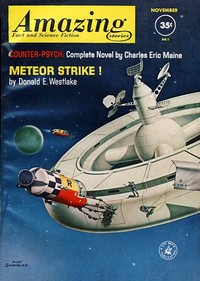
Meteor strike!
English443 downloads on Project GutenbergDownload EPUB
Public-domain ebook sourced from Project Gutenberg #73593.
Public-domain ebook
English443 downloads on Project GutenbergDownload EPUB
Public-domain ebook sourced from Project Gutenberg #73593.
The opening · free to read
Harvey Ricks had always bit off more than he cared to chew. Somehow, he had always managed to chew, and swallow. Now, standing for the first time in the vacuum of Space, he wondered if this was the bite that would choke him.
[Transcriber's Note: This etext was produced from Amazing Stories November 1961. Extensive research did not uncover any evidence that the U.S. copyright on this publication was renewed.]
The cargo was crated for delivery at Los Angeles, where the workers didn't consider it anything special. In the company where they worked, this particular cargo was of the type called a Standing Repeater. That is, a new order was shipped out every six months, regular as clockwork. First the order department mailed off a suggested list of specifications to the General Transits, Ltd. main office in Tangiers. Next, the list came back, usually with a few substitutions inked in, and was sent down to LA, to the warehouse, for the specific items to be crated for shipment.
There were seven aluminum crates in the cargo, each a three-foot cube. Aluminum was still the lightest feasible crating material, and this cargo was destined for the Quartermaster Base orbiting the Moon.
The seven crates left the warehouse by helicopter and were flown north to the airport mid-way between LA and San Francisco. There they spent thirty-two hours in another warehouse before being flown to the Tangiers Poe. (Even in nomenclature, Man made it apparent that his thoughts these days were ever outward, away from Earth. The spaceport on Earth was called Tangiers Poe, which stood for Port Of Embarkation. The spaceport on the Moon was called Moon Pod, for Port Of Debarkation. It was as though Man didn't want to admit that he still had to make the round trip.)
The cargo arrived at the Tangiers Poe a day ahead of schedule, and spent one more night in a warehouse. Across the field, the four lighters from Station One were being unloaded. Their cargo was almost exclusively manufactured items from the factories on the Moon. Manufacturers had discovered, to their astonishment, that the lighter gravity and the accessible vacuum and the ready availability of free raw materials on the Moon more than offset the additional cost of labor and buildings and transportation. In the last fifteen years, the Moon had become studded with heavily-automated factories, producing everything from delicate electronic equipment to razor blades. Though human exploitation of the Moon had begun as a military venture, back in the late nineteen-sixties, by 1994 it had been taken over almost completely by commercial interests.
A few of the cartons being unloaded across the field were samples or data from the scientific teams on the Moon. These teams, all affiliated with one university or another, were for the most part supported by the manufacturers themselves. As at all times in the past, commercial business success had been shortly followed by commercial philanthropy. A part of the profits of what one newspaper columnist had dubbed the Moonufacturers were siphoned off to give scientists an opportunity and a freedom for research and investigation unavailable through any short-range Government grant.
There were as yet no tourist facilities either for travel to the Moon nor for a stay on the Moon. A rumor was current that a number of hotel and restaurant corporations were banding together to found a Moon resort, but so far nothing had come of it.
The seven aluminum crates spent the night in the Poe warehouse, and in the morning were turned over to Glenn Blair, whose charge they would be for the next thirty-three days, until they reached the Quartermaster Base.
Glenn Blair was a big man, big-boned and fully-fleshed, with a short-cropped head of light hair. Thirty-four years of age, he had been for the last seven years one of the two Chief Cargomasters for General Transits, Ltd., the franchised operator of the Earth-Moon transportation system.
He came into the warehouse now with Cy Braddock, the Poe Cargo Chief, and the two of them compared the stacked crates half-filling the warehouse with the manifest flimsies attached to Braddock's, checking off each item as they found it. When they came to the seven crates from Los Angeles, Blair said, "Cargo for QB. Let's see, what's the specification?" He read the line on the manifest, and grinned. "I forgot it was time for another shipment. Six months already." He patted the nearest of the seven crates. "The boys at QB will be happy to see you fellas," he said.
Braddock looked over his shoulder and read the specification. "What's so important about that stuff? I thought that was low priority."
"Check your regs, Cy. These fellas are priority number one. If they don't get to QB, there'll be hell to pay. Within a month, QB would be more dangerous than a cannibal village."
Braddock shook his head. "You people have a funny set of values," he said. "The more I know about you, the happier I am to stay right here. Come on, let's finish the checkout and get loading. Takeoff is scheduled for eleven-seventeen."
They finished the first checking of the cargo, and went on out of the shed and across the sunbaked tarmac toward the lighter. The Tangiers Poe was a great concrete oval, ringed by warehouse sheds and repair huts and administration buildings. All of Earth's space shipping was conducted here, close to the Mediterranean coast of North Africa, where perfect flight conditions were rarely marred by clouds or rain or cold. Where flight plans include three variables--a lighter moving from a moving Earth to a moving Space Station--no one can afford delays caused by bad weather.
In the shed, the cargo handlers loaded small open-sided carts, which were then driven across the field to the lighter. The cargo for QB came out on the second cart, and Glenn Blair supervised its careful stowing and tying down in the hold, then made the second check after its specification line on the manifest. The first checkmark meant that he had found the seven crates in undamaged condition in the shed. The second one meant that he had accepted delivery onto the lighter. Eight more checkmarks would be made before the cargo was finally delivered to QB.
All cargo and personnel traveling between the Earth and the Moon made the trip in five stages. Stage One was transit from the surface of the Earth to the Space Station, aboard a torpedo-shaped ship familiarly known as a lighter. Stage Two was aboard the Station, during its fifteen-day trip from perigee, four hundred miles up, to apogee, eighty-four thousand miles from Earth. (Space Stations One and Two circled the Earth, one at perigee whenever the other was at apogee, so that a shipment left for the Moon every fifteen days.) Stage three was via a ship technically known as V-T-V (vacuum-to-vacuum) but informally called the Barbell, because of its shape. This stage also took fifteen days, and covered sixty-two thousand miles, terminating at its meeting with Space Station Three, eighty-four thousand miles from the Moon. Station Three orbited the Moon every fifteen days, so that this lap of the trip, Stage Four, took seven and a half days. And finally Stage Five, via another lighter, was from Station Three at perigee two hundred fifty miles above the Moon to the surface of the Moon itself or, as in the case of the seven aluminum crates from Los Angeles, from Station Three to Quartermaster Base, the maintenance satellite for the whole system, in permanent orbit two hundred miles above the surface of the Moon.
Although it had taken four lighters, this trip, to bring down to the Poe the shipment of manufactured goods and scientific samples from the Moon, only one lighter was required for the return shipment. The Moon colony was not yet self-supporting, but the first steps in that direction had already been made. A part of the colony's food was home-grown, hydroponically. New plant buildings and new machinery were built right on the Moon, by firms whose only customers were other Moon companies. Clothing and furnishings were made of synthetics.
Most of the Moon-bound cargo was paperwork, of one sort or another. There was the fifteen days accumulation of mail for the Moon personnel, sheafs of new product specifications for the managers of the Moon plants, financial reports, and so on. The rest, except for the cargo for QB, was primarily food, meat and dairy products and other foods unavailable through hydroponics. There were also three engineers, new employees of Interplanetal Business Machines, replacing three men whose two-year contracts were ending and who would be coming back to Earth on the next transit.
Blair greeted the three men at the lighter ramp, checking their names and identity cards against the manifest and then saying, "My name's Blair, Glenn Blair. I'm Cargomaster on this trip, and you boys are part of the cargo. You've got any questions or problems, bring them to me. I'm liaison between you and the rest of the Transit personnel. Okay?"
One of the engineers said, "If we decide we can't take it we shouldn't bug the working types, is that it?"
"You're Ricks? Yes, Ricks, that's exactly it. None of you people have been off-planet before, so you can't make any sure statements about how you'll act. A good quarter of our first-time passengers are plenty scared. It's nothing to be ashamed of. If any of you feel it getting to you come to me. Don't try to burrow your way through the wall, don't try to kill yourself, don't go running around screaming. We've had all of that, at one time or another, and it plays merry hell with the working day."
Ricks grinned. "If I need a shoulder to cry on, Mister Blair," he said, "I'll run straight to you."
"You do that. Come on, I'll show you your quarters."
Blair led the way up the ramp and into the lighter. The bottom half of the ship was engine and fuel-space, and most of the upper half was cargo hold, leaving only two levels at the top for human occupancy. The uppermost level was the control room, with passenger space on the level beneath.
The three engineers, Ricks in the lead, followed Blair up the inside ladder to the second level, a smallish circular room with twelve bunks, in tiers of three, around the walls. The center space was empty.
"There's only four of us," said Blair, "so we can all take middle bunks. The middle's best; there's less noise and vibration."
"Beds for the babies, is that it?" said Ricks.
Blair grinned at him. "You wouldn't want to be standing up when we blast," he said. "Now, you lie face down in these bunks. This indentation is for your knees, and this pillow up here is for your chin. You hold onto these handles here, in front of the pillow, and you brace your feet against this bar back here. Just before we blast, you dig your chin down into that pillow hard. If you have your mouth open, you're liable to get up to the Station minus a few teeth. In front of each bunk here, you see these three lights. The green one means you can relax, talk if you want to, readjust your position, whatever you want. The orange one means a blast within one minute, and the red one means a blast within ten seconds. The red one stays on throughout a blast. Okay?"
The book keeps going
Reading is free forever. Sign up and watch scenes appear while you read.



Scenes Storieta drew for other classics.
New illustrated classics
Once or twice a month: the latest books to get full character casts, scene art, and free comic editions. No account needed.