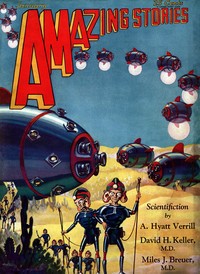
When the events of which I am to tell took place all the world was interested solely in their final outcome, but when that last awful day was ended, and time enough had passed to give our world a chance to find a way to apply and use the awful forces it had had forced upon it, or, indeed, had even found how to control their immense energies, men began to wonder about the true story of the Invasion.
I had always been a writer, first newspaper work, then a book or two. Perhaps because of this the world expected that an account would soon be presented. But had those millions seen that awful battle, seen those mighty wrecks on the hot sands, even then might they understand my dread of telling of that titanic conflict--a conflict in which the weaker was a million times more powerful than any force man had previously seen! It still burns in my memory, that awful scene in its desolate setting--the vast rolling desert below, seared, blasted, fused in great streaks where the intense, stabbing heat rays had cut it, mighty craters blasted in its surface where the terrific explosions of the shells had heaved thousands of tons of sand into great mounds, and those ghastly wrecks that lay crushed and broken on the hot sands below, bathed in the ruddy light of the sun of sunset, now slowly sinking behind the distant purple hills, as the last of the Invaders crashed on the packed sands below.
Two men of all Earth's billions saw that scene--but those two will never forget--as Stephen Waterson and I can testify.
Ten years have passed, ten years of stupendous change, readjustment, and cosmic conquest. Ten years in which a world has been added to man's domain, yet still sharp and clear in my memory is the picture of those shapeless masses, those lumps of glowing metal, that lay on the sands beneath us, the sole vestiges of the mighty ships of Mars.
Never have I wanted to think long on that scene of titanic destruction, destruction such as man never before knew, but friends have convinced me that it is my duty as one who lived in closest contact with the facts, and one of the two men who saw that last struggle, to tell the story as it unrolled itself before me.
Brief it is. The entire event, for all its consequences, lasted but two days--days that changed the history of a Universe!
But in this march of mighty events, I was but a spectator, and as a spectator I shall tell it. And I shall try to depict for you the character of the greatest man of all the System's history--Stephen Waterson.
It was late afternoon in May, 1947, and the temperature had climbed to unbelievable heights during the day. It seemed impossible to work with that merciless sun beating down on the roof. It is odd that a temperature of 95 in May should seem far higher than a similar temperature in July. On the top floors of the great apartments it was stifling. The great disadvantage of roof landings for planes had always been the tendency of the roofs to absorb heat in summer, yet on the top-most floors of those apartments people were living, and in one of those apartments a man was trying to work. Heat was a great trouble, but he found thoughts of hunger in the not too distant future an even greater inspiration to work. The manuscript he was correcting was lengthy, but this was the final revision, which was some comfort. Still the low buzz of the telephone annunciator was a relief. It was so much easier to talk. He took up the telephone.
"Gale speaking."
"Hello Dave, this is Steve. I hear you are having a bit of hot weather in New York today. I have a suggestion for you--I'm coming to pick you up in an hour and a half, and if you will be ready on your roof then, in a camp suit, and with camp clothes for about a month packed, I can guarantee you some fun, providing, of course, that you're still the man I knew. But I can't guarantee to return you! Meet me on your roof in an hour and a half."
"Well, I'll--now what's up? So he isn't sure I'll get back--and he calls that a 'suggestion'! Anyhow it sounds interesting and I'll have to hurry. I wish he'd get into the habit of warning a fellow when he is going to start one of his expeditions! And I may not come back--I wonder where on Earth he's going now--and where he was then. The only reason he gives me an hour and a half is because it will take him that long to get here. He would drop in on me without any notice otherwise. In that case he must be about three hundred miles from here. But where?"
An hour and a half later he was on the roof, watching the darting planes, there were a good many, but by far the larger part of the world's business and pleasure was on the ground in those days. Still the crimson and gray special of Waterson's ought to be easily visible. He was late--unusual for Steve. Gale hadn't seen him in more than a year--probably been working on one of his eternal experiments, he decided.
Still he searched the skies in vain. Only the regular planes, and one dirigible--tiny in the distance--it seemed to be coming toward him--and it certainly was coming rapidly--it couldn't be a dirigible--no gas bag could go that fast--then he saw the crimson and the gray band around it--it was Steve.
And now as it darted down and landed gracefully on the roof beside him, he saw that the machine was but thirty-five feet long, and ten or so in diameter. Suddenly a small round hatchway opened in its curved, windowless side of polished metal, and a moment later Stephen Waterson forced his way out. The door was certainly small, and forcing that six-foot-two body in and out through it must have been a feat worthy of a magician. Gale noticed that he would just about fit it, but the giant Waterson must have intended to use it very infrequently to make it that size.
"Hello, Dave--how do you like my new boat? But get in, we're going. There, your bag's in already."
"Good Lord, Steve, what is this? I gather you invented it. Certainly I never saw nor heard of it before," said Gale.
"Well Dave, I suppose you might say I invented it, but the truth is that a machine invented it--or at least discovered the principles on which it is based."
"A machine! A machine invented it? What do you mean? A machine can't think, can it?"
"I'm not so sure they can't, Dave, but get in--I'll tell you later. I promised Wright I would be back in three hours, and I've lost ten minutes already. Also, this machine weighs three thousand tons--so I don't want to leave it on this roof longer than is absolutely necessary."
"But, Steve--let me look at it. Man, it is beautiful. What is that metal?"
"Try the inside, Dave--there!"
Dave Gale was rather good sized--five feet ten, and weighing over one hundred and sixty pounds, but Waterson was in perfect physical condition, two hundred and ten pounds of solid muscle, and Gale had been popped into the hatch like a bag of meal, so quickly was it done.
Now he turned to look at the tiny room in which he found himself. It was evidently the pilot room, and around the front of the room there ran a clear window, curved to fit the curve of the ship's walls, and about three feet high, the center coming at about the level of the eye of a person sitting in either of the two deeply cushioned chairs directly facing it. The chairs were evidently an integral part of the machine, and from the heavy straps attached to them it was obvious that the passengers were expected to need some support. The arms of each chair were fully two feet broad, and many small instruments and controls were arranged on their polished black surfaces. Waterson had seated himself in the right hand chair and strapped himself in. Gale hastened to secure himself in the left chair.
"Take it easy Dave, and be prepared for a shock when we start."
"I'm ready Steve, let's go!"
Waterson moved his right hand a bit, and a tiny red bulb showed on his left instrument panel; many of his instruments began to give readings and several on Gale's board did so also. Another movement, and there was a muffled hum of an air blower. Then Waterson looked at Gale and turned a small vernier dial--Gale had been watching intently--but suddenly the look left his face--and was replaced by a look of astonished pain. The entire car had suddenly jerked a bit, then that peculiarly unpleasant sensation connected most intimately with a rapid elevator or helicopter starting from rest had made itself unpleasantly pronounced. Gale's pained and somewhat sick expression caused Waterson's smile to broaden.
"Whew--Steve--what is this--why don't you warn a fellow of what's coming!"
"I did warn you, Dave," answered Waterson, "and if you will look out, I think you will understand this."
The car was rising, at first slowly, but ever faster and faster, from the roof, not as a helicopter rises, not as a dirigible rises, but more as a heavy body falls, with high acceleration ever faster and faster. Soon it was rising quite rapidly, straight up. Then another tiny red bulb flashed into life on Waterson's switchboard, and the ship suddenly tilted at an angle of thirty degrees. Then it shot forward, and continually accelerated an already great speed, till New York lay far behind, and then the sky became dark and black, and now the stars were looking in at them, not the winking, blue stars of Earth, but the blazing, steady stars of infinite space, and they were of every color, dull reds, greenish, and blue. And now as they shot on across the face of Earth far below, Gale watched in rapture the magnificent view before him, seeking the old friends of Earth--Mars, Venus, Jupiter, and the other familiar, gleaming points. Then he turned his gaze toward the Sun, and cried out in astonishment, for the giant sphere was a hard, electric blue, like some monster electric arc, and for millions of miles there swept from it a great hazy, glowing cloud, the zodiacal light, almost invisible from Earth, but here blazing out in indescribable beauty.
"We're in space! But, Steve, look at the sun! What makes it look blue? The glass of the window isn't blue, is it?" said Gale excitedly.
"We're in space all right--but it isn't glass you're looking through; it is fused quartz. Glass that thick would crack in a moment under the stress of temperature change it has to undergo. The sun looks blue because, for the first time in your life, you are seeing it without having more than half its light screened off. The atmosphere won't pass blue light completely and it cuts off the ultra-violet transmission very shortly after we leave the visible region of the spectrum. The reason the sun has always looked yellow is that you could never see that blue portion of its spectrum. Remember, a thing gets bluer and bluer as it gets hotter. First we have red hot, bright red, yellow, white, then the electric arc is so hot that it gives blue light. But the sun is nearly two thousand degrees centigrade hotter than the electric arc. Naturally it is blue. Also, I'll bet you haven't found Mars, have you?"
"No, Steve, I haven't. Where is it?"
"Right over there. See it?"
"But that can't be Mars. It's green, green as the Earth."