Public-domain ebook
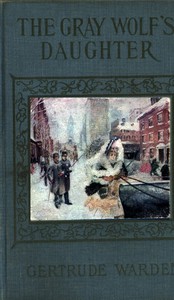
The gray wolf's daughter
Language: en503 downloads on Project Gutenberg
Subjects
Public-domain ebook sourced from Project Gutenberg #73734.
Public-domain ebook
Language: en503 downloads on Project Gutenberg
Subjects
Public-domain ebook sourced from Project Gutenberg #73734.
The opening · free to read
“My Own Daughter Clare” (it began),
“Your brother Jim sets sail for America on Tuesday next, and we all hope if once he gets out in Canada with Uncle Pete he’ll do well. But you know what the boy always was about you. It was ever Clare first, and the rest of us nowhere. He won’t budge a foot without seeing you, and giving a good-by kiss to his little sister, for all she’s a great lady now. Now, my girl, it’s hard enough to have had never a sight of you for them three years, save now and again as you’ve drove past in your carriage, and that one time you contrived to slip off to the old cottage for half an hour. I’m hungering to speak to my beautiful girl. Maybe I’m wrong, but I’ve thought I seen a sad look on your face of late. It’s wicked and unnatural for Sir Philip to part flesh and blood, and as to us not being gentlefolks, he should have thought of that afore he took ye. What you say he threatened about shooting as poachers any on us as come within his property, that’s mere tall talk. What harm to anybody will it do for your father and brother to see you for ten minutes or so, and give you a good-by kiss, and tell you how dear you are to us still? So, my girl, to-morrow night, at any time between nine and eleven, do you slip out to the shrubbery at the back of the paddock. If it rains hard we shan’t expect you, but if it’s fine, seeing as the gray wolf is away, we know you’ll come, my pretty, to your loving brother, and your old father.”
Dr. Netherbridge read the letter carefully, and returned it to Lady Cranstoun. He was beginning to understand several things which had puzzled him. One point was very clear--Sir Philip Cranstoun had married beneath him, and had forbidden his young wife from communicating in any way with her relations.
“Did you go?” the doctor asked.
She supported herself on her elbow, and spoke in quick, gasping tones:
“It was a beautifully clear night. I thought Sir Philip was away, but he had returned from London without my knowledge. Somehow, some one--one of the spies who are about me, waking and sleeping--picked up and read this letter. I can only suppose this, for all I know is that as I crept out of the house at about half-past nine I was followed. Just as I reached the shrubbery, and caught sight in the moonlight of my father and brother in waiting under the dark shadow of the trees, I was seized from behind, something was thrust into my mouth and over my eyes, and I was carried back into the house. I fought and struggled, but to no purpose, and I could plainly hear several shots, the sound of a scuffle, and a great cry as of a man in mortal agony. From that day to this I have been able to learn nothing of what happened on that night. But yesterday Margaret overheard Sir Philip telling his steward that he was going to Guildford to-day, where the sessions are held, to appear as a witness against some poachers who were found in his grounds several weeks ago, and who have been in jail ever since. Dr. Netherbridge, I am certain he meant my father and my brother!”
“But how could that be?” he asked, trying to allay her fierce excitement. “Your father and brother are not poachers surely?”
A faint red color stole into her white cheeks.
“My people don’t see that the rich are injured by the loss of a hare or a rabbit now and again,” she muttered with lowered eyelids. “They should belong to the people, wild game like that, and a bird or two--but that’s not what we were talking of. It was no poaching brought out Jim and father that night. Sir Philip knew that right enough. He made me take a solemn oath never to betray to anybody what he called my disgraceful origin. Disgraceful!” she repeated, with burning cheeks. “A Carewe’s as good as a Cranstoun any day, as I’ve told him often enough. I’ve never broken my vow until to-day; not even Margaret knows who my people are. But I’ve told you, because I must and will know what has happened to my father and my brother Jim to-day.”
As he watched her talking, and noted the English nature of her beauty, the intense blue-blackness of her hair, and a certain touch of wildness about her free, graceful gestures and rapid speech, another conviction came home to Ernest Netherbridge’s mind, and this was that Lady Cranstoun, wife of Sir Philip Cranstoun, of the Chase, Surrey, Cranstoun Hall, in Aberdeenshire, and Berkeley Square, London, had in her veins the untamable blood of the true “Egyptian,” those despised wanderers over the face of the earth who are found and hated in all the chief countries of Europe.
In spite of his patient’s beauty, Dr. Netherbridge could not help wondering how so proud a man as Sir Philip was considered had ever been so far carried away by his feelings as to wed a girl of gypsy origin. Lady Cranstoun seemed to divine what was passing in his mind. Raising herself to a sitting position, she tapped one slender well-arched foot upon the ground while she said, as though in answer to his thought:
“Of course, you wonder how Sir Philip came to marry me. I can see that in your face. When I was only eight years old I got blamed for something, as we were on the road going from fair to fair in the summer. So I ran away in a rage, and walked till I was tired and fell asleep under a hedge by the wayside, in Devonshire. A rich lady drove by, the Hon. Mrs. Neville, a widow without children, Sir Philip Cranstoun’s eldest sister. Because I was so pretty, she had me lifted into her carriage, and took me to her beautiful home and had me educated, taught French, and music, and dancing, and drawing, and all that, meaning me to be a governess. Every now and then I broke loose and went tramping through the fields and lanes after my own people, whom I loved the best all along. Often and often, when my fingers ached with practising the piano, and I felt all stiff in tight clothes and shoes, I’d long for the old free life again. But when I saw my people, stealing out at night to them, they begged me to stay where I was. I could help them with money, and times were hard. Before my mother died she made me promise to remain a lady, and Mrs. Neville was kind enough to me by fits and starts, and very proud of what training and education had done. She used to show me off as a sort of successful experiment, too, before people, and that made me mad. She was a hard, capricious woman, like all the Cranstouns in nature, and was all for breaking what she called my absurd pride, and reminding me I’d only been a vagrant after all. But she didn’t do so much of that as she’d have liked, because I told her I’d run away, and that wouldn’t have suited her, as I played and read to her, and amused her, and she couldn’t well do without me. But I never could be reconciled to the notion of being a dependent, and so when Sir Philip Cranstoun came on a visit--he was a handsome enough man of five-and-twenty then, and me only a little bit over sixteen--and he glared at me, and could hardly let me out of his sight, and said he loved me, I got all excited between the notion of being a great lady and being loved and being free from Mrs. Neville’s taunts. But Philip wanted me to run away with him, but I wouldn’t hear of it, and refused to speak to him. I was very pretty then, prettier than you can think just seeing me now, and he was regularly crazy about me. So, early one morning, he made me meet him in a church at Torquay, and we were married. Just three years ago it was yesterday, a day I shall curse as long as I live!”
“Surely,” said the doctor, as she paused, apparently lost in sombre thought, “Sir Philip must have been very deeply attached to you?”
“Yes,” she returned, bitterly, “and for how long? First, nothing was too good for me, but that state lasted only a few weeks, and even then I was afraid of him. Then violent, raging scenes of jealousy if, when we were in Italy, I so much as looked at a waiter and asked him for bread. Then, forever storming at me, and reproaching me, if a gondolier so much as called me the ‘beautiful signora.’ And, after that, scenes constantly. I’ve a temper like fire myself, I own. We Carewes have never been known for meekness, and even when I was a baby child I’d been taught to think myself a princess. All his life Sir Philip had his own way in everything, and all who came in his path had obeyed him, cowed by his masterful temper and sullen fury. But I withstood him. I thought he loved me well enough to let me have my way, and when I found out my mistake I began to hate him, and more than once tried to run away from him. But he followed, and swore he would murder me if I dared, gypsy as I was, to bring disgrace upon his ancient name. Gradually, my will and my health seemed to be breaking down. Our first child pined away and died, because I could not care for it--could not look at it. It was his child, like him, I thought, even at that age, and so I could not love it. When his son died, Sir Philip was mad with anger, but I had grown past caring. It isn’t all my fault, Dr. Netherbridge,” she added, suddenly, while big tears rolled down her cheeks. “I may have been silly when I married, but I tried my utmost for over a year to love Sir Philip, and to please him, but he is more a fiend than a man, I think, and I would rather die than see a child of mine grow up resembling him. It is all these thoughts which, together with my awful anxiety for my father and Jim, are breaking my heart, and ruining my health. It is hate, and terror, and misery, and cruel, cruel anxiety, which make me starve myself and hope to die. But now that I have trusted you, and told you everything, you will befriend me, will you not? Come to-morrow early, and let me know everything--everything, mind--that took place in court to-day, and I will let you cure me, if you choose. Will you promise?”
“I promise,” he said, “to do everything in my power to serve you,” and with that assurance he took his leave.
PROLOGUE.--PART II.
As Dr. Netherbridge left Lady Cranstoun’s apartments, and proceeded down the broad oak staircase to the ground floor, he found a man servant waiting for him in the hall.
“Sir Philip has just arrived, sir, and wishes to see you before you go. Will you kindly come to the library?”
The little doctor followed the man, filled with considerable curiosity as to what manner of man could have inspired so strong a sensation of fear and dislike in the breast of his young wife. Lady Cranstoun’s father had spoken of the son-in-law who would not acknowledge his existence as the “gray wolf.” But then Gypsy Carewe was hardly an unprejudiced person, and Dr. Netherbridge, who always desired to preserve an impartial mind, reminded himself of the fact that a girl of Clare Cranstoun’s undisciplined, keenly emotional nature would necessarily be an extremely trying companion to a man as reserved and proud as Sir Philip was popularly supposed to be.
“Dr. Netherbridge, sir.”
The servant threw open the library door after a deferential tap on its panels, which was followed by a curt “Come in!” The young doctor found himself in a spacious apartment completely lined with oaken book-cases well filled with volumes. Before the fire, in the Englishman’s favorite attitude, his hands behind him, and his feet set rather wide apart on a lion-skin rug, stood a broad-shouldered and deep-chested man, rather below the medium height, with a square pale face, and black hair which, in spite of the fact that he was but eight-and-twenty, was already streaked with gray. In some indefinable way Sir Philip impressed all who saw him with the sense of power, of mental as well as physical force of very exceptional kind. In features he somewhat resembled the first Napoleon Bonaparte, but, if anything, his mouth was even more rigidly compressed and hard in outline than that of the great conqueror. He appeared to be a man of superb health and physique, notwithstanding his exceptional pallor, which contrasted strangely with the inky blackness of his eyebrows, and of the lashes which bordered his deep-set, glittering, steel-gray eyes. He gazed keenly at the doctor, and then with haughty condescension waved his long white hand toward a chair, which the latter did not take, but remained standing.
The book keeps going
Reading is free forever. Sign up and watch scenes appear while you read.



Scenes Storieta drew for other classics.
New illustrated classics
Once or twice a month: the latest books to get full character casts, scene art, and free comic editions. No account needed.