Public-domain ebook
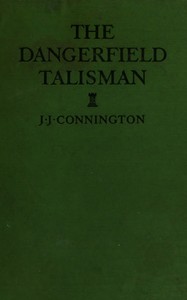
The Dangerfield Talisman
English441 downloads on Project GutenbergDownload EPUB
Public-domain ebook sourced from Project Gutenberg #73753.
Public-domain ebook
English441 downloads on Project GutenbergDownload EPUB
Public-domain ebook sourced from Project Gutenberg #73753.
The opening · free to read
“Lucky again, partner,” commented Westenhanger, breaking into Eileen Cressage’s thoughts as he took up the scoring-block. “That’s game and rubber, Douglas. Your mind must be wandering.”
Douglas Fairmile had glanced down the room to where a fair-haired girl was sitting with a rather red-faced man. Douglas’s brows contracted slightly. That fellow Morchard had attempted to monopolise Cynthia this evening; but surely anyone could see that the girl was bored. A persistent creature, Morchard—rather too persistent at times, Douglas felt. Then at the sound of Westenhanger’s voice, his attention came back to the bridge-table.
“Game and rubber?” he repeated. “Sorry, partner. My fault entirely. You see, I’m getting rusty in auction nowadays. It’s nearly gone out at my club; nobody plays it any more. We’re all on to this new game that’s just come in.”
“New game? What new game?” demanded Westenhanger, arranging the cards for his shuffle. “Have the Cardsharpers rediscovered Old Maid or the simple joys of Happy Families? Out with it, Douglas.”
Douglas Fairmile made a gesture as though apologising for Westenhanger.
“Tut! Tut! He’s jealous, poor fellow. My fault for mentioning the Romarin Club. A sore subject with Conway, and no wonder. You know, we have an entrance examination for candidates: test ’em in following suit and remembering what’s trump. And somehow Conway didn’t get in. Or else he was afraid to enter. A sad business, anyhow; don’t let’s dwell on it. So he calls us the Cardsharpers out of spite.”
Mrs. Caistor Scorton began to deal. Douglas passed the box of cigarettes to Eileen; and, when she refused, took one himself. Westenhanger looked at him with feigned anxiety.
“I notice a certain tendency to wander in your talk, of late. This inconsecutiveness of mind is growing on you, Douglas. Do you ever find yourself, in the morning, putting on your jacket first and your waistcoat afterwards? Pull yourself together. Squails Up-to-Date, or something like that, was what you were trying to tell us about before you began to ramble.”
“Oh! Suspension Bridge, that’s it. Suspension Bridge. Never heard of it? Well, well. These soulless mechanics! You take the two of spades out of the pack, put in a joker instead; and then play according to auction rules. You’ve no notion of the superior feeling it gives you when you go No Trump with five aces in your hand. Confidence, that’s the word! A splendid game.”
“Splendid!” Westenhanger conceded, sarcastically. “Invite me to take a hand in the inaugural game, will you? It’ll be an historic occasion, no doubt; and I might get my name into the newspapers.”
Douglas looked hurt.
“He doesn’t believe me, Eileen; he thinks I’m . . . Oh, sorry!”
He picked up his cards, and the game continued. For the third time in succession, Eileen Cressage laid down her hand with an inaudible sigh of relief. Being dummy, she could think about other things than the table before her. She had never been a keen bridge-player; her card-memory was too weak for anything beyond the most obvious tactics. And on this evening especially, her interest in the game was of the slightest. She played mechanically; and she had quite failed to note how, time and again, a skilful intervention by her partner had extricated her from a risky declaration.
As Westenhanger gathered up their first trick, her mind went back to her ever-present money difficulties. Some bills had reached her by the last post. Somehow, bills always dropped in at that time; and she had begun to dread the very sight of an unsealed envelope among her correspondence. If these wretched things had come in the morning, the affairs of the day might have helped to put them out of her mind; but when they arrived after dinner, they seemed to rivet her attention through the whole night.
The problems of a girl trying to keep up a decent appearance on a tiny income seemed to be approaching an insoluble state. Her quarter’s income was nearly exhausted; and yet something would have to be done. It was no use approaching her trustees in the hope of anticipating her income for the next three months. She had tried that before; and all she had got was a lecture on the folly of over-spending. It appeared that the thing was impossible under the will. Besides, the trustees were simply lawyers, without a spark of personal interest in her affairs or herself. So far as they were concerned, Eileen Cressage was a name on a deed-box or a docket. No help there, obviously.
And yet something would have to be done. She could pay some of her creditors and leave the rest of the affairs standing; but which people ought she to attend to first? Her mind was busy with a sort of jig-saw puzzle with the bills as a picture and the available money as the pieces; but with half the fragments missing, it was a hopeless business. One fact was evident: some of these bills would have to be settled, and settled soon.
With an effort she put the whole affair at the back of her mind and tried to divert her attention. But her first glance across the room brought the thing back to her from a different angle. There was her host, old Rollo Dangerfield, sitting in a despondent attitude beside the window. What had he to be low-spirited about? If she herself owned the Dangerfield Talisman, her troubles would be conjured away. The thing was worth £50,000 on the last occasion when it had been valued; and the price of diamonds had gone up a good deal since then.
Her eyes passed to where Mrs. Brent and the American collector sat. Neither of them had money worries. At sixty, Mrs. Brent seemed to get a good deal out of life; and the steam yacht in the bay at the foot of the garden was a fair proof that a few hundred pounds one way or the other was not likely to trouble her.
A rustle of the cards brought Eileen’s attention to the bridge table. She leaned back a little in her chair and glanced, with an envy which was quite devoid of malice, at the three players intent on their game.
Mrs. Caistor Scorton’s husband had been one of those hard-faced men who had made fortunes in the War. When he died she had got the money; and her enemies said that the hard face had been bequeathed also, in a codicil to his will. She certainly had a very keen appreciation of the value of a Treasury note.
Then there was Douglas Fairmile, with a big private income. His only worry at present was whether Cynthia Pennard would marry him or not. No great need for anxiety there, Eileen reflected. Cynthia wasn’t throwing herself at his head, certainly; but it was one of those affairs which are bound to come right in the end. If only her own affairs would look as bright!
Finally, her partner, Conway Westenhanger, very obviously hadn’t a care in the world. Those mechanical inventions of his were known to be small gold mines; he wasn’t in love with anyone; and he got on well with people. What more could a man want?
Half unconsciously she compared the two men. Douglas was once described to her as “one of those delightful people who can always be cheery without getting on your nerves with it.” He had the gift of playing the fool in season without looking like a fool while he was doing it. One laughed with him, always, and never at him. Conway Westenhanger was a more complex person, but just as attractive in his own way. She liked his mouth; its clean-cut lines seemed to have something sympathetic in their curves; and the thinker’s sharply-marked vertical lines between the eyebrows rather added to the attractiveness of his face.
Mrs. Brent broke the silence, addressing her host. “Rollo! would you mind if we have that window opened further? The heat’s almost unbearable to-night.”
Old Dangerfield came out of his brown study with a start, made a gesture of acquiescence, and threw open the window to its full extent. Through the embrasure a faint breath of air wandered in from the outer twilight, laden with the smell of parched soil and the heavy perfume of flowers; but it brought no coolness with it.
“I suppose this doesn’t affect you, Mr. Wraxall?” Mrs. Brent turned to the American beside her. “You’re a New Yorker, aren’t you? Heat waves won’t trouble you as much as they do me. You’re acclimatised, no doubt.”
“It’s warm to-night. It’s certainly not what one calls cool. But I’ll admit that I’ve known it hotter over there. And this air of yours hasn’t got that used-up feeling about it that city air has. It’s fresh, even if it’s hot. You’d know it was garden air and not street air, even if the flowers weren’t there. But you’re wrong about my being acclimatised. I don’t use New York much in the summer.”
“Of course, you’ve got a country big enough to let you choose your climate for almost any day in the year, haven’t you? Well, there’s something to be said for an island. If this heat gets worse I shall simply take the Kestrel away for a night or two until the hot spell is over. Another couple of days of this would be unbearable. Luckily the Dangerfields understand me; they won’t be offended if I disappear without warning. One would think twice about doing that with most people, but Friocksheim is a real Liberty Hall.”
“They’ve been very kind in asking me down,” the American explained. “I didn’t know them; but I got an introduction; and when I explained I was interested in some of their things, they invited me to stay for a few days.”
He glanced through the window and across the moonlit bay which stretched beyond the lawns.
“The Kestrel? Little white yacht with copper funnels, lying in the bay? Is that the one? I saw her as I drove up here this evening.”
“Yes, that’s the Kestrel. You liked her looks?”
“Very pretty. Graceful lines, she has. My own yacht’s rather larger; but she’s not so neat, not so neat. I wanted lots of room on board.”
“The very thing I didn’t want on the Kestrel. I use her as a kind of retreat, Mr. Wraxall, the place for a rest-cure. I’ve never had a guest on board; there isn’t even a spare cabin. Sometimes I want to get clean away from everybody; and that was the best way I could think of for managing it. Callers don’t drop in when one’s fifty miles from port.”
The American looked at her with interest kindling in his eyes.
“You feel that way, too? That’s interesting. That’s very interesting. I take it you’re not a philanthropist, then?”
Mrs. Brent shifted her position slightly and looked up at her neighbour’s clean-shaven face. It was of the long rather than the square American type, the face of a man with a certain imagination.
“If you mean contributing to charitable funds and that sort of thing, I’m certainly not philanthropic,” she answered. “I don’t think I’ve spent a penny in that way during the last ten years. People come bothering me with tales of sad cases; at least they used to do that. But once you get the name of being kind-hearted, you’re simply pestered to death by demands, mostly from frauds. I’ve shed that reputation long ago. I don’t say I don’t give something here and there. Everybody does. But unless I see a thing with my own eyes I refuse to part with a farthing. My eyesight is still fairly good for my age; and I’m quite able to see a thing for myself without needing some fussy creature to point it out to me.”
The book keeps going
Reading is free forever. Sign up and watch scenes appear while you read.



Scenes Storieta drew for other classics.
New illustrated classics
Once or twice a month: the latest books to get full character casts, scene art, and free comic editions. No account needed.