Public-domain ebook
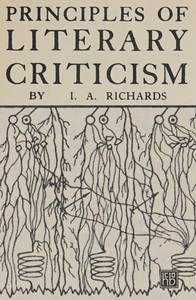
Principles of literary criticism
Language: en1,673 downloads on Project Gutenberg
Subjects
In: Language & Communication·Philosophy & Ethics
Public-domain ebook sourced from Project Gutenberg #73827.
Public-domain ebook
Language: en1,673 downloads on Project Gutenberg
Subjects
In: Language & Communication·Philosophy & Ethics
Public-domain ebook sourced from Project Gutenberg #73827.
Ivor Armstrong Richards’s Principles of Literary Criticism is a systematic treatise that seeks to rebuild the foundations of aesthetic judgment. The work opens with a preface that likens a book to a loom, promising to re‑weave the tangled strands of civilization by interlinking diverse viewpoints on value, psychology, and communication. From the outset Richards declares criticism to be the disciplined discrimination of experience, insisting that any meaningful analysis must rest on a clear theory of value and an understanding of the nature of experience itself. The opening chapter, “The Chaos of Critical Theories,” surveys the long tradition of aesthetic thought, from Aristotle to modern poets, highlighting the persistent lack of a unified explanation for why art matters. This framing sets the stage for a densely argued, cross‑referenced exploration that moves from abstract theory to concrete applications in poetry, painting, sculpture, and music.
Written in the late‑1920s, the book reflects the modernist confidence in scientific rigor and the emerging discipline of psychology. Richards’s prose is precise, occasionally austere, and deliberately avoids the emotive flourishes typical of contemporary literary essays. Readers who appreciate a scholarly, almost mechanical approach to art, students of literary theory, philosophy, or the history of criticism, will find the work rewarding. Those seeking a lyrical or narrative exploration of literature may prefer a more impressionistic style, but anyone interested in the intersection of logic, psychology, and aesthetics will be drawn to Richards’s methodical, intellectually disciplined voice.
The opening · free to read
“Extraordinarily interesting. . . . He is erudite and he is intelligent; he makes the courageous attempt to be at the same time scientific and psychological; and he has the great advantage of having at his disposal a knowledge of semantics. His terms are clear, useful, and conveniently few.”—_The Nation_.
“What he has done is to make thinking about art clearer, and about life, too. This is precisely the merit of Richards’ remarkable volume.”—_Christian Science Monitor_.
“The book is compact with stimulating criticism of the great critics of the ages, and with numberless original suggestions on all phases of the creation and appreciation of art.”—_Springfield Republican_.
“An important contribution to the rehabilitation of English criticism—perhaps, because of its sustained scientific nature, the most important yet made. . . . The principles enunciated are pursued in more particular aspects of literary criticism, always with a clear rest and consequent elucidation. Parallel applications to the arts of painting, sculpture, and music form the subjects of three chapters. Another important chapter deals with the availability of the poet’s experience.”—_The Criterion, London_.
“Mr. Richards is an entertaining writer, whose work avoids easily the tedium of a technical treatise.”—_The British Journal of Psychology_.
This eBook was created from a 1928 edition, scans of which are available from the Internet Archive. Tildes (~) indicate words that were set in Fraktur script in the original text.
New original cover art included with this eBook is granted to the public domain.
International Library of Psychology Philosophy and Scientific Method
The book keeps going
Reading is free forever. Sign up and watch scenes appear while you read.



Scenes Storieta drew for other classics.
New illustrated classics
Once or twice a month: the latest books to get full character casts, scene art, and free comic editions. No account needed.