Public-domain ebook
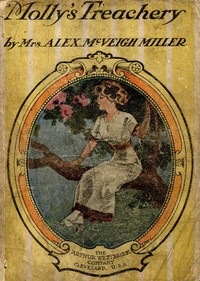
Molly's treachery
Language: en423 downloads on Project Gutenberg
Subjects
Public-domain ebook sourced from Project Gutenberg #73856.
Public-domain ebook
Language: en423 downloads on Project Gutenberg
Subjects
Public-domain ebook sourced from Project Gutenberg #73856.
The opening · free to read
“MOLLY E. TRUEHEART.”
“TO MISS LOUISE BARRY, “Staunton, Va.”
The Ferndale estate did not deserve the title “horrid old hole,” as applied to it in that gushing, school-girlish letter. On the contrary it was a magnificent place of about a hundred acres--a valley farm, situated a few miles distant from the historic old town of Lewisburg, and less than six miles distant from the Greenbrier White Sulphur Springs. The large, old-fashioned red brick mansion was almost hidden by a far-spreading grove of gigantic old forest trees, beneath whose shade, dark and damp and heavy, flourished the splendid ferns that gave the place its distinctive name. But after all, perhaps the dense shade and unavoidable dampness made the old house unwholesome, for old Mrs. Barry, its mistress, was an aged, withered crone, little more than skin and bones, with a temper none of the sweetest, and her servants as a whole were sour-tempered too, as if they did not get enough sunshine on their faces and into their souls. It was this subtle influence perhaps that made Mrs. Barry’s young guest vow to herself that she should go melancholy mad if she stayed much longer at Ferndale.
So with a heart beating high with hope she entered the old-fashioned family carriage and was driven into Lewisburg ostensibly to purchase the silk dress, but in reality to secretly register and post the letter of entreaty that was to wring her release from her probation at Ferndale and insure her speedy return to her own home.
She rather enjoyed the ride that sunny June afternoon, up hill and down dale in the jolting carriage over the rough, mountainous road, and her depressed spirits rose until she began to feel mildly jolly and hummed a little tune softly to herself that ended suddenly in an undeniable whistle of surprise as they came around a bend of the road and in sight of a picturesque plateau on which stood a beautiful country residence built of rough gray stone. There were two towers over which the pretty American ivy was picturesquely creeping, and the oriel windows here and there, and jutting verandas, were in a style of architecture quite unusual to the country, and betokening both wealth and taste. Our heroine thought she had never seen anything prettier than the great gray stone house with its creeping ivy, and its windows glistening in the sunlight, which had free play here, for there was a sloping lawn in front of the house with just enough trees grouped here and there to add beauty to the scene without at all obstructing the view.
The girl put her pretty, dark head out of the window and said, eagerly,
“Who lives there, Uncle Abe?”
The old family servant who had spent all his life in West Virginia, and knew every place for many miles around, answered promptly:
“Dat’s de ole Laurens place, honey. Fambly’s all in Yurrup now eddicating de darters and de sons. Mighty rich and proud, all dem Laurenses, missie. Come uv old English stock and ebry now an’ den some o’ dere kin dies ober de sea and leabes dem anoder fortin.”
“Oh,” said Molly, drawing a long breath, her piquant face glowing with eager interest.
She looked in something like awe at the beautiful home of these favorites of fortune.
“I wish I was one of ‘de darters’!” she said, quaintly.
“Hi, honey!” exclaimed old Uncle Abe, quite reproachfully. “Ole Mis’ Barry’s niece just as good as dem proud Laurenses.”
“Yes, Uncle Abe,” answered Molly, demurely, the mischievous golden brown lights dancing in her big, dark eyes, and her red lips dimpling with mirth at the old negro’s family pride.
“Miss Looisy Barry, I t’ink you mus’ be c’azy. Don’t you know dere ain’t nobody better den de Barrys? I been livin’ long o’ dem as slave and freedman all my life, me an’ my ole ’oman, and de Barrys is always de top o’ de pot, or, as ole missus say, cweam delly cweam. Dat’s F’ench for top o’ de pot, you mus’ know, chile. As fo’ de Laurenses, dey hab always been hand and glove wif de Barrys! Umph, chile, you don’t seem to know nuffin’ ’tall ’bout de ’portance of your own fambly,” concluded old Abe, shaking his gray head disgustedly, and turning his attention wholly to his horses for they had left the gray stone house out of sight, and were descending a steep hill now.
Molly Trueheart sat quite still with a distinctly wistful expression on her lovely girlish face.
“What do I care about the importance of the Barrys? I know that one of them at least can stoop to selfish scheming!” she muttered, impatiently. “Oh, I wish I was well out of this scrape. It is not so funny masquerading as I thought it would be! I nearly exploded into a confession when the poor old soul gave me that money, little fraud that I am!”
If she was a little fraud, as she declared herself to be, she had the frankest, honestest, prettiest face in the world, and many curious and admiring eyes turned on her as she alighted from the carriage on reaching Lewisburg and tripped lightly across the narrow pavement into the post-office.
After she had duly registered the letter containing the forty dollars she went into a few stores, where she looked at summer silks; shook her dark, curly head in pretended disapproval of the prices, bought a paper of pins and a neck ribbon, then returned to the carriage before Uncle Abe, who was exchanging the compliments of the day with some gossips of his own color, was half ready to leave.
“Lor’, Miss Looisy, you aine a-gwine yit?”
“Yes, Uncle Abe.”
“Dem hosses aine got rested yit, dat’s a fac’. Doane you want stay awhile, honey, and call on sum o’ de fust famblies o’ de town?” wheedlingly.
The girl laughed merrily.
“I don’t know a person in Lewisburg from Adam,” she said. “Come on, Uncle Abe; you’ve gossiped enough this time,” and with a resigned sigh the old darky climbed to his seat again, whipped up the horses, and set off on the return journey to Ferndale.
Molly Trueheart leaned back in the carriage and gave herself up to the enjoyment of her own thoughts until they again came in sight of the Laurens estate when she called out to the old driver:
“Uncle Abe, who stays over there when the family goes abroad?”
Uncle Abe, out of humor at being separated so soon from his gossip, grunted out crossly:
“Nobody but dem sassy Laurens niggers.”
Molly felt herself snubbed and drew back her curly head, relapsing into a silence that lasted until she again crossed the threshold of Ferndale.
Mrs. Thalia Barry was sitting in the wide hall taking snuff out of a golden snuff-box.
She was a tall, spare woman with a frame that had originally been strong and stout, although now dwindled by the encroachments of age and the horrors of a chronic dyspepsia. She had thin, masculine-looking features, a false front of waved, white hair, false teeth, and her small, twinkling, greenish-gray eyes were partially hidden by gold-rimmed spectacles. She dressed habitually in soft, thick, gray silk, and pinned her collar of the yellowest old real lace with a magnificent diamond brooch. Ill-health had magnified an already imperious temper; and Molly was not far wrong when she complained that the aristocratic old lady was a perfect old dragoness, for she was the terror of her servants when in one of her “spells,” as they called them, and even her young visitor had more than once smarted under the lash of her displeasure.
But she looked up now with some eagerness, and said in her shrill, curt tone:
“Back so soon? I hope that old rascal, Abe, did not drive my horses too fast! Well, Louise, come and show me your silk.”
The pretty, dark eyed girl, in her cheap white dress and rustic straw hat, halted in the door-way with a frightened expression and gazed half appealingly into Mrs. Barry’s stern, ugly face.
“Well?” said the lady, impatiently. “Do you want some one to bring your bundle in from the carriage? Here, Ginny Ann,” to an old negro woman hovering about the back door, “go out to the carriage and get Miss Barry’s bundle!”
Molly sprang forward, her frightened expression changing to one of defiant bravery.
“Oh, aunt, she needn’t go! There’s--there’s no bundle there! I didn’t buy the dress!” she cried out, desperately.
“But why?” cried Mrs. Barry in amazement.
And the girl faltered, with hot blushes.
“I didn’t need it, you know.”
The book keeps going
Reading is free forever. Sign up and watch scenes appear while you read.



Scenes Storieta drew for other classics.
New illustrated classics
Once or twice a month: the latest books to get full character casts, scene art, and free comic editions. No account needed.