
Public-domain ebook
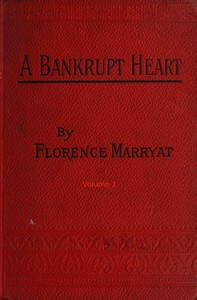
A bankrupt heart, Vol. 1 (of 3)
Language: en361 downloads on Project Gutenberg
Subjects
In: Romance·Novels·British Literature
Public-domain ebook sourced from Project Gutenberg #73972.
Public-domain ebook
Language: en361 downloads on Project Gutenberg
Subjects
In: Romance·Novels·British Literature
Public-domain ebook sourced from Project Gutenberg #73972.
The opening · free to read
Miss Llewellyn was standing at the window of her own room, in the house of Lord Ilfracombe in Grosvenor Square, gazing at the dust-laden and burnt-up leaves and grass in the gardens before her. It was an afternoon towards the close of July, and all the fashionable world was already out of town. Miss Llewellyn had been reared in the country, and she could not help thinking how that same sun that had burnt up all the verdure of which London could boast, had glorified the vegetation of far-off Wales. How it must have enriched the pasture lands, and ripened the waving corn, and decked the very hedges and ditches with beautiful, fresh flowers, which were to be had for the gathering. Her thoughts went back to rural Usk where King Arthur built a bower for Guinevere, and in fancy she felt the cool air blowing over its fragrant fields and woods. She heaved a deep sigh as she remembered the place of her birth, and, as if in reproach for such heresy to her present condition, she drew a letter from her pocket and opened its pages.
Miss Llewellyn nominally held an inferior position in the house of the Earl of Ilfracombe. She was his housekeeper. Old-fashioned people who associate their ideas of a housekeeper with the image of a staid, middle-aged woman, whose sole business is to guard the morals and regulate the duties of the maidens of the establishment, would have stared at the notion of calling Miss Llewellyn by that name. All the same she was a very fair specimen of the up-to-date housekeeper of a rich bachelor of the present time, with one exception, perhaps. She was handsome beyond the majority of women. Her figure was a model. Tall and graceful without being thin, with a beautiful bust and shoulders, and a skin like white satin, Miss Llewellyn also possessed a face such as is seldom met with, even in these isles of boasted female beauty. Her features would have suited a princess. They were those of a carved Juno. Her abundant rippling hair was of a bright chestnut colour; her eyes dark hazel, like the tawny eyes of the leopardess; her lips full and red; and her complexion naturally as radiant as it usually is with women of her nationality, though London air had toned it down to a pale cream tint. She was quietly, but well-dressed, too well dressed for one in her station of life perhaps, but that would depend on the wages she earned and the appearance she was expected to make. Her gown of some light black material, like mousseline-de-laine, or canvas cloth, was much trimmed with lace, and on her wrists she wore heavy gold bangles. Her beautiful hair was worn in the prevailing fashion, and round her white throat was a velvet band, clasped by a diamond brooch. The room, too, which Miss Llewellyn occupied, and which was exclusively her own, was far beyond what we should associate with the idea of a dependant. It was a species of half study, half boudoir, and on the drawing-room floor, furnished by Liberty, and replete with every comfort and luxury. Yet Miss Llewellyn did not look out of place in it; on the contrary, she would have graced a far handsomer apartment by her presence. To whatever station of life she had been brought up, it was evident that circumstances, or habit, had made her quite familiar with her surroundings. As she perused the letter she drew from her pocket for perhaps the twentieth time she looked rather pale and anxious, as though she did not quite comprehend its meaning. Yet it seemed a very ordinary epistle, and one which anybody might have read over her shoulder with impunity. It was written in rather an irregular and unformed hand for a man of thirty, and showed symptoms of a wavering and unsteadfast character.
‘DEAR N.,--I find I may be absent from England longer than I thought, so don’t stay cooped up in town this beastly hot weather, but take a run down to Brighton, or any watering-place you may fancy. Warrender can look after the house. Malta is a deal hotter than London as you may imagine, but I have made several friends here and enjoy the novelty of the place. They won’t let me off, I expect, under another month or two, so I shall miss the grouse this season. However, I’m bound to be back in time for the partridges. Be sure and take a good holiday and freshen yourself up. Have you seen Sterndale yet? If not, you will soon. He has something to tell you. Whatever happens, remember your welfare will always be my first consideration.--Yours truly, ‘ILFRACOMBE.’
Miss Llewellyn read these words over and over again, without arriving at any conclusion respecting their meaning.
‘What can he mean?’ she thought; ‘why should I see Mr Sterndale, and what can he possibly have to tell me, that I do not already know? I hope Ilfracombe is not going to do anything so stupid as to make a settlement on me, for I will not accept it. I much prefer to go on in the dear old way, and owe all I have to him. Has not my welfare always been his care? Dear Ilfracombe! How I wish I could persuade him to come home and go to Abergeldie instead! I am sure he runs a great risk out in that horrid climate, especially after the attack of fever he had last autumn. If he were to fall sick again, without me to nurse him, what should I do?’
As she spoke thus to herself, she turned involuntarily towards a painted photograph which stood in a silver frame on a side-table. It represented a good-looking young man in a rough shooting suit, with a gun over his shoulder. It was a handsome and aristocratic face, but a weak one, as was evidenced by the prominent blue eyes and the receding chin and mouth, which latter, however, was nearly hidden by a flaxen moustache. It is not difficult to discover with what sort of feeling a woman regards a man if you watch her as she is looking at his likeness. As Miss Llewellyn regarded that of Lord Ilfracombe, her face, so proud in its natural expression, softened until it might have been that of a mother gloating over her first-born. So inextricably is the element of protective love interwoven with the feelings of every true woman for the man who possesses her heart. The tears even rose to Miss Llewellyn’s handsome eyes, as she gazed at Lord Ilfracombe’s picture, but she brushed them away with a nervous laugh.
‘How foolish,’ she said to herself, ‘and when I am the happiest and most fortunate woman in all the world, and would not change my lot with the Queen herself. And so undeserving of it all, too.’
Women who honestly love, invariably think themselves unworthy of their good fortune, when, perhaps, and very often too, the boot (to use a vulgar expression) is on the other foot. But love always makes us humble. If it does not, it is love of ourselves, and not of our lovers.
A sudden impulse seemed to seize Miss Llewellyn, and, sitting down to her pretty writing-table, she drew out pen, ink and paper, and wrote hurriedly,--
‘MY DEAREST,--Do you think I could enjoy a holiday without you? No! Whilst you are away, my place is here, watching over your interests, and when you return I shall be too happy to leave you. But come back as soon as you can. I don’t want to spoil your pleasure, but I am so afraid for your health. You get so careless when you are alone. Don’t go bathing in cold water when you are hot, nor eating things which you know from experience disagree with you. You will laugh at my cautions, but if you only knew how I love you and miss you, you would sympathise with my anxiety--’
Miss Llewellyn had written thus far, when a tap sounded on the door of her room, and on her giving permission to enter, a servant appeared and addressed her with all the deference usually extended to the mistress of a house.
‘If you please, ma’am, there is a young man and woman from Usk below, who want to speak to you.’
Miss Llewellyn became crimson, and then paled to the tint of a white rose.
‘From Usk, Mary?’ she repeated; ‘are you sure? I don’t expect anybody this evening. What is the name?’
‘Oh, I’m quite sure, ma’am. They said their name was Owen, and they asked particularly for Miss Llewellyn, the housekeeper.’
‘What is the young woman like?’
‘Rather nice-looking, ma’am, that is, for a person from the country. I’m sure they’re not Londoners from the way they speak, though I don’t know where Usk is; but she’s got nice curly hair, much the colour of yours, ma’am.’
‘Well, well, show them into the housekeeper’s room, Mary, or stay, as his lordship is away, you may as well put them in the library, and say I will be with them in a minute.’
As soon as the servant had left her, Miss Llewellyn ran up to her bedroom, with her hand tightly pressed over her heart, and commenced to rapidly pull off her ornaments, and to take a plainer dress out of her wardrobe.
‘If it should be a message from mother,’ she murmured breathlessly, as she stripped off her finery, ‘they mustn’t go back and say they found me like this. Dear, dear mother. She would break her heart to find out the meaning of it all.’
She threw the black lace dress upon the bed, and selecting a quaker-looking fawn cashmere from her wardrobe, put it on instead, and having somewhat smoothed down her rippling hair, she tied on a black silk apron, and took her way down to the library. She opened the door with a beating heart, for she had begun to fear lest the strangers might prove to be the bearers of bad news to her, but the moment she set eyes on the figure of the young woman, she gave vent to an exclamation of surprise and delight, and rushed into her extended arms.
‘Hetty! Hetty!’ she cried hysterically, ‘my own dear sister! Oh, how is it you are in London? Why did you not tell me you were coming? You have not brought bad news, have you? Oh, don’t tell me that mother is ill, for I couldn’t bear it.’
‘No, Nell, no!’ exclaimed the younger sister, ‘they are all as well at home as can be. Mother and father are just beautiful, and the crops first-rate. But we--that is, Will and I--thought we would give you such a grand surprise. We have such news for you! You’d never guess it, Nell! Don’t you see who’s this with me? William Owen, our old play-mate! Well, he’s my husband. We were married the day before yesterday.’
‘Married!’ repeated Miss Llewellyn, incredulously. ‘Little Hester, who was always such a baby compared to me, really married. This is a surprise!’ And to prove how much she thought it so, Miss Llewellyn sat down on a sofa and burst into tears.
‘Oh, Nelly! you are not vexed because we did not tell you sooner, are you?’ cried Hetty, kneeling down beside her sister. ‘We thought you would like the grand surprise, dear, and I made Will promise that the first thing he did was to bring me up to London town to see my beautiful sister Nell! And oh, Nell, you do look such a lady. I’m sure I feel so countrified beside you, I can’t say.’
‘You look too sweet for anything,’ replied Miss Llewellyn kissing her, ‘and I was only crying a little for joy, Hetty, to think you are so happy. But what a child to be married! Why, how old are you? Not more than seventeen, surely!’
‘Oh, yes, Nell; you have not been home for such a time, you forget how it goes on. I was twenty-one last spring, dear; and you are twenty-four! But how different you are from what you used to be. Is it London life that makes you so grand? You look like a queen beside me! You must think I am a bumpkin in my wedding clothes.’
The book keeps going
Reading is free forever. Sign up and watch scenes appear while you read.



Scenes Storieta drew for other classics.
New illustrated classics
Once or twice a month: the latest books to get full character casts, scene art, and free comic editions. No account needed.