Parvutī, the mountain-born, the daughter of the Himalaya, the mountain goddess, the mother of Gănésh the wisest of deities, on the birth of her son, charmed with his beauty, and proud of the infant, in the presence of the gods assembled in council, requested their congratulations on the happy event.
Shivŭ the destroyer, although he paid the compliments necessary on the occasion, ever avoided looking upon the child. The mother naturally reproved him; Shivŭ, annoyed at the rebuke, gazed upon the infant, whose beautiful head instantly withered away beneath a glance which none can endure and live.
Indra, the abode of the gods, resounded with the lamentations of Parvutī, who, struck with dismay, was inconsolable.
Brahma, having pity on her distress, bade her be comforted, and commanded Shivŭ to bring the head of the first animal that he should find lying with its head to the north.
This sleeping with the head to the north is unlucky, and ever to be avoided, it being forbidden by the Shăstr, and the penalty thereof death.
Shivŭ went forth: the first animal he encountered in the above-mentioned unlucky position being an elephant, he cut off its head, and, returning to the assembly of the gods, fixed it upon the body of Gănésh. Seeing this, the mother became frantic, nor could she be consoled until Brahma thus addressed her: “Lament not the fate of your child;—with the head of an elephant he shall possess all sagacity. In pūja Gănésh shall be invoked ere any other god be worshipped, hence shall he be greater than all the gods. Ere a pious Hindū commence any sort of writing, the sign of Gănésh shall he make at the top of the page, otherwise his words shall be folly, and his traffic a matter of loss. He shall be the patron of learning, his writing shall be beautiful.
“‘Behold! he writes like Gănésh!’ who shall say more?—with the simplicity of the child shall be united the wisdom of the elephant, his power shall be all-seeing—The patron of literature and work-perfecting.”
The daughter of the Himalaya listened to the words of Brahma, and the heart of the mother found consolation in the honours bestowed upon her child.
He is called two-mothered, uniting the elephant’s head to his natural body, therefore having a second mother in the elephant.
In the wars of heaven he lost one tusk, hence his appellation one-toothed.
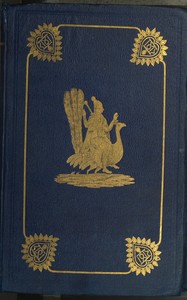
His quadruple hands and arms denote power. In one of his hands is the ānkus, the instrument with which the elephant is guided; in another a battle-axe. Being a child, and therefore fond of sweetmeats, a third hand bears a small cup filled with pera, a sweetmeat common in all bazārs; in the fourth he carries a short rosary, wherewith he counts his beads. Around his neck is twined the Cobra-di-capello, the holy serpent, whose hood is outspread upon his breast. This image is dignified by a frontal eye, signifying the sun, encircled by a crescent, a sol lunar emblem and mystical mark, hence “moon-crowned,” “triple-eyed.” His attendant, a rat, holding a pera, sweetmeat, is placed at his side: on his head is a crown, and around his limbs a yellow dhotī, a cloth of Benares tissue edged with gold. His body is covered with ornaments of rich jewellery, such as are worn by men in the East,—his single tusk is bound with gold,—his hands and feet are dyed with menhdī, hinnā. On each of his four arms are two bāzūbands, or armlets; and chūrīs, or bracelets, of massive gold, adorn his wrists. A golden plate on the back of the hand is fastened round the wrist by chains of gold, and from the upper part similar but finer chains pass over the back of the hand, and unite with rings on all the fingers and the thumb. This ornament is very peculiar; both hands are thus adorned. The chaunrīs above his head, emblems of royalty, are used by the attendant Brahmāns to keep off the flies; they wave them over the head of the idol during pūja.
Gănésh is seated on an altar, such as is used in the mut’hs, Hindū temples, surrounded by divers idols, sacred shells, and instruments of worship; small brass cups filled with oil, called chirāghs, are burned as lamps before the shrine. The worshippers pour oil and the holy water of the Ganges over the head of the god, which is thus bathed daily, and offerings of boiled rice and flowers are made at the time of prayer. The conch shell, which lies before him, is blown by the Brahmāns during the hours of pūja at different times—it is considered very holy—the priest holds it clasped in both hands, and blows into it from the top. The sound can be heard afar off, especially when on the river at the time of evening worship; it resounds from every side of the water, mingled with the ringing of the priest’s bells and the sound of a sort of brass castanet, which they strike whilst chanting forth their prayers.
The opening of these shells is on the left side; but they say a shell is sometimes found with the opening on the right side, and its spiral involutions reversed; it is then called Dūkshina Vŭrtŭ, and is valued at from three to five hundred rupees. Vishnŭ is said to hold a shell of this sort in his hand. Shells are placed with flowers around the idol, the bull-mouthed is considered sacred, and often adorns the shrine.
Small brass bells are used in worship; some are decorated with the image of Hŭnoomān, some with the sacred cow. They are rung during pūja, not only, it is said, to amuse the god, but to keep off evil spirits.
The shape of the spoon with which the rice or oil is put upon the head of the image is remarkably beautiful and antique. The top of the spoon bears the image of Gănésh, crowned by the Nāgā, or holy serpent, with a hundred heads, which are outspread, to screen him from the sun.
This idol is made of solid white marble, and weighs three hundred weight and a quarter. It is painted and gilt, as in the Frontispiece. It was brought down from Jeypūr to the sacred junction of the triple rivers at Prāg, at which place it came into my possession.
Although a pukka Hindū, Gănésh has crossed the Kālā Pānī, or Black Waters, as they call the ocean, and has accompanied me to England.
There he sits before me in all his Hindū state and peculiar style of beauty—my inspiration—my penates.
O Gănésh, thou art a mighty lord! thy single tusk is beautiful, and demands the tribute of praise from the Hājī of the East. Thou art the chief of the human race; the destroyer of unclean spirits; the remover of fevers, whether daily or tertian! The pilgrim sounds thy praise; let her work be accomplished!
SALĀM! SALĀM!