Public-domain ebook
Cities in the air
Language: en363 downloads on Project Gutenberg
Subjects
In: Science-Fiction & Fantasy·Novels·American Literature
Public-domain ebook sourced from Project Gutenberg #74171.
Public-domain ebook
Language: en363 downloads on Project Gutenberg
Subjects
In: Science-Fiction & Fantasy·Novels·American Literature
Public-domain ebook sourced from Project Gutenberg #74171.
The opening · free to read
[Transcriber's Note: This etext was produced from Air Wonder Stories November, December 1929 Extensive research did not uncover any evidence that the U.S. copyright on this publication was renewed.]
Here is one of the most extraordinary stories that it has been our good fortune to read. For sheer audacity in construction, excellence in science and breath-taking adventure, this story undoubtedly stands in the foreground of science air-fiction stories of the year.
The recent advances in aeronautics where airplanes have been in the air for weeks at a time without coming down to the ground, point the way for tremendous achievements in the generations to come.
City life today is a conglomeration of structures close together. We have buildings now that house as many as 40,000 people at one time and soon we will have single business buildings that will house 100,000 and more individuals at the same time. Furthermore, every doctor will tell you that living at the surface of the earth is usually unhealthy because of the dust and the high density of the air, which gives rise to most pulmonary diseases, particularly consumption, colds and the like. At high altitudes such diseases tend to disappear. Therefore physicians usually send their afflicted patients to the higher altitudes.
You may be sure that conditions such as are described by the author of this marvelous story will come about sooner or later.
We also know that this story will arouse a great storm of discussion among our readers, due particularly to the audacity of the author in picturing his ideas as to future aviation--which by the way will not seem so fantastic two hundred years hence as they might seem now.
"Captain Martin Brant, of American Federation Air-Cruiser 3885!"
As the high clear voice rang through the bridge-room of my racing cruiser, I turned toward the distance-phone from which it issued. Pressing a stud beneath the instrument I answered into it.
"Captain Brant speaking."
"Order of the First Air Chief to Captain Brant: You are informed that the European and Asiatic Federations have combined in alliance to launch a great and unexpected attack upon the American Federation. The European Federation fleet of five thousand air-cruisers is now racing over the Atlantic toward New York and other eastern cities, while the Asiatic Federation fleet of the same size is heading over the Pacific toward our western coasts. All American cruisers patrolling east of the Mississippi, including your own, are ordered to head at full speed toward New York, where our eastern squadrons are assembling to meet the European Federation fleet. Upon arriving there yourself and all other squadron commanders will report at once to the First Air Chief."
The clear voice ceased, and I turned from the distance-phone to meet the startled eyes of Macklin, my first officer, who stood at the cruiser's wheel beside me.
"Head eastward--full speed, Macklin!" I cried to him. "It's war at last--war with the European and Asiatic Federations!"
Instantly Macklin swung over the wheel in his hands, and as he did so the whole long bulk of our cruiser swung likewise in mid-air, curving up and backward to race eastward above the green plains, the descending sun at our backs. A moment more and the cruiser's long torpedo shape, gleaming and unbroken metal save for the rows of portholes and the raised, transparent-walled bridge-room in which we stood, was splitting the air eastward at a speed that mounted with each moment. I reached for the order-phone, and as Hilliard, my young second officer, answered from the motor-rooms beneath, I informed him briefly of what had just been told me. Then there was a muffled cheer from the hundred-odd members of our crew, beneath, and a few minutes later the drone of the great motors had reached to an even higher pitch, and we were racing through the sunlight high above the earth at more than a thousand miles an hour.
Standing there with Macklin in the bridge-room as we shot eastward, though, my thoughts were grave enough despite the exciting quality of the news we had just heard. War!--the war that we of the American Federation had expected, had feared for decades. It had not been more than thirty years since the third Air War of 2039. Three mighty nations alone now shared the world between them; the American Federation, comprising the whole North and South American continents, with New York as its capital; the European Federation, which included all Europe west of Caucasus and all Africa, its center at Berlin; and the Asiatic Federation, which held all Asia and Australasia for the brown and yellow races, with Peking as its capital.
And though for three decades now there had been peace between them, it had been an uneasy peace dictated by the fact that each feared to attack another lest he be attacked by the third. The great navies of air-cruisers of the three mighty Federations had patrolled the air in ceaseless vigilance, their air-forts ever watchful. Lately, however, it had become apparent to all that a rapprochement had taken place between the European and Asiatic Federations, and such an alliance could only mean an attack upon our own, the American. So we had stood even more vigilantly upon the watch, and now that for which we had waited had come at last, and the two great Federations had launched their two mighty fleets upon us.
Gazing ahead, as our cruiser drove onward, I was as silent as Macklin, at the wheel beside me, and as young Hilliard, who had come up into the bridge-room from beneath. Far beneath us the green plains were rolling swiftly backward, as our motors hummed their unceasing song of power. Those great electric motors drew their current in limitless quantities from the electrostatic or atmospheric electricity surrounding the earth, by means of great transformers that changed it from electrostatic to current electricity to give us a power that could hurl us forward with almost unlimited endurance and speed. Connected as they were to our great horizontal tube-propellers, which were set in the cruiser's walls and which moved it forward by drawing immense volumes of air at vast speed through themselves from ahead, those motors could fling us on at more than a thousand miles an hour. This utmost force, as our indicators told us, was shooting us eastward now.
Beneath us the green plains had given way to the great tumbled folds and peaks of the Alleghanies. Somewhere to the south lay Pittsburgh, and to the north Cleveland and Buffalo, but being headed directly to New York, we therefore did not see them. Beneath us we could make out in swift flashes of vision masses of the air-traffic between those cities, great passenger-liners and bulky freight-carriers and slender private craft, but in our own military-craft level there moved only a few cruisers like our own racing eastward toward New York in answer to the alarm. With these, however, there was small danger of collision.
Now the Alleghanies had dropped behind and we were rocketing over the rolling, pleasant countryside that lies between them and the eastern Appalachians. As we shot on I gazed downward, over the green and silent and empty landscape rushing beneath us, and wondered momentarily what a citizen of fifty years ago would have thought to see this once-populous land over which we were speeding lying as lifeless and deserted beneath us as it was now. Then it had given way to the greater folds and ridges of the Appalachians, and then, as we shot on and over their tumbled masses, Macklin lifted his hand from the wheel to point ahead.
"The air-forts!" he said.
Swiftly they were looming before us as we rushed on toward them, giant domed cubes of dull metal, each five hundred feet in width, that hung in a great, curving line in mid-air before us, five miles above the green land. At intervals of five miles they hung, floating motionless there in a great grim chain or ring, the metal sides and dome of each bristling with great heat-guns like those of our own cruisers, and with narrow openings from which the occupants could gaze forth. Each of these great air-forts, we knew, was suspended thus high above the ground by the gravity-repelling effect of the cosmic rays. It had been but fifty years since the machinery had been discovered which directed the great power of the cosmic rays to overcome the force of gravity. It had been found that the rays could be collected and their power concentrated in the structures that they were to support. Dynamic towers were used for the collection of this great limitless energy.
In a great ring they hung before us, the line of them curving away vastly to right and left, a great ring that encircled and defended New York, as air-forts hang in rings about all air-cities for defence. Then as we drove toward the nearest of these great fortresses of the air, there came from the distance-phone before me its sharp challenge.
Swiftly I replied to that challenge and then we were driving past the air-fort, past the openings in its walls through which we could see those inside standing ready at the great heat-guns. We heard faintly their cheers as we flashed past them toward the east; we cheered ourselves somewhat by the sight of the air-forts. They could maneuver in space in any direction, though at only a fraction of the speed of the air-cruisers. They would form a stubborn defence for New York, we knew, though incapable of meeting alone a swift invading fleet. But now far ahead, as we rushed within the mighty ring of the air-forts, we glimpsed the gray gleam of the Atlantic's vast expanse, stretching away to the east, the green, irregular coastline, the narrow little island, between a larger island and that coast, that had been the site of the New York of fifty years before. Green and deserted as all the countryside behind us it lay now, but I glanced at it only, looking up as there came a low exclamation from Hilliard, beside me.
"New York!"
Full before us lay the mighty city, now, waxing with each moment greater as we raced on toward it. The air about and beneath us was filled with the great swarms of cruisers like our own and of merchant-traffic that was converging from north and west and south upon it. For the moment we three gazed toward it, forgetful of the peril that had brought us to it. We were caught and entranced as always by the splendid and superb beauty of this New York. For it was a New York immeasurably different from that city upon the earth, that decades ago had born its name. It was a city, not of the earth, but of the air.
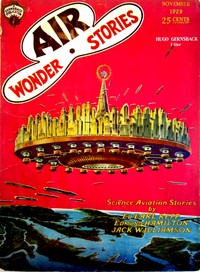
It was a city whose close-clustered spires and towers and pyramids had been gathered together upon a vast metal disk-like base, and hung suspended five miles above the green earth! It was circular in form and of five miles diameter, the colossal metal base or disk upon which it rested more than a thousand feet in thickness, the metal buildings and towers that rose from that base and were integral with it soaring for five thousand feet farther upward! A colossal city floating there in the air, with its streets and buildings swarming with activity, with thronging hordes, and with great masses of fear-driven craft speeding through the air toward it from all directions.
The book keeps going
Reading is free forever. Sign up and watch scenes appear while you read.



Scenes Storieta drew for other classics.
New illustrated classics
Once or twice a month: the latest books to get full character casts, scene art, and free comic editions. No account needed.