Public-domain ebook
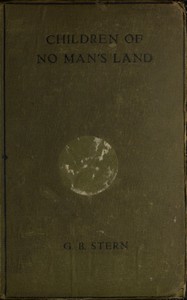
Children of No Man's Land
by G. B. Stern
Language: en1,365 downloads on Project Gutenberg
Subjects
Public-domain ebook sourced from Project Gutenberg #74256.
Public-domain ebook
by G. B. Stern
Language: en1,365 downloads on Project Gutenberg
Subjects
Public-domain ebook sourced from Project Gutenberg #74256.
Children of No Man’s Land is a wartime novel set in the final months of World War I, focusing on the tangled lives of English and German youths caught in a Swiss border town. The opening scene places the teenage English boy Richard Marcus amid a family debate about liberty and duty, while his German peer Lothar von Relling argues over Shakespeare versus Goethe. Their conversations quickly turn to personal entanglements, engagements, secret affections, and the pressures of impending military service, against a backdrop of strained family relations and a town humming with industrial labor and nationalist song. The narrative begins with a blend of philosophical musings on love of country and a vivid, dialogue‑driven portrait of youthful restlessness, hinting at the larger cultural clash that will shape the characters’ fates.
The prose reflects the early‑ twentieth‑century British style, marked by formal diction, extended sentences, and a theatrical tone that mirrors the era’s literary conventions. Its focus on cross‑national friendships, the anxieties of adolescence, and the looming specter of war will appeal to readers who enjoy historical fiction that explores identity and loyalty through richly detailed dialogue and a setting steeped in the social tensions of 1914‑1918 England and Germany.
The opening · free to read
“But everyone knows for a positive fact that Shakespeare is the greatest writer of all. Why, who has ever heard of your Goethe, outside Germany?”
“And who has ever read your Shakespeare, inside England?” Lothar retorted, with the horrid glee of a person who has made a remark with an unpleasant amount of truth in it. His spectacles gleamed, two round, triumphant dazzles in the sunset which streamed through the closed windows of his study.
Richard repeated stubbornly, but without conviction: “Everyone knows Shakespeare is the greatest writer.” His defence of Shakespeare was strictly impersonal; he had no vehement sentiments on the subject; the whole argument bored him. But on principle, when a German boy asserts that Goethe is greater than Shakespeare, the English boy can have no option but to make reply that Shakespeare is greater than Goethe.
“It shall be decided one day,” Lothar grimaced ominously.
And Richard had an inspiration. “Shakespeare has been translated into German, because you jolly well couldn’t get on without him. I’ve never seen Goethe properly put into English. That about proves I’m right.”
“There was no Englander great enough to translate a man so great. I do not say,” Lothar explained conscientiously, “that I have not of the works of your Shakespeare also with much benefit an exhaustive study made. Let us converse on them. Do you then prefer Macbess or Otello?”
“Macbeth,” Richard muttered at a venture, and walked restlessly to the window; fidgeted with the beaded blind-cord, to signify that he expected better entertainment from his host than this irritating controversy. He wished his sister had not been so quick to accept Mrs Koch’s invitation to visit her at Dorzheim. To be dragged away in the middle of the extra July of summer holiday which an epidemic of scarlet fever at school had procured him; dragged away from a jolly hotel in Switzerland, to this stupid, little, dead-and-alive German town; finally, to be expected to chum up with Lothar von Relling, merely because they were “of the same age”—it was a bit thick!
Deb could quite well have come alone, if this was her idea of enjoyment.
He wondered why Lothar was crossing and uncrossing his legs in their bright striped stockings, and breathing heavily as though about to unburden himself of a confidence.
“Have you a heart’s dearest, you?”
Richard Marcus was fifteen. A normal boy, muscular, pugnacious, taciturn. The question drew from him a shout of laughter.
“What should I do with one, if I had it?”
“You English boys are babies all,” Lothar said, unexpectedly scornful. “You play always your stupid games, rather than write verses to the loved one. Ach, but she ...” he whirled his hearer along an incoherent tide of description: “a wonder, a dream, a night of scented dusk,” that mysterious goddess who seemed but recently to have emerged from the nebulous glamour which encircles all womanhood for the Teuton yet in his teens.
“Are you engaged to her?” yawned Richard, who by the merest fraction preferred these confidences to the Goethe-Shakespeare debate.
“Betrothed? But not possible. I am already betrothed to Frieda-Marie. Our peoples betrothed us a great many years ago. It is wearisome, but——” Lothar shrugged his plump shoulders—“it is suitable. We are of one faith. Her father, the Herr Sanitäts-Rath Hauffe, will withdraw his sanction if he outfinds anything of my faithlessness.”
Richard swung round and surveyed with disfavour Lothar’s vague features under their bush of upstanding tow. “Do you mean there’s really anything for him to find out about you and the other girl, or are you swanking?”
“Only that I schwärm—I swarm with love for her. I watch in the streets, and once I drop at her feet a fair rose costing fifty pfennig. She knows nothing of my passion. But what goes me that on? It is more beautiful, more ideal, so.” Suddenly he slid from lofty altitudes. “One has also one’s emotions away from these. One is flesh. One is not altogether air....” He spattered a few inky hints regarding the demands of his adolescence. From a pink, chubby face his spectacles glittered knowingly, inviting his companion to betrayal of like perplexities. But Richard preserved that admirable stolidity for which his looks were so well adapted: powerful jaw, big nose, dark head well thrust forward from the short neck and broad shoulders; and, rather obscured by all these pugnacities, a pair of pleasant, humorous light-grey eyes, from which now, however, he had chased all expression save of blank idiocy. Not likely he would give himself away to Master Lothar! Richard wondered if there were a German boy good form enough to know that Lothar was bad form, and to ostracize him as such. Unlikely; the fellow would hardly be as cocksure if he had once been put in his place. All this blither about Goethe and girls.... “Do you mean to marry this person?” interrupting the other’s critical appraisement of a lady professionally well-known in Dorzheim, appraisement to which Lothar had essayed to impart the personal note.
“I have explained,” patiently, “I am plighted to Frieda-Marie. She is a good Christian maiden. She learns cooking. She has a respectable gift-along. Why do you smile?”
“Your English is so funny.”
“I have not yet had the pleasure of hearing your German,” politely sarcastic. For Richard had felt in honour bound not to reveal to Dorzheim that his knowledge of their tongue, though faulty, was fluent enough, as was natural in a grandson of Hermann Marcus of Munich.
“I will take me a wife when I am twenty-seven. First must I be through with my examinations. Then do I perform my military service. You also? No?”
“Oh, we don’t have to fag with that sort of thing in England.”
“It is for the Fatherland. Also one is attractive in uniform. One dashes. One lives. Me, I must betray a several of maidens before I can afford one to keep.”
Richard scowled discouragement. “You’re not sixteen yet, are you?”
“At sixteen one is no longer a child. One cannot go mad....” To Richard’s horror, Lothar suddenly buried has head in his arms, shuddering violently.... “That I were dead! that I were dead!” he moaned.
The English boy stared at him. These outbursts of confidence, alternately sentimental and morbid, seemed to emphasize his growing sense of having been brought into a world completely alien. He sent a swift thought to his chum, Greville Dunne, now on board a training-ship; wished old Greville were here. Foreign kids were unbalanced, hysterical; they read too much; brooded too much; talked too much.... Lothar had no right to unburden himself to a stranger, of different nationality and hostile outlook. Richard began to be afraid he had given an impression of too ready sympathy.
Lothar raised his head and announced solemnly: “Swine-hound that I am, believe that I preserve a reverence supreme for my Loved One!” His eyes were swamped in facile tears. “I have no father,” he added, after an uncomfortable pause; “and you, you have no mother, I hear.”
“Oh, that’s all right, thanks,” Richard’s shoulders were expressive of sullen embarrassment. “Got a stamp collection?”
“I will show you my botany-box.” And Lothar littered the blue and red check table-cloth with his specimens of pressed leaves and flowers, neatly labelled. Presently he reverted to the subject of Frieda-Marie. It appeared as though he were trying unsuccessfully to tell Richard something....
“Pity that she should be so blonde. The Ideal One is a brunette. She is a witch; a black velvet pansy. Hark, I will describe her to you.”
A full five minutes elapsed, however, before Richard awoke to the fact that the concrete sum of Lothar’s lyrical ecstasies made up a personality closely resembling that of his sister.
“Good Lord! Deb!”
“But at last! Since an hour have I tried to reach your understanding.”
“Couldn’t you say straight out that you meant Deb, instead of making an inventory of her?”
This was too great a strain on Lothar’s English. “She was mine from the first moment I saw her feet on the pavement my window outside press,” he breathed.
“Look here—do you want to marry Deb?”
“You come me always with that!” peevishly. “I tell you I am betrothed to Frieda-Marie. I cannot marry your sister. She is only a Jewess.”
“I like your cheek! Then what’s the good of you?”
“I can worship her.”
“Umph!”
The book keeps going
Reading is free forever. Sign up and watch scenes appear while you read.



Scenes Storieta drew for other classics.
New illustrated classics
Once or twice a month: the latest books to get full character casts, scene art, and free comic editions. No account needed.