Public-domain ebook
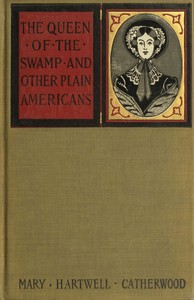
The Queen of the Swamp, and other plain Americans
Language: en380 downloads on Project Gutenberg
Subjects
In: Short Stories·American Literature
Public-domain ebook sourced from Project Gutenberg #74271.
Public-domain ebook
Language: en380 downloads on Project Gutenberg
Subjects
In: Short Stories·American Literature
Public-domain ebook sourced from Project Gutenberg #74271.
The opening · free to read
On Christmas Day a large congregation poured from George’s Chapel into the early dusk. Quarterly meeting, which for a week had drawn together, not only the neighborhood, but people from Millersport, Basil, and even Kirkersville, closed that afternoon. The presiding elder and his assistants were wrapping up their throats and joking with each other, for the occasion had been blessed with converts and a fairly liberal collection.
These men must ride on around the circuit, risking health, and accepting whatever fell to their lot, yet nothing checked their flow of spirits. The only solemn person near the group was Mr. Warner, a local preacher and exhorter, who habitually prayed with a war-whoop, and kept the young people tittering at his pompous phrases. His father, an aged apparition, tottering on a stick, was circulating genially to shake every hand, known or unknown, and inquire, toothlessly, “Hi-ya! hi-ya! how’s your consarn?” which being interpreted meant, “How are you, how are you, how’s your concern?” (in religion).
Women clustered together near the red-hot stove, exclaiming to each other, as their work-worn palms met, “Hoddy-do, Mis’ Waddell, does your family keep well?” and “Law! Mis’ Davis, it’s good for sore eyes to see you out to meetin’ once more!” “Yes, I been kept close all fall, but I told him it wouldn’t do, we must come to big meetin’.” “It’s been a good time. One o’ my boys,” the speaker pressing her neighbor’s hand, “was gathered in, and I have my suspicions the other’s touched.” “Yes, there’s more under conviction than’ll own to it.”
They made excuses to each other for neglecting neighborly duties in the past, but promised, now such good sleighin’ had set in, to go more. One had had whooping-cough in her family, another a teething baby, and not a few had been very busy getting the butchering done and making sausage. The men-folks were also constantly hauling with the teams.
Warm Christian feeling pervaded the whole separating assembly, even the young girls greeting each other with unusual affection. The young men drove their conveyances up to the door, exchanging merry remarks; there were many fine horses, and some of the sleighs were painted, but the general vehicle was a wagon-bed, stuffed with straw and comforters, and running on two short sleds called “bobs.”
Theophilus Gill’s sleigh was of this pattern, and he intended to drive the young folks to Macauley’s. His spirited team pranced so that he stood up to control it, though at full height Theophilus Gill was but a little fellow. He had, however, a strong black beard.
“How many goin’ in our load, Theoph?” inquired Philip Welchammer, resting one foot on the forward runner.
“’Bout ten couple. Mart, he’s got to take his mother home, so he won’t be along.”
“You feel like as if you could spare him?”
“I always ken. Now, don’t you go to cut me out if I try to engage her company for Sunday night.”
“Oh, you and Mart fer it,” said Philip. “I ain’t fer cuttin’ neither of ye out. But Persilla Thompson’s a pretty girl.”
“She’s the Queen of the Swamp,” said little Gill, with emphasis.
Priscilla at this moment stepped down from the chapel threshold into the snow, to wait for her party. Philip brought her to the sled and Gill insisted on placing her in a warm and sheltered place just behind the driver’s bench, which he had specially prepared for her.
“Macauley’s is makin’ a big house-warmin’ this Chris’mas,” remarked Priscilla’s little suitor to her. “They’s four tables full of old folks to their turkey-roast, and the young folks all invited in the evenin’. I reckon the old lady’s doin’ it for Mart. She’s bound for him to marry that Miller girl, some says.”
Priscilla replied, with pleasant nonchalance, she reckoned so. She did not look at Mart Macauley at all, but she saw him watching her while he untied his bay filly, and held its head until his mother finished talking with her dinner guests.
He had loved Priscilla Thompson when she was a little girl with black plaits of hair hanging down her linsey back. In those days he gave her a bead purse, and whipped all her tormentors. When she began to be a big girl he shyly courted her, stopping his plough by the fence if he saw her coming, and dropping in of a Sunday night to see her brother, whom he despised, and who had since married and left him without excuse for his visits. When she got a certificate and went into the Kemmerer neighborhood to teach school, with her clothes neatly packed in a large wicker basket, he had no peace of mind all summer. He had himself been to Worthington to college, but in all his experience saw no one to compare with her. Wherever he saw her, so modest and lovely in manner, he cherished the ground her shoes rested on. The cold air gave her a bright color, which the depth and length of her bonnet could not conceal. She wore a wadded alpaca cloak and cloak cape, and Martin’s memory showed him how trimly under these her delaine dress was coat-sleeved to her arm and pointed at her waist.
Mrs. Macauley, climbing into her own sleigh, could take no exceptions to Priscilla Thompson’s manner or appearance, though she would have done so gladly for the benefit of her favorite son. Mrs. Macauley disliked the Thompsons. Her husband before his death objected to them. She thought little Theophilus Gill the best match in the neighborhood for Priscilla Thompson. Her own large light-haired son was too dutiful to marry without her consent. She was educating him to be a doctor; the younger boys could work the farm under her direction. She expected Martin to do his family credit by looking higher than the Thompsons.
Priscilla, on her part, held Mrs. Macauley in secret aversion. She felt sorry for Martin’s younger brothers and sisters, who were all obliged to stand in a row and take pills or tincture before breakfast. Mrs. Macauley was too high-handed and all-prevailing. Priscilla’s disposition was cheerful, but that Ohio region known as the Swamp could not escape the tinge of the period, and at that date the extremely feminine woman with a bias toward melancholy was the standard. Mrs. Macauley was so mannish that Priscilla thought her fully entitled to the tufts of beard in her moles.
The young people crowded merrily into Theophilus Gill’s sled. They all knew how matters stood between the Macauleys and Thompsons. The Thompsons, excepting Priscilla, who was a reticent girl, talked about the Macauleys, and the Macauleys held their heads rather high, excepting Mart; but he thought the world of his mother. The girls suspected Priscilla was going to-night because her staying away would make talk. Some of them believed Theophilus Gill would get her, and others thought things might take a turn so that she would marry Mart Macauley after all.
There was a day when she would have given half her life to go to Macauley’s, but stayed away. That was when Martin broke his collar-bone racing his bay filly. Nobody knew that she hid in her father’s field corn-crib all that day. Yet it was not an occasion for extravagant fears. Mrs. Macauley was the best nurse in Fairfield County, and soon had her son mended to perfection.
A few flakes of snow fell on Gill’s load, and made it all the merrier. No joke could fail to strike fire at once on the steel-clear air, and many a time-honored one was repeated by the young men as their fathers before them had repeated it, and enjoyed by the girls as their mothers had enjoyed it.
Philip Welchammer was pitied for having his arm out of place, and Nora Waddell, discovering it at that instant around her, told him tartly there is folks that their room’s better than their comp’ny. Upon this he genially retorted that she never made no such fuss when they were out sleigh-ridin’ alone; and Nora glowed in her red merino hood while the laugh turned upon her.
Then a girl’s voice, to cover her confusion, started a thrilling old revival hymn, and the load poured its bass and treble through the lines. Darkness approached as near as the white world would allow. The triumphant strain echoed among treetops and stirred emotion in Priscilla.
“There, there on eagles’ wings I soar, And sense and sin are felt no more. There heaven comes down our souls to greet, And glory crowns the Mercy Seat-- And glo-ry crowns the Mer-cy Seat.”
The road was bounded by that distinctively American fence, the rail, or stake-and-ridered, showing drifts of snow in its angles, and white lines like illuminations along the top of every lichened rail. The sled flew over corduroy spaces now deeply bedded. On each side the trees rose out of frozen pools, from which they seemed to conduct a glazed coating upward, for every twig glinted icily through the dusk. In spring-time, when the Feeder and creek rose out of banks, acres of this swamp lay under water, with moss scum and rotting leaves at the top and bottom.
Priscilla found always in these woods a solemn beauty. Her wildest dream was of living deep in their summer shade with an unnamed person, and sitting on the doorstep at nightfall, her hand locked in his. The amber lights, the cry of tree-frog and locust, the mysterious snap of twigs, the reverberating bark of a dog, the ceaseless motion of water under a foot-log, all gave her delight. One spring she worked in her father’s sugar-camp. A bark shelter that they passed reminded her of it, of collecting the sugar-water, watching the bubbling kettles, and dropping the wax on snow, of stirring-off, which was such a festival, and at the same time such a miracle, for you could feel the hardening wax grain to sugar on your tongue.
Theophilus Gill turned his horses from the road, and drove through a gap into the woods.
“What are you doin’ that for?” exclaimed John Davis, who loved a horse, like every good Ohio man, but was always ready to sacrifice it to his comfort or speed.
Theophilus explained there was a bad bit of road ahead, and the circuit through the woods might be better.
If he dreaded cutting his team’s ankles, the danger was not lessened by this choice of routes. For after some easy progress and much winding among saplings and jarring against stumps, they descended to a seldom-used bridge across the Feeder, standing like an island in a frozen lake. Theophilus Gill drew up his horses. There was not room in which to turn back, and the occupants of the sled rose with some apprehension.
Nora Waddell said she would never go over that bridge. Theophilus observed doubtfully he’d risk gettin’ the team across, but mebby some of the boys had better walk over and lighten the load.
Everybody alighted except the driver, who cautiously, and reassuring his snorting horses, moved across the ice and up the bridge. It shook under their tread to such a degree that nearly all the party resolved to trust the ice in preference, and pushed their tracks carefully upon the snow-covered Feeder. Besides Nora Waddell, Philip Welchammer took under his charge Mary Thompson, Priscilla’s flighty young sister, who was barely fifteen and in short dresses, but so headstrong that she would go into company whenever Priscilla did. Starts and exclamations were finally blended into a general outcry, for the ice gave way, and several figures disappeared to their very necks. Then the young men who had landed were prompt in action, while some of the girls showed courage and pioneer swiftness of resource. Philip and his two companions were pulled out, and huddled, dripping, into the sled, all available covering being piled upon them. Everybody scrambled in, and Theophilus, restraining his horses, asked, in an excited shout, if they were all in. Mary Thompson, through her chattering teeth, retorted, “Of course all of us were in, and if he did not mean to kill us entirely, he’d better whip up and get to some fireplace.”
The book keeps going
Reading is free forever. Sign up and watch scenes appear while you read.



Scenes Storieta drew for other classics.
New illustrated classics
Once or twice a month: the latest books to get full character casts, scene art, and free comic editions. No account needed.