Public-domain ebook
Strangers to Straba
by Carl Jacobi
Language: en350 downloads on Project Gutenberg
Subjects
In: Science-Fiction & Fantasy·Adventure·Novels
Public-domain ebook sourced from Project Gutenberg #74295.
Public-domain ebook
by Carl Jacobi
Language: en350 downloads on Project Gutenberg
Subjects
In: Science-Fiction & Fantasy·Adventure·Novels
Public-domain ebook sourced from Project Gutenberg #74295.
The opening · free to read
Can a ship hate--and have a strange hideous life of its own?
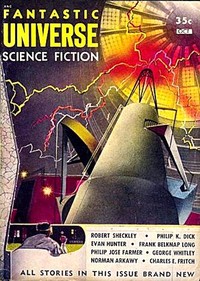
[Transcriber's Note: This etext was produced from Fantastic Universe October 1954. Extensive research did not uncover any evidence that the U.S. copyright on this publication was renewed.]
Like Robert Bloch, Margaret St. Clair, Frank Belknap Long and the late great Howard P. Lovecraft, Carl Jacobi won his first bright laurels as a story teller in the "ghoul-haunted woodland of Weir." He was one of that early group of supernatural horror story writers who have since turned to science fiction, and achieved in the newer medium a fame quite as illustrious and quite as enduring. We know you'll like this somberly exciting yarn.
They sat in Cap Barlow's house on the lonely planet, Straba. It was early evening and Straba's twin moons were slowly rising from behind the magenta hills. Outside the window lay Cap's golf course, a study in toadstool cubism, while opposite the flag of the eighteenth hole squatted the kid's ship.
The kid had landed there an hour ago. He had introduced himself as Clarence Raine, field man for Tri-Planet Pharmaceutical, and had announced urbanely he had come to make a botanical survey. All of which mildly amused Cap Barlow.
The kid was amused too. From the Pilot Book he had learned that Cap was the sole inhabitant of Straba, and he regarded him--and rightly so--as just another hermit nut who preferred the spacial frontiers to the regular walks of civilization.
The old man packed and lit a meerschaum pipe.
"Yes sir," he said, "efficiency ... regulation ... order ... that's what's spoiling all life these days. Those addle-headed scientists aren't satisfied unless they can dovetail everything."
Raine smiled and in the pause that followed cast his eyes about the room. It was circular and no attempt had been made to conceal its origin: the bridge-house of some discarded space-going tug. Along the continuous wall ran a triple tier of bookshelves, but it seemed that most of the books lay scattered on the table, chairs, and floor.
Above the shelves the wall was decorated with several three-dimensional water colors, pin-up girls in various stages of undress and mounted trophies of the rather hideous game Straba provided.
"About this survey," the kid began.
"Only last month," Cap Barlow continued, unmindful of the interruption, "a salesman stopped off here and wanted to sell me a gadget for my golf course. Said it would increase the gravitation over the fairways and prevent the ball from traveling any farther than it does on Earth."
He spat disgustedly. "You'd think any fool would realize it's an ideal course that can offer a Par three on a thousand yard hole."
But Raine hadn't come this far to listen to the dissertations of an old man. He was tired from long hours of sitting at the console of his ship. He stood up wearily.
"If you'll show me where I can stow my gear," he said, "I think I'll turn in and get some sleep. I've got a lot to do tomorrow."
For a week the kid didn't bother Cap at all. Each morning he went out with a reference book, a haversack and a canteen, and he didn't show up again until dark. Cap didn't mention that Straba had been officially surveyed ten years before or that results of this survey had been practically negative as far as adding to the Interplanetary Pharmacopoeia went. If Tri-Planet wanted to train its green personnel by sending them on a wild goose chase, that was all right with Cap.
But the old man had one thing that interested young Raine: his telescope mounted in a domed observatory on the top floor. Every night, Raine spent hours staring through that scope, sighting stars, marking them on the charts. Cap tried to tell him that those charts were as perfect as human intellect could make them. Raine had an answer for that too.
"Those charts are three years old," he said. "In three years a whole universe could be created or destroyed. Take a look at this star on Graph 5. I've been watching it, and the way it's acting convinces me there's another star, probably a Wanderer, approaching it from here." He indicated a spot on the chart.
He was efficient and persistent. He watched his star, checked and rechecked his calculation, and in the end, to Cap's amazement sighted the Wanderer almost exactly where he said it would be.
That discovery only excited him more and after that he spent an even greater amount of time in the observatory. Then late one night he came to the top of the stairs and called for Cap.
Cap went up to the scope, and at first he didn't see anything. Then he did see it: a darker shadow against the interrupted starlight.
"It's a ship," the old man said.
Raine nodded. "My guess too. But what's it doing out of regular space lanes?"
"You forget you landed here yourself. Straba does occasionally attract a visitor. Her crew may need water or food."
Raine shook his head. "I hedge-hopped in from asteroid, Torela. This fellow seems to be coming from deep space."
They continued to watch that approaching shadow, taking turns at looking through the scope. It seemed to take a long time coming; but finally there was a roar and a rush of air and a black shape hurtled out of the eastern sky. The two men ran outside where Cap began to curse volubly. The ship's anti-gravs were only partially on. It had hit hard, digging up three hundred yards of the sixteenth fairway and completely ruined two greens.
Then the dust cleared and the two men stared. The ship was a derelict, a piece of space flotsam. There was no question about that. It was also a Cyblla-style coach, one of the first Earth-made passenger freighters to utilize a power-pile drive, designed when streamlining was thought to mean following the shape of a cigar. On her bow was a name but meteorite shrapnel had partially obliterated the letters.
"Jingoes," said Raine, "I never saw a ship like this before. She must be old--really old!"
The hatches were badly fused and oxidized, and it was evident that without a blaster it would be impossible to get in. Cap shrugged.
"Let her stay there," he said. "I can make a dog-leg out of the fifteenth, and keep the course fairly playable. And if I get tired of seeing that big hulk out of my dining room window I can always plant some python vines around the nearside of her."
Raine shook his head quickly. "There's no telling what we may find inside. We've got to find an opening."
He went over the ship like a squirrel looking for a nut. Back under her stern quarter, just abaft her implosion plates, he found a small refuse scuttle which seemed movable. He took drills and went to work on it.
Three hours later the two men were inside. There was nothing unusual about the crew quarters or the adjoining storage space. But when they reached the control cabin they stood and gaped.
It was like entering a museum. The bulkheads were covered with queer glass dials, and several panels of manual operating switches. The power-pile conduits were shielded with lead--lead mind you--and the lighting was apparently done with some kind of fluorescent tubes bracketed to the ceiling. It brought Cap back to the time he was a kid and his grandfather told him stories and legends of the past.
Just above the pilot's old-fashioned cosmoscope was a fancy metal plate with the ship's name stamped on it. Perseus!
"Do you know what ship this is?" demanded Cap, excitedly.
"I can read," said Raine.
"But do you know its history ... the story behind it?"
Raine shook his head without interest.
Cap Barlow was still staring at the nameplate. "_Perseus!_" he repeated slowly. "It goes back to the First Triad Empire when the planets of Earth, Venus and Mars were grouped into an Oligarchy, when Venus was still a frontier. Life there was pretty much a gamble in those days, and the Oligarchs enforced strict laws of eugenics. They set up Marriage Boards and all young men and women had to undergo physical and mental examinations. Couples were paired off only after scientific scrutiny. In other words it was a cold-blooded system which had no regard for what we call love."
The book keeps going
Reading is free forever. Sign up and watch scenes appear while you read.



Scenes Storieta drew for other classics.
New illustrated classics
Once or twice a month: the latest books to get full character casts, scene art, and free comic editions. No account needed.