Storieta
Sign up

About this book

The Baz‑nama‑yi Nasiri is a Persian treatise on falconry written by Prince Taymūr Mīrzā, grandson of Fatḥ ʿAlī Shāh. The work opens not with a description of birds of prey but with a vivid, almost theatrical account of the chaotic succession struggles that followed the shah’s death in 1834. The narrative details the rival claims of princes, the meddling of foreign officers such as the Englishman Lynch, and the rapid disintegration of armies, all set against a backdrop of winter marches, snow‑blocked passes, and desperate retreats. This historical prelude, drawn from the author’s own family’s turbulent experiences, leads directly into the author’s declaration that the treatise was composed in 1868 and later lithographed in Tehran, with later editions appearing in Bombay.

The voice is unmistakably that of a courtly aristocrat steeped in Persian literary tradition, blending formal prose with occasional poetic invocations and extensive genealogical references. Its style reflects mid‑nineteenth‑century Persian historiography, marked by elaborate sentence structures, honorific titles, and a reverent tone toward royalty and divine providence. Readers interested in the cultural history of Iran, the interplay of politics and sport, or the literary conventions of Qajar‑era manuscripts will find this work rewarding, while those seeking a straightforward manual on falconry may prefer a more technical guide.
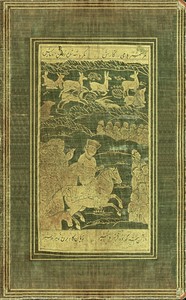
Opening lines

On the death of Fatḥ ʿAlī Shāh, in A.H. 1250 (A.D. 1834), general confusion prevailed: the claimants to the Crown were many. The details of these claims and the actions of the various aspirants to establish them are exceedingly complicated and difficult to follow. The old Z̤ill^u ’s-Sult̤ān first mounted the throne at Teheran. His nephew the young Muḥammad Mīrzā was then Governor of Tabrīz, and his troops had not been paid for some time. However, receiving pecuniary support from the English ambassador, and moral support from the Russian, he marched on Teheran (putting out the eyes of a brother or two en route), and was met by the army (hastily paid up to date, and even in advance), of the Z̤ill^u ’s-Sult̤ān.

Keep reading free · chapter 1 needs no account

More like this

The field and garden vegetables of America: Containing Full Descriptions of Nearly Eleven Hundred Species and Varieties; With Directions for Propagation, Culture, and Use.

The field and garden vegetables of America: Containing Full Descriptions of Nearly Eleven Hundred Species and Varieties; With Directions for Propagation, Culture, and Use.

Fearing Burr

The work is a comprehensive reference on American field and garden vegetables, cataloguing nearly eleven…

Studies of American Fungi. Mushrooms, Edible, Poisonous, etc.

Studies of American Fungi. Mushrooms, Edible, Poisonous, etc.

George Francis Atkinson

The work is a scientific survey of North American fungi, concentrating on the practical distinction between…

Cover of Manual of Military Training Second, Revised Edition

Manual of Military Training Second, Revised Edition

James A. Moss

The Manual of Military Training, Second Revised Edition, is a technical handbook produced by the United…

The Horsewoman: A Practical Guide to Side-Saddle Riding, 2nd. Ed.

The Horsewoman: A Practical Guide to Side-Saddle Riding, 2nd. Ed.

Alice M. Hayes

The Horsewoman is a practical manual on side‑saddle riding written by Alice M.

Cover of Practical Mechanics for Boys

Practical Mechanics for Boys

James Slough Zerbe

Practical Mechanics for Boys is a hands‑on manual that sets out, in plain language, the fundamentals of…

The Elements of Bacteriological Technique A Laboratory Guide for Medical, Dental, and Technical Students. Second Edition Rewritten and Enlarged.

The Elements of Bacteriological Technique A Laboratory Guide for Medical, Dental, and Technical Students. Second Edition Rewritten and Enlarged.

J. W. H. Eyre

The Elements of Bacteriological Technique, second edition, is a practical laboratory manual aimed at medical,…