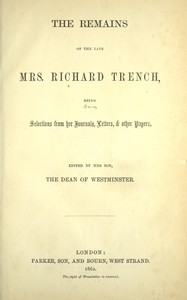
In making public this selection from my Mother’s literary ‘Remains,’ I am as far as possible from wishing to present these as materials of a life, or as contributions to one. It is only the fact, that the more valuable among them consist of letters and fragments of journals, such as naturally are best read in a chronological order, and indeed could hardly be presented in any other, that gives my book the remote appearance of such. Even this I would willingly have avoided, if it had been possible; for the adage, whether true or not in its first application, is certainly true concerning the English matron—_Bene vixit, quæ bene latuit_; so that it is only reluctantly, and by the necessities of the work in which I am engaged, that I at all disturb this sacred obscurity; as assuredly I have no desire to bring into public gaze any of those many incidents which, deeply interesting to the members of a family, can have no interest to any beyond. But without some few biographical notices connecting these letters and other papers, I must either have withdrawn many of them as unintelligible, or left them to be very imperfectly understood. I soon then felt, that only by doing a certain violence to a just feeling of reserve, could I avoid, in one of these ways or the other, serious injury to whatever interest the book might possess; even as in other respects also this feeling of reserve must up to a certain point be overcome. This, however, is the law and limit of the narration, that whatever is not absolutely necessary to elucidate, illustrate, or explain the published ‘Remains,’ is passed by.
Unfortunately, the materials which came two years ago into my hands, are very incomplete as compared with what they might have been; and it is now impossible for me to know by what accident they have mainly suffered. Of my Mother’s journals, especially of those kept during the earlier part of her life, very far the greater portion has perished, or, at any rate, gone hopelessly astray. The volumes, or, fascicles, consisting for the most part of loose sheets of paper, not very carefully sewn together, with or without covers, may seem in some measure to have provoked their fate. Yet this would rather explain occasional deficiencies than account for so sweeping a disappearance, leaving only here and there a fragment surviving. At the same time, the largest of these fragments contains her visit to Germany in 1799-1801, no doubt the portion having most novelty and interest; although even this is imperfect, and comes to an abrupt termination, leaving no record of the later months of her tour. Her journals of later years have all, I believe, reached my hands; but at this time they much less deserve this name than they did at an earlier date, containing only occasional entries, with no attempt at continuity.
As it is with the journals, so it is also with the letters. During the years, now nearly thirty-five, which have elapsed since my Mother’s death, all, or nearly all her cotemporaries, all her correspondents, whose deaths had not already preceded her own, have passed away, and the papers of most of them have been either scattered or destroyed. It has thus come to pass that I have only two or three series of letters at all approaching to completeness. Of her letters to some, with whom for years she maintained a lively correspondence—as, for instance, ‘the ladies of Llangollen’—I do not possess a single specimen; while of those to two others, the most intimate friends of her life, I should be equally destitute, if she had not in later years entered now and then in her journal, and as constituting a portion of this, copies in whole or in part of the most interesting. I suppose that much the same must always in such cases be expected; but to me my inability to recover more has proved a disappointment; for I have thus only remains of her ‘Remains’ from which to make my selection. In connexion with this matter, I will only say in conclusion how deeply thankful I should be to any who, possessing any of her letters, should be willing to entrust them to my care, to make such discreet use of them as to me might seem good, if hereafter opportunity of this should occur.
WESTMINSTER, MARCH 10TH, 1862.
REMAINS, ETC.
Reading is always free
Keep reading, and see it illustrated
The full text is free. Sign up to keep reading with every scene drawn and each character a consistent portrait.