Public-domain ebook
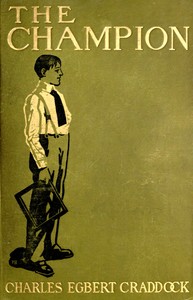
The champion
Language: en392 downloads on Project Gutenberg
Subjects
In: Novels·American Literature
Public-domain ebook sourced from Project Gutenberg #74435.
Public-domain ebook
Language: en392 downloads on Project Gutenberg
Subjects
In: Novels·American Literature
Public-domain ebook sourced from Project Gutenberg #74435.
The opening · free to read
The devil was looking out of the window. Yet the traffic in the streets was unchecked. The cable-cars whizzed past with a clanging clamor. Great rumbling vans laden with freight alternated with carriages rolling noiselessly on rubber-tired wheels. The sidewalks were crowded with pedestrians. Men and boys, ladies and little children, boldly came and went over the neighboring crossing, although they could plainly see the devil's head poking out of a high window in the newspaper building and hear the shrill tones of the devil's voice as he discoursed to his friend within.
For in fact this was not the old Enemy of Mankind, but a small imp--commonly known as a printer's devil--who by virtue of a beguiling chirp of "Copy!" served as a means of communication between the foreman of the composing-room and the editorial staff.
"That's wher' they set her up!" he said, pointing to the composing-room in an explanatory way, and with a paw copiously smeared with ink.
There were streaks of this commodity on his face also, although his functions had no concern with it. Still the devil is not the only fiend who dabbles in printer's ink without a call.
His friend, Peter Bateman, a heavy, thickset boy, with a broad, sullen, flushed face and a lowering eye, cast a glance at the cases visible through the open door from the hall.
"Wher' do the boss do the writin' at?" he asked, in a hoarse, wheezy voice.
The devil tossed his red head. "Boss don't hev ter write none!" he retorted arrogantly. "_Foreman_ is what we call him--bes' printer in these 'ere Newnited States!"
"But wher' do the feller stay what hes ter write?" persisted Pete.
"Oh,--_him_?" responded the devil, disparagingly. "They puts him in a little 'rinktum,' they call it, all by himself. He ain't much force! He can't write a word if folks git ter gabblin' ter him. Why, sometimes when I jes' say 'Copee' ter him, he looks like he will go out of his mind! They hev ter hire a whole passel o' other fellers ter help him jes' do the writin'. They hev got a double row of desks for a lot of 'em in that long room. They are all orful slow. Sometimes I be kep' yappin' 'Copee' at 'em all day so I can't stay abed o' night--ef I eats toler'ble hearty,--but jes' keeps jumpin' out an' yappin' 'Copee' in my sleep, till my mother gits afeard I'll fetch the perlice with my noise."
He grinned at the recollection of these somnolent vagaries. Then in his self-assumed duties as cicerone to his friend, showing the plant of the daily newspaper, as the rooms were nearly deserted at this hour, he duly exhibited the type-setting machine, a comparatively new acquisition in this southwestern city, and not altogether popular in the composing-room, where much of the work was still done by hand.
"It is a go, of course," said the devil discriminatingly, reflecting the sentiment of his elders, "but I tell you now, this machine ain't in it for speed an' percision with a reg'lar old-fashioned, gilt-edged, greased-lightning compositor like Bob Platt,--that's our foreman, ye know! That's the kind o' printer I'm goin' ter be,--ye kin bet yer hat!"
He hesitated and seemed a trifle out of countenance for a moment after he had said this. For when he had first been employed in the office, a raw little country lad, his admiration of the printer's craft had been so great, his ambition so exuberant, his ingenuous emulation so open that he had immediately announced his determination to be some day a champion compositor and stand preëminent at the case! The galley-boys and junior printers, of the variety called "cubs," would have been more or less than human had they failed to improve so promising an opportunity for fun. They guyed him unmercifully, and they called him "the Champion" so relentlessly that there was no one employed about the paper, from the engine-room to the "rinktum" (sanctum) of the editor-in-chief, who was unaware of the application of this proud designation. The little devil, Edward Macdonald by name, winced and wilted under the ridicule of his fellows, but it had no deterrent effect upon his determination and the great object of his ambition. He accounted it the chief feat of manual dexterity; and he thought the greatest sight the city could afford was the spectacle of Bob Platt swiftly distributing type, while the bits of metal rattled like a furious hail into their appropriate boxes. Even now he was volubly pitying Peter Bateman that he had never beheld this phenomenon, and possibly was fated never to witness it.
Then, with the enthusiasm of a predestined compositor, he declared, "I'd ruther stand at the case when I gits my growth than be the bigges' editor goin'!"
They presently sauntered out again into the dusky hall, dimly illumined by a flickering gas-jet here and there, for twilight was at hand, and leaned once more against the sill of the window.
"Them reporters hev the bes' time o' any o' the staff. Them men skeet around town till they are wore ter nothin' but eyes and lead pencil! They see everything!--always on the go! An' hev compliments o' the season all hours,--an' free passes ter the theaytre, lemme tell ye!"
An impressive silence ensued. Then a shadow crossed Ned's ink-streaked face, which was the paler because of the fading of his freckles, natural concomitant of his red hair, by reason of his indoor work.
"Now look at me!" the devil resumed in a tone calculated to invite contrast. "I hev ter stay cooped up 'ere half the day an' nigh all night, an' I work an' work, an' I pays all my wages over ter my mother; I never keep a cent for myself. I ain't grudgin' her nor my little sister neither--but ain't I goin' ter see inside a theaytre never no more?"
He thrust his hands into his empty pockets. His heart was swelling. He breathed hard. Suddenly Pete, his thin lips askew, his eyes narrowed to the merest slits, till it seemed surprising that so much slyness could look out thence, nodded his head again and again, till the motion seemed automatic, as if he were a queer bit of bobbing machinery.
"What d' ye mean by that?" cried Edward, observing him dubiously, mystified and in some sort offended by this enigmatic dumb show.
Pete's bullet head became stationary; pride and munificence were alike expressed in his features.
"_I_ kin give ye a free pass ter the theaytre," he declared with magnified importance. "I'm the boss,--an' don't ye forget it."
"Wha'--wha'--wha' say?" stuttered Ned excitedly.
Pete glanced apprehensively over his shoulder in the closing twilight. "D' ye know Gorham's theaytre?" he asked.
Edward nodded.
"It's got a window,--a back window,--what ain't more 'n eight feet off 'n the ground." Pete made this announcement in a mysterious gurgling whisper.
Edward stared.
"Ef ye'll boost me, I'll lean out an' reach down an' give ye a lift," Pete explained.
The devil stood aghast at this bold scheme.
"S'pose the play-actors war ter nab us?" he suggested in an appalled staccato.
Pete snapped scornful fingers in the air. "Then we'll be put out o' the door, an' that's the way the tony folks goes out what ain't obleeged to come in at the window."
Ned laughed in sympathy. The novelty of the adventure tempted him. Opportunity favored him. There was always a lull in the pressure of his duties at this hour. Much of the "copee" was already in type, and until the later dispatches should begin to come in the work of the office would not show that increasing momentum which was wont to culminate in the final rush of going to press. He knew that he could be back before he would be needed, and still see a good bit of the play. This certainty reënforced the longing for the lights and the crowd and the splendor of the scenic display. But something--an ill-defined something--held him back. He remembered afterward that, though so subtle a sensation, it was for the moment as strong as if a material hand had clutched him. It was not his habit of honesty, for just then he did not realize that this was stealing,--that in surreptitiously seeing the play he absolutely robbed the management of the price of his appropriate seat among the gallery gods. Perhaps it was the instinct of filial obedience.
"My mother can't abide for me ter go to the theaytre nohow," he reflected. "But some folks say that it is eddication for a boy. But my mother, she say from all she hears it's apter ter eddicate him ter be a hoodlum than anything else,--an' if a boy wants real eddication the Public School is yawnin' fur him."
He remembered this as he ran down the stairs beside Pete. He hesitated even at the street door.
"Come on--we're in for a orful bully time!" wheezed Pete. "Few folks kin go ter the theaytre this-a-way!"
Ned put his doubts behind him and started up the avenue. "Shucks!" he argued within himself, "a boy to suit my mother's notions couldn't ever have no fun an' see the sights and know what's goin' on. An' she hain't never had no schoolin' sca'cely, and has lived way back in the country mighty nigh all her life. She never was in a theaytre in her born days."
Night had come at last, but its black mantle, which elsewhere enveloped the world, was here torn into dun-colored fringes and spangled about with gas-jets and electric lights. Up and down the façades of distant buildings the illuminated windows shone like swarms of golden bees. The incandescent street lamps stretched in glittering files on either side of the ascending avenue, converging and converging till they seemed to meet in a rising planet in the limits of the far east. Above their brilliant ranks now and again swayed a central arc-light, displaying a splendid focus of intense white lustre, and flinging the luminous rays of its encircling aureola far into the surrounding darkness. Below were dimmer lights of yellow or blue which marked the progress of the cable cars. They crashed and banged as they passed. The imperative strokes of the gong sounded now and again to clear the way. The shriller bells jangled sharply. The passengers stood in the aisles packed like sardines, or clung to the platforms of the already crowded open grip-car.
"They are all goin' ter Gorham's," crowed Pete, rejoicing in the prospective crowds as if he had a share in the receipts.
Ned began to think it a fine thing too. He had all the afflatus of public amusement. To be one of a great joyful crowd seemed to him to multiply the pleasure by the multitude. His step grew light. He heard the light steps behind him. Everybody was going, and he was going too.
The theatre was well filled before they came in sight of the massive building. In front of it on the sidewalk was a gilded standard supporting a pyramid of gas-jets. A circle of boys sat beneath this with fans to sell, for the May weather was growing warm and the palm-leaf industry was looking up. The boys had besieged the crowd as it was entering the theatre, and now they waited to waylay the belated pleasure-seeker. At a distance the pyramid, with the circle of fluttering palm leaves beneath it, looked like some strange, gigantic, many-petaled flower.
Pete stopped short at the sight.
The book keeps going
Reading is free forever. Sign up and watch scenes appear while you read.



Scenes Storieta drew for other classics.
New illustrated classics
Once or twice a month: the latest books to get full character casts, scene art, and free comic editions. No account needed.