Public-domain ebook
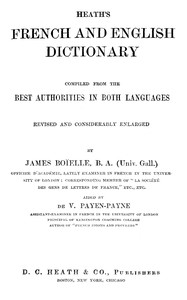
Heath's French and English dictionary
Language: en4,305 downloads on Project Gutenberg
Subjects
Public-domain ebook sourced from Project Gutenberg #74672.
Public-domain ebook
Language: en4,305 downloads on Project Gutenberg
Subjects
Public-domain ebook sourced from Project Gutenberg #74672.
Heath’s French and English Dictionary, compiled by Jean‑Louis‑de‑Lolme, is a scholarly reference work that seeks to bring a living language up to date. The author explains that the project, which occupied him for four and a half years, grew far beyond his original expectations, resulting in a “new work” that adds thousands of entries, idioms, proverbs and geographical names. The French‑English side follows the smaller Littré and Bescherelle, offering illustrative examples and a careful classification of meanings, while the English‑French side draws on Cassell’s dictionary and includes the latest scientific, commercial and military terminology. The volume is expanded by two hundred columns of print, with special typographic treatment for verb prepositions, pronunciation guides, and a comprehensive list of French vowel and consonant sounds.
The diction is unmistakably nineteenth‑century, written in a formal, didactic tone that reflects the era’s reverence for exhaustive scholarship. Its meticulous layout, alphabetical tables, phonetic notes, and star‑marked exceptions, makes it a valuable tool for serious students of French, linguists, and historians of language. Readers who appreciate detailed grammatical instruction and enjoy navigating dense reference material will find this dictionary a rewarding, if demanding, companion for mastering French pronunciation and usage.
The opening · free to read
COPYRIGHT, 1903, BY WILLIAM T. BELDING. ENTERED AT STATIONERS’ HALL, LONDON.
PREFACE TO REVISED EDITION.
When I was asked to undertake the preparation of this French Dictionary, I had no idea of the formidable nature of the task that lay before me. It was obvious, of course, that a very great deal would have to be done to bring up to date a dictionary of a living language that is ever growing, and in which new words and new meanings of words are being coined almost daily. But I found, in the course of the four and a half years during which I have been engaged upon the work, that it assumed proportions altogether undreamt of, and that I was virtually producing a new work.
Perhaps I may be permitted to direct attention to some of the features which distinguish the new edition.
Many thousands of new words and phrases, idioms and idiomatic expressions, proverbs and proverbial expressions, have been included. In a great many instances chapter and verse have been given. Two hundred columns of print have been added to the book.
For the words in the French-English part, I have closely followed the smaller Littré as well as Bescherelle, and have taken special care to give, as far as the compass of the Dictionary would allow, illustrative examples of the many and various meanings conveyed by the words under review. These various meanings have also been classified, as far as possible, under their respective heads. In the English-French portion I have, as far as the selection of words is concerned, closely followed the lines of Cassell’s English Dictionary. The latest classical, general, scientific, commercial, naval, and military terms are incorporated. In this part, too, the “notation” of the words has been carefully marked throughout and the pronunciation revised.
Among other features of the work which may justly, I think, be accounted improvements, I may mention the following, viz.: the different prepositions governing verbs have been printed in heavier type—thus simplifying one of the greatest difficulties of the language; the pronunciation of the words, where necessary, has been carefully indicated; and the list of geographical names of countries and places has been largely added to.
The work has occupied me, as I have said, for more than four years; but the process of revision has been to me most interesting, and while the labour expended has been far greater than anything I could have anticipated, I trust that the result will give satisfaction to an even larger circle of readers than was obtained by previous editions.
J. B.
ON FRENCH PRONUNCIATION.
=NOTE.=—The rules given below must be considered as general. Some are subject to more or less exceptions, which, for the sake of brevity, have not been mentioned, but they will all be found clearly and fully noticed in their respective places.
ALPHABET.
Old Approximate Modern Approximate French French English French English Alphabet. Pronunciation. Pronunciation. Pronunciation. Pronunciation. A a a ah a ah B b bé bay be bu-t C c cé say ce su-m D d dé day de du-ll E e é a e u-p F f èff eff fe fu-n G g jé zhay ge zhu-t H h ash ash he hu-g I i i ee i ee-l J j ji zhee je zhu-g K k k kah ke cu-t L l èl el le lu-ck M m èmm em me mu-d N n ènn en ne nu-t O o o o o o-ld P p pé pay pe pu-n Q q qu ku ke cu-rl R r èr air re ru-st S s èss ess se su-n T t té tay te tu-b U u u u u u V v vé vay ve vu-lgar X x iks eeks kse ksu-t Y y i grec ee grek y y-ore Z z zed zed ze zu-n
FRENCH VOWEL SOUNDS.
The Simple, or Vowel sounds, in the French language, are as follows:—
French. English. French.
a (short) like a in bat, exemplified by mal.
â (long) like a bar âge.
e sounded like a villă me, je.
è, ê e e’er, there père.
é ai, e air, eh! été.
i ea peak pique.
î ie field gîte.
o o rob mol.
ô o no môle.
u no equivalent in English (nearest approach is u in brunette) exemplified by suc.
û no equivalent in English sûre.
eû sounded like e in her (but longer and deeper) jeûne.
ou oo root exemplified by goutte.
oû oo noose voûte.
an no equivalent in English tan.
in fin.
on bon.
un brun.
Y, when alone, or when preceded or followed by a consonant, is pronounced like an i; except in pays, paysan, paysage. When placed between two vowels, it performs the office of two _i_’s, and is always preceded by a, e, o, or u. When preceded by a or e, it unites its first i with this vowel, and sounds è, as in rayon, which is pronounced rè-ion; when preceded by o, its first i is sounded in conjunction with o, like wa in the English word wag, as in joyeux, which is pronounced joa-ieû; and when preceded by u, its own two _i_’s preserve their natural sound, as in appuyer, which is pronounced appui-ié.
A is long in the termination aille, except in médăille, je travăille, détăille, émăille, băille (I give). It is also long in ation, as, nation, admiration, oblation; pronounce therefore, pāille, limāille, canāille, nātion, admirātion, oblātion, etc.
In the terminations of the imperfect of the subjunctive of verbs of the first conjugation, the a is always short; as que je parlăsse, que je donnăsse.
NASAL SOUNDS.
The nasal syllables are: aim, ain, am, an, aon; ean, eim, ein, em, en, eon, eun; im, in; om, on; um, un; ym.
Am, an, ean, are pronounced like an, without exception; as ambition, vendant, songeant. Em and en are also pronounced like an, as in emploi, empire, envie; but not always. In words derived from foreign languages, they are pronounced liked ème, ène; as Jerusalem, hymen. In words terminating in en or ein, and in their derivatives, en is pronounced like in; as mien, Chrétien, Chrétienté; and in the verbs tenir, venir, and their derivatives, en is sounded like in; as tiens, viens.
The book keeps going
Reading is free forever. Sign up and watch scenes appear while you read.



Scenes Storieta drew for other classics.
New illustrated classics
Once or twice a month: the latest books to get full character casts, scene art, and free comic editions. No account needed.