Public-domain ebook
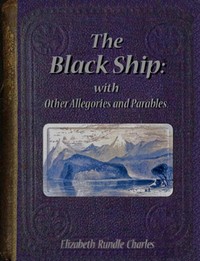
The black ship: With Other Allegories and Parables
Language: en426 downloads on Project Gutenberg
Subjects
In: Novels·Mythology, Legends & Folklore·British Literature
Public-domain ebook sourced from Project Gutenberg #74714.
Public-domain ebook
Language: en426 downloads on Project Gutenberg
Subjects
In: Novels·Mythology, Legends & Folklore·British Literature
Public-domain ebook sourced from Project Gutenberg #74714.
The opening · free to read
THEY lived at the foot of the Pine Mountains, in the island of the King's Garden, the mother, with her little son and daughter. The boy's name was Hope, and the little girl's, May.
The children loved each other dearly, and were never separated. They never had any quarrels, because Hope was the leader in all their expeditions and plays; and May firmly believed that everything which Hope planned and did, was better planned and better done than it would have been by any one else in the world, by which May meant the island. Hope, on his side, had always a tender consideration for little May in his schemes, such as kings should have for their subjects. May would never have dreamed of originating any scheme herself, or of questioning any which Hope planned. If you had taken away May from Hope, you would have taken away his kingdom, his army, his right hand; if you had taken away Hope from May, you would have robbed her of her leader, her king, her head, her sun. Bereaved of May, I think Hope would have been driven from his desolate home into the wide world; bereaved of Hope, I am sure May would never have left her home, but sat silent there until she pined away. But together, life was one holiday to them; work was a keener kind of play, and every day was too narrow for the happy occupations of which each hour was brimful.
Their cottage was at the foot of the mountains, on the sea-shore. Indeed, every house and cottage in the island stood on the sea-shore, because the island was so long and narrow, that, from the top of the mountain range which divided it, you could see the sea on both sides. If in any place the coast widened, little creeks ran in among the hills, and made the sea accessible from all points. The island consisted entirely of this one mountain range towering to the clouds; the higher peaks covered with snow, with a strip of coast at their feet, sometimes narrowing to a little shingly beach, sometimes expanding to a fertile plain, where beautiful cities with fairy bell-towers and marble palaces gleamed like ivory carvings amidst the palms and thick green trees.
But Hope and May knew nothing of the island beyond the little bay they lived in, and no one they had ever seen or heard of had scaled the mountain range and looked on the other side; no one, either in the scattered fishermen's huts around them, or in the white town which perched like a sea-bird on the crags on the opposite side of the bay. Indeed, it was only from their mother's words that the children knew their country was an island; and ever since they had heard this, the great subject of Hope's dreams, and the great object of his schemes, had been to scale the mountains and look on the other side. But this was quite a secret between Hope and May; the happy secret which formed the endless interest of their long talks and rambles, but which they could not speak of to their mother, because she was so tenderly timid about them, and because it was to be the great surprise which one day was to enchant her, when Hope was a man. He was to scale the mountains, penetrate to the wondrous land on the other side, and bring thence untold treasures and tales of marvels to May and his mother.
The children thought Hope would very soon be old enough to go; and they had a little cave in the rocks close to the sea where they treasured up dried fruits and bits of iron to make tools of with which to chop away the tangled branches in the forests, and cut steps in the glaciers which Hope was to traverse. The lower hills the children knew well; and the ravine which wound up far among the hills they had nearly fixed on as the commencement of the journey.
So the days passed on with the children, rich in purposes and bright with happy work. For they were helpful to their mother. From their mountain expeditions they brought her firewood, and forest-honey, and eggs of wild-fowl, and various sweet wild-berries, and wholesome roots. They always noticed that their mother encouraged these mountain expeditions, and seemed much happier when they took that direction than when they kept by the sea.
"Mother, how beautiful our country is! And I think it is so happy always to be in sight of the sea. How dull those lands must be you tell us of which are so large that many people have to live out of hearing of the waves! I could not bear to live there; it must seem so narrow and close to be shut in on the land with nothing beyond. But here we can never get out of sight of the sea. May and I always find, wherever we roam among the hills, we never lose the sea. When we wander far back from the shore, the beautiful blue waters seem to follow us as if they loved us; and in the inmost recesses of the mountains we always see beneath us some glimpse of bright water in the creeks, which run up among the hills, or the rivers which come down to meet them. The sea seems to love every corner of our country, mother, and penetrate everywhere."
A cold shudder passed over the mother's frame, and tears gathered in her eyes.
"The sea is indeed everywhere, my children," she murmured, and then with a burst of irresistible emotion she clasped them to her heart, and added bitterly, "Happy the country which that sea cannot approach!"
May and Hope wondered greatly at her words; but there was something in her manner which awed them into silence. For some time after that, they often speculated together as to what her words could mean, a vague terror seemed to murmur in the ripple of the waves. But gradually the impression wore off in the happy forgetfulness of childhood, and their old schemes were resumed with the same zest as before.
One evening, however, as they were busied with their treasures in the cave, the tide surprised them, and when they set out to return home, they found the rocky point which separated them from their cottage surrounded with deep water. The sides of the cliff in the little cove where their cave lay were sheer precipices of smooth rock, too steep to climb, so that the children had to wait some hours before they could creep round the point. Eagerly they watched the declining sun and the retreating tide, and when the waves were only ankle-deep they bounded through them, and in a few minutes were at the cottage door.
It was not yet dark, and the children were dancing into the cottage full of spirits at their adventure, when they were startled at the appearance of their mother. She was leaning, stony and motionless, with fixed eyes and clasped hands, against the doorpost, and for a moment the sight of her darlings did not seem to rouse her. Then springing up with a wild cry, she strained them to her heart, covered them with kisses, laughed a wild laugh, broken with convulsive sobs, and at last fell fainting on the floor.
The children knelt beside her, and gradually she revived, and fell into a sleep. But every now and then she started as if with some terrible dream, and murmured in her sleep, "The ship—the Black Ship; not now, not yet; take me, not them; or take us all—take us all!"
The terrified children could not sleep, and all the next day they clung close to their mother, and scarcely spoke a word. In the evening, however, she rallied, and tried to speak cheerfully and account for her alarm.
"You were late, darlings; and I knew you were by the sea—the terrible sea."
But the children could not be comforted. They felt the weight of some vague apprehension; they could not be tempted to leave their mother; they crept noiselessly about, watching her movements. Until at last one night they whispered together, and resolved to take courage and ask their mother what made her dread the sea; and then they consulted long as to the best way of introducing the forbidden subject.
The next evening, as they sat together by the fireside, Hope began, and forgetting all the speeches they had prepared, fixed his large eyes on his mother's, and said abruptly, "Mother, what is there terrible in the sea?"
She paused a moment, her face grew deadly pale, and her lips trembled.
"Children, why should you wish to know? You will learn too soon without my telling you."
"O mother, tell us," said May. "We can bear anything from you. Do not let any one else tell us."
A sudden thought seemed to flash across her, and she said, "Children, you are right."
Then folding one arm around Hope as he stood by her, and taking May on her knee, she said, "It is not the sea I dread; it is the Black Ship. That is the terrible secret; and it is, indeed, better you should learn it from my lips than learn it by losing me, and no one be left to tell you how.
"My children," she continued, making a great effort to speak calmly, "this is the one sorrow of our country. From time to time a Black Ship, without sails or oars, glides silently to our shores, and anchors there. A dark, veiled Figure lands from it, and seizes any one of our people whom it chooses, without violence, without a sound, but with irresistible power, and quietly leads the victim away to the Ship, which immediately glides away again from our coasts as swiftly and noiselessly as it came; but no one ever sees those who are thus borne away any more."
"Whence does the Ship come, mother?" asked Hope, after a long silence. "And whither does it go?"
"No one knows, my child. That is the terrible thing about it. There is no sound nor voice. The agonised cries of those who are thus bereaved avail not to bring one word of reply from those lips, or to raise one fold of that dark veil. If we only knew, we could bear it."
"Have you ever seen it, mother?" asked Hope, determined bravely to plunge to the bottom of the terrible mystery, while May could only cling round her mother's neck and cry.
"I have seen it twice," she replied, speaking low and rapidly. "We did not always live here. Your father was rich and a man of rank, and loving us most dearly, he resolved to do all in his power to keep the terrible Form away. For this end, he built that castle you have often seen above the white tower. It is far above the sea; the rocks are perpendicular; it is built of solid stone; the doors were of oak, studded with iron; the windows barred with iron. No one was ever to be permitted to cross the moat without being strictly scrutinised. The gates were always to be closed.
"When it was finished, he made a feast. And after it, when the guests had left, and every bolt was drawn, we stood at the window of the room where you slept, and looked down triumphantly on the sea. A little sister of yours was sleeping in my arms. In the bay at our feet was moored the Black Ship. Our eyes seemed fascinated to it, and we could not speak. We saw the Veiled Figure; descend the side, and slowly scale the precipice beneath us, as if it had been a road made for it to tread. It walked over the waters of the castle moat, which did not seem to wet its feet. It stood on the balcony outside our window, and we could not stir. It passed through the iron bars. It laid its hand on my sleeping babe.
"Your father's strong arm was around us both, but before we could utter a cry, the darling had glided like a shadow from our embrace. The bright face of our baby was hidden from us under the folds of that impenetrable veil. We watched the terrible Form noiselessly descend the steep, re-enter the ship, and not until the Black Ship was already gliding swiftly out of sight could we overcome the terrible fascination. Then my cries of agony awoke the household, boats were manned in pursuit, but in vain, in vain—we felt it was in vain. We never saw the babe again."
The book keeps going
Reading is free forever. Sign up and watch scenes appear while you read.



Scenes Storieta drew for other classics.
New illustrated classics
Once or twice a month: the latest books to get full character casts, scene art, and free comic editions. No account needed.