Public-domain ebook
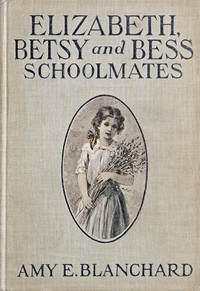
Elizabeth, Betsy, and Bess—schoolmates
Language: en372 downloads on Project Gutenberg
Subjects
In: Children & Young Adult Reading·Novels
Public-domain ebook sourced from Project Gutenberg #74754.
Public-domain ebook
Language: en372 downloads on Project Gutenberg
Subjects
In: Children & Young Adult Reading·Novels
Public-domain ebook sourced from Project Gutenberg #74754.
The opening · free to read
Miss Jewett had just rung the bell and the children trooped into the schoolroom, taking their places as quietly as exuberant youthful spirits would permit, the smallest boys and girls in the front row, the older ones further back. It was a cheerful room, and Elizabeth, by the side of her chum, Betsy, thought of the changes which had taken place there since Miss Jewett was installed as teacher. Where had been bare walls, except for a couple of uninteresting maps, now were attractive pictures which brought visions of all sorts of delightful historical places; shelves in front of the windows displayed gay, blossoming plants, while in an aquarium, standing in their midst, gold-fish darted about. In the centre of the black-board Miss Jewett had just drawn the picture of a man and woman in Puritan dress; a big yellow pumpkin ornamented one corner of the board, in another was a turkey, in the third an ear of corn and in the fourth a squirrel nibbling a nut. The pictures were drawn with colored chalks and there was not a child who did not look upon them with sparkling eyes.
“Thanksgiving,” the whisper went around. Miss Jewett nodded. “Yes, Thanksgiving, and when we come to our history lesson I will tell you how our first Thanksgiving Day originated and why we still keep it in remembrance.” Then Miss Jewett took up her violin and drew the bow across the strings. She paused a moment before she began to play. “We will sing a very old hymn this morning,” she said, “one that was written by a man named Kethe, away back in the sixteenth century, and it might well have been sung by the Pilgrim Fathers on that first Thanksgiving Day. It is very quaintly worded, I think. You may all look for it in your hymnals; it begins: ‘All people that on earth do dwell,’ and we shall sing it to the tune Old Hundred, for that seems most appropriate, as the tune is as old as the hymn.”
She started the first note and Elizabeth gave a quick sigh of pleasure. It was a constant surprise and delight to her to find how many things Miss Jewett could do: she could play the violin and sing sweetly, if not very powerfully; she could draw wonderful things on the board; she wore the daintiest and most becoming clothes and she made the lessons a pleasure instead of a task. Surely she was the most wonderful teacher in the world, and Elizabeth adored her. “Anything more like an angel than Miss Jewett could not possibly be,” she confided to Betsy at recess, “especially when she plays the violin.”
“But angels play on harps,” objected Bess Ferguson who had joined them.
“They don’t always,” returned Elizabeth, “for I’ve seen pictures of them with violins; Betsy’s uncle Rob has one among the photographs he brought from Europe.”
That settled it and Bess had no more to say; indeed, Elizabeth had a way of forcing unanswerable arguments upon this less quick-witted friend of hers, and it was seldom that she did not get the best of it. Just here Flo Harris came up and was greeted cordially; she was not often invited to join this trio, for it was an understood thing that Elizabeth with her first best friend, Betsy, and her second best, Bess, did not care for an addition to the group at lunch time. It was regarded as a privilege when another girl was admitted; Flo, however, had special claims upon this occasion, for this was her first appearance after some weeks of illness. She was still rather pale and thin, and the girls regarded her with something like admiring envy.
“Come right over here, Flo,” Elizabeth invited her. “We have a lovely lunch today. Betsy has some of those great big red grapes that grow in her aunt’s garden, Bess has some special cakes and I have a special jar of marmalade. You’re well enough to eat anything now, aren’t you?” she asked a little anxiously.
“Oh dear, yes,” returned Flo, accepting the attentions offered, “but I have been awfully ill; I wasn’t expected to live.”
The three girls gazed at her with new interest. The phrase, “not expected to live” had a weird fascination for them all, Elizabeth especially. She had never reached such a danger point, although she had gone through an ordeal during the summer when an accident threatened to rob her of her sight. “Well,” she said, “I was never quite that bad, although I did nearly have my eyes put out.”
“And once I was awfully ill with measles,” put in Bess.
“Yes, but you were never where they gave you up,” returned Flo in triumph. “There was one night when, my mother said, the doctor declared that he didn’t expect I would live till morning.” Again the alluring phrase.
Elizabeth offered another spoonful of marmalade, Betsy laid half a second bunch of grapes in Flo’s lap and Bess added her last cake, from which she had just taken one bite.
“You look so lovely and pale,” said Elizabeth admiringly. “I would give anything to be pale; it is so interesting. I think when I die I would like to languish away,” she added sentimentally, “although I wouldn’t like to have a worm feed on my damask cheek.”
“Who had that?” inquired Flo with interest.
“Why, don’t you know the poetry that says a worm in the bud fed on her damask cheek?”
At this a merry little chuckle sounded from just above them and Miss Jewett’s bright face looked out from the window; “Elizabeth, you funny girl,” she said, “you don’t get that quotation right; it is: ‘And let concealment, like a worm i’ the bud, feed on her damask cheek.’”
“I always thought it was a worm, a real live worm,” replied Elizabeth, quite taken aback. “I don’t believe I understand it yet, Miss Jewett.”
“Neither do I,” spoke up Flo.
“Why, it means this: that the young woman concealed her love and the effort to do so showed its effect; concealment took her vitality, the rose from her cheek, and made her pale--just as a worm in the bud of a rose destroys it.”
“Oh!” The girls saw the point. “I am rather glad it is that way,” decided Elizabeth, “for I cannot bear any kind of worm, and Betsy is always teasing by putting caterpillars on me; I dislike them more than spiders. Miss Jewett, did you know that Flo wasn’t expected to live?”
“Yes, I heard the sad news at the time. We are very thankful to have her back again, aren’t we? I hope she will get some roses into her pale cheeks.”
“I think it is nice to be pale,” remarked Elizabeth honestly.
“Oh dear me, what a notion,” exclaimed Miss Jewett. “It is much nicer to be rosy and healthy and strong and active.”
Elizabeth looked doubtful. She was generally very ready to adopt Miss Jewett’s opinions, but she could not give up this treasured idea at once though she did not say so; instead she asked solemnly, “Miss Jewett, were you ever at the point of death?”
Miss Jewett smiled. “I believe so, when I was a child.”
Elizabeth sighed regretfully. “I never was.”
“You think it is something to boast of?” said Miss Jewett. “Why?”
Elizabeth cast about in her mind for a true reason, but she could not settle upon a satisfactory one. “I don’t know exactly,” she answered at last, “but we girls always do. I suppose it is just like having the biggest or the finest or the rarest of anything; we feel proud of it because it goes ahead of what the rest have.”
Miss Jewett laughed. “That is not a bad explanation, Elizabeth. You use your mind very well, though one doesn’t always want to be the biggest in all directions.”
“No,” returned Elizabeth with conviction, “I shouldn’t want to be the biggest liar or thief, for instance.”
They all laughed, Miss Jewett included. “You’d better come in now,” she said. “We want to have that Thanksgiving story, you remember.”
“But that won’t even be a fib,” retorted Elizabeth merrily.
“No, we can depend upon its being solid fact,” returned her teacher.
Having disposed of the last remnant of marmalade, the final grape and the remainder of the cake, the girls shook the crumbs from their laps and went inside to hear the story of the first Thanksgiving, and then to go forth, somewhat earlier than usual, for their holiday. On the way home there was great talk of the next day’s jollification. Miss Jewett and her aunt, Miss Dunbar, were to dine at Betsy Tyson’s, and the afternoon Betsy and Elizabeth were to spend together at the home of the latter. This was determined upon after Betsy explained that she would be left alone otherwise. “There will be no one at home,” she told her friends, “for uncle Rob and Hal are going to the football game with Miss Jewett and your sister Kathie, Elizabeth.”
“What will your aunt Emily do?” queried Elizabeth.
“She and Miss Dunbar are going to take tea with Mrs. Lynde.”
“And I have to stay at home,” complained Bess. “Grandma said she couldn’t think of my going away from home on Thanksgiving.”
“It will be rather stupid, won’t it?” said Elizabeth compassionately.
“Yes, it will,” returned Bess in an aggrieved voice. “I wish you and Betsy would come over and spend the afternoon with me.”
“Oh, but--” Elizabeth began and looked at Betsy. There was never much fun in visiting at Mrs. Lynde’s; everything was so spick and span, so very orderly. Mrs. Lynde did not like any noise and would not permit anything out of place. The girls never had as good a time anywhere as at Elizabeth’s home, the least pretentious among them all. For this holiday Betsy and Elizabeth had planned a specially entertaining afternoon and were not ready to give it up.
The book keeps going
Reading is free forever. Sign up and watch scenes appear while you read.



Scenes Storieta drew for other classics.
New illustrated classics
Once or twice a month: the latest books to get full character casts, scene art, and free comic editions. No account needed.