An Indian council-fire was lighted on the banks of Seneca lake; the flames streamed up cold and white in the radiance of the setting sun, and the heavy clouds of smoke, tinged like rainbows by its beams, rolled away over the forest and floated in transparent mist over the Iroquois village built on a picturesque curve of the shore. The glory of midsummer lighted up the woods and lay warm and bright on the beautiful lake. It was the season when all that was poetical and picturesque in savage life wore its richest charms—when those rude natives forgot all the hardships of the cold, stern winter, and yielded themselves to the indolent enjoyment of the long, sunny days.
A great stillness lay over the Seneca village; the people had come out of their wigwams and were gathered as near the council-fire as they dared approach, their picturesque dresses lighting up the background until they looked like a flock of strange tropical birds hovering around the flames which they dared not approach. About the council-fire were grouped the leading chiefs of the Six Nations’ tribes, who, for several weeks past, had been participants in the unusual feasting and merriment which had made the old forest joyous.
It was a band of noble, stately-looking men, sitting in a circle in the red firelight, grave and dignified as Roman Senators gathered in their forum, listening calmly to the various speeches, weighing carefully each word and bringing all the vivid power of acute minds to bear upon the matters in question.
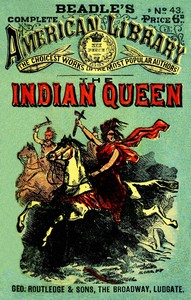
In their midst stood a woman in the fairest bloom of youth, with her crimson robes falling so royally about her, and her every gesture so full of intellect and refinement that any stranger unacquainted with her history and her designs, might have almost believed with the poor savages, that she was a direct messenger from heaven to work their good. This was Mahaska, the white queen, or Mahaska the Avenger, as she loved to call herself. She was Katharine, daughter of Frontenac, the French Governor-General of Canada, by an Indian woman who was daughter of the Seneca chief Nemono. When, in accordance with the will of their dying prophet, they brought the half-white girl Mahaska to be their principal ruler, most of the chiefs among the nations were so deeply impressed by the last revelations of their beloved prophet that they accepted her presence and the state which she took upon herself with the blind fidelity of humbler members of the several tribes; but there were a few who, either from personal ambition or the contempt for women which made a part of their savage education, opposed her will in every way that they dared, and were trying their utmost to raise up a party which would enable them to counteract her rapidly-increasing influence. Mahaska, perfectly acquainted with their plans, and confident of her power to thwart them, only waited for the best moment to crush their schemes forever by some daring act or some craftily-woven plot, whichever should best suit her purposes and be likely to produce the greatest effect on the tribe.
Mahaska’s present ambition was a desire to wage war against the Delawares—a powerful tribe residing south of the Iroquois territory—who had been known to speak slightingly of her claims. This she deemed a favorable opportunity to prove her warlike powers to the Indians, and stronger still was her desire to avenge the slightest affront offered her by that powerful tribe and to crush any daring spirit among her own people that had the audacity to dispute her power.
As the council-fire flamed up and the chiefs grew more and more attentive, she spoke in her bold, imaginative way, carrying the hearts of the people along with her by her resistless eloquence, and noting the effect she produced by the occasional murmurs which broke from the multitude stationed in the background, in spite of the utter silence and decorum it was their habit to preserve on such solemn occasions.
She ended her thrilling appeal and turned toward the chiefs, folding her statuesque arms over her bosom and with the flame-tinted light quivering like a glory around her.
“Mahaska has spoken,” she said; “let the chiefs weigh well her words.”
“Mahaska’s voice is like the wind sent by the Great Spirit,” returned the oldest chief in the assembly; “it goes straight to the hearts of her brethren.”
“Mahaska speaks only as the Great Spirit commands her,” she said, “from the wisdom of the visions which he sends to her in the night time.”
The little knot of chiefs who were opposed to her whispered ominously among themselves—the woman’s quick eye noticed this.
“Do the braves meet at the council-fire to hold secret consultations?” she demanded, turning toward the old chief Upepah.
“They meet to speak their thoughts and wishes,” he answered; “why is Mahaska troubled?”
She pointed toward the little group and said in a low, silky tone, which, after the savages learned to know her better, they knew covered the fiercest and bitterest anger:
“Because, the Fox whispers among his friends and sneers at Mahaska’s words.”
The chiefs turned toward the little party with frowning brows, and murmurs of disapprobation broke from the people in the background, over whom Mahaska’s influence already was almost boundless.
The braves with whom the Fox had been whispering dropped slowly from his side, not daring to support his cause however strongly their wishes might go with his. He was a middle-aged man, with a peculiar depth of firmness and sullen obstinacy in his face. Though he looked slightly discomposed by this unexpected address, he bore the dissatisfied glances with cold dignity.
“Mahaska came among her people because the Great Spirit sent her, and because the Senecas asked her to come,” continued the woman. “It is not well that, in the very outset of her work among you, designing chiefs should whisper among you like bad spirits to counteract her great purposes.”
A murmur went up from the crowd in echo to her words:
“It is not well, it is not well!”
“Mahaska has obeyed her people’s wishes; she has chosen a husband from among their chiefs; if the Iroquois will listen to her she will lead them on to new glory.”
“They listen and cherish her words,” returned Upepah, the old chief. “Mahaska has seen them rejoice over her coming—she knows that the hearts of our braves and our young maidens have been gladdened by her presence; let her have faith in her people. She is a great chief.”
She turned slowly toward him and lifted her face full upon him and smiled with a power of fascination which lighted up her features into wonderful beauty.
“It has been the dream of Mahaska’s life to be with her people,” she answered; “every wish in her heart has turned toward them as a young bird pines for its nest in the green leaves.”
“They have watched for her coming,” he said; “the young maidens and children have been taught to speak her name with reverence; they will come like children to hear the wisdom which she has learned among the whites.”
“Let the chiefs listen too,” she exclaimed, with the arrogance natural to her; “Mahaska has visions such as never were unfolded to their greatest prophets; she will teach them arts which will make them able to combat the cruel whites who are seeking to tread out the red-man’s footsteps from the broad lands their fathers owned.”
“The Iroquois have not had babes and cowards for their chiefs,” said the Fox, unable to keep silent, however unfit the moment to dispute her wishes, or however dangerous to himself might be the result of bringing the angry feelings between them to an issue before the council.
Mahaska scanned his lofty figure from head to foot; the smile did not leave her features, but it looked on the hardness of her face like sunlight playing over ice, and the light in her eyes deepened and grew vicious like those of a serpent just ready to spring.
“The chief is not content with the woman chief his people have chosen,” she said, in her lowest, softest tone.
“Mahaska mistakes,” he answered; “the Fox welcome her willingly as his brothers, but he never heard that she was to sit at the council-fire and be treated as a chief.”
“When Mahaska is not a chief she leaves the tribe forever,” she replied calmly.
“Mahaska is married; why does not Gi-en-gwa-tah her husband speak for her?”
The young chief to whom he alluded rose on the instant and answered with stately pride:
“Gi-en-gwa-tah is chief of the Senecas, but he can not know the visions which Mahaska sees; the Great Spirit converses with her as he did with our prophet, but her husband is like his brethren, only a warrior; he can not understand words from the Great Spirit.”
Mahaska gave him an approving glance and moved nearer the council-fire.
“Let the Fox speak,” she said; “what are his thoughts?”
Thus unexpectedly confronted by the woman armed with the double spell of her gorgeous beauty and the spiritual influence which she had over the minds of a superstitious people, the chief was at loss to reply. For a few seconds he sat silent while Mahaska watched him with a look of grave expectation.
“Why is the Fox silent?” she cried.
“He is not a woman that his words should fall easily and are lost, like the rain,” he answered.
“No!” she exclaimed, “he is silent because he is true to his name—because he is crafty and wants to work under ground; he wishes to carry on his plans in the dark and uproot the love of the people for Mahaska, but when he looks in her face he has no courage to speak.”