Public-domain ebook
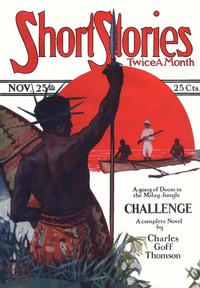
The silent cabin
Language: en389 downloads on Project Gutenberg
Subjects
In: Short Stories·Novels·American Literature
Public-domain ebook sourced from Project Gutenberg #74922.
Public-domain ebook
Language: en389 downloads on Project Gutenberg
Subjects
In: Short Stories·Novels·American Literature
Public-domain ebook sourced from Project Gutenberg #74922.
The opening · free to read
Farrell knew that he was a dying man. There remained in his mind not the shadow of a doubt on that score.
Sitting at the present moment in the open doorway of his cabin, he gazed out over the frost-colored forests which for five years now had been a part of his life. A very close and integral part. He loved the forests, and especially did he love them in the flaming beauty of the fall garb which cloaked them at this time. His only regret, now that he knew he was leaving it all for good, was that he hadn’t come up here sooner in his life.
Well, he reflected, he had nothing to complain about, by and large. His life had on the whole been an eventful and satisfying one, and even the touch of tragedy that had sent him north no longer caused him the inward pain which it had at first.
Yes, taken as a whole, his had been a happy life, as lives go. He was sure of that. And if he had erred here and there--and he knew, of course, that such had been the case--he had, by the same token, now and again gone out of his way to do things that had caused others happiness. At the present moment this was a comforting and reassuring thought. Somehow he felt strangely at peace with the world.
Nor did the conviction that he was soon to die alone and unattended up here in the wilderness appall him. He found himself looking forward to it, rather, with a certain contented resignation, as do men who have an abiding faith that the next world is one step better than the present plane.
At any rate he had no regrets as he sat now in his doorway, smoking his pipe and gazing out over the gold and crimson forests which he loved so well. That is, he had no regrets save one. One thing did trouble him, it is true. It had been troubling him for some days past.
Dying alone as he knew he would, it would be hard to attend to, and there was furthermore no certainty that anyone would pass this way for some months to come.
He pondered for some time upon this, turning it over in his mind, seeking a solution and gradually as he puffed upon his pipe a way out occurred to him. He nodded his head as if in approval.
“Yes, I guess that’s the best, Farrell,” he mused presently, “I’ll do that. Sort of let it rest that way.”
And rising and going slowly to the table, he took up a piece of dry birchbark and proceeded to write thereon his last request.
Winter had laid hold of the Fairbanks country. Snow bowed the limbs of the spruces. The strong Alaskan cold had come to stay.
Two men were making their way over the Chena trail from Nation to Fairbanks, where rumor had it high wages were being paid in the mines. Over the welcomed noonday fire, while the dogs rested, the younger of the two men remarked, among other things, “If this trail doesn’t improve, Miller, we won’t get through to Fairbanks for another three days.”
Miller shrugged his shoulders and helped himself to another cup of the black coffee to top off the meal they had already finished. “With my luck,” he observed, “I’m thinkin’ we’ll be lucky if we get through at all. Confound such luck! And the chances are there won’t be a job left, time I get through, anyway. My luck always was rotten.”
The younger man smiled. “You make it so by talking that way,” he reasoned.
The other snorted. “Dry up with that kid philosophy of yours, Steel,” he said. “I’m gettin’ fed up on it.”
“Yes, but it’s so all the same,” the younger man argued. “Every time you talk that way, old man, you’re just putting in an advance order for hard luck.”
And in the silence that followed, he studied the other man’s face, round, heavily bearded, bearing marks of dissipation about the eyes.
Steel was young, twenty-five, and he had come north solely in a spirit of adventure. To him good luck and hard luck were all a part of the game. Miller, on the other hand, was nearer forty, and whatever spirit of adventure he once might have possessed had long since been lost in his life of hard reality. He made life hard. He had ceased to have visions. Among men he had earned the name of “Hardrock” Miller because of an incident that occurred one fall down on the-- But no matter. That is another story.
To get back to Steel: he was, at the present moment, beginning to regret his accompanying the older man on the trip through to Fairbanks. Miller was proving himself far from the best of company. And the young man reflected that he might better have waited until someone else was going through. But there, no use grumbling. The trip would soon be over. In the future, however, he assured himself, he would pick his trail partners with considerable more care.
“Well, let’s be movin’,” Miller remarked shortly, rising from the log he had been sitting on. “Suppose you take a turn breakin’ trail, kid.”
“Sure,” said Steel willingly, “I was just going to suggest that.” And he took his snowshoes which he had stuck upright in the snow behind him, and proceeded to put them on. He added, as he did so, “Here’s hoping the drifts aren’t so bad up ahead. Likely they won’t be.”
“Oh, they will be,” the other corrected, stepping to the handlebars of the sled. “The devil knows when I’m comin’ along and sprinkles the stuff heavy along the trail.”
Steel chuckled, and in another moment, at a word from the man behind the sleigh, they started forward. The sun, which had put in a brief half-hour’s appearance, had now gone down amid a bank of purple mist, and the world which a while ago had sparkled like a carpet of diamonds was now a dull, cheerless gray. The long Arctic night was closing in. Too, it was growing steadily colder.
After perhaps half a mile had been covered, Steel observed, “Hello! There’s a cabin up there on the left.” He pointed a mittened hand. “Could just as well have stopped there for dinner, if we’d known.”
“Wasn’t there six years ago,” Miller replied. “That was the last time I mushed this trail.”
Steel, who had been studying the small cabin that stood on the wind swept crest of a hardwood knoll, now remarked, “There’s no smoke coming from the chimney. Must be deserted--hello!” he interrupted himself, “what’s that?”
“What’s what?”
“That on the door. Looks like something white’s been nailed there. Perhaps we’d better take a look. Wait, I’ll run up.” But Miller, from behind, said disapprovingly, “We ain’t got time to waste foolin’ around. Keep goin’.”
“But something might be wrong,” Steel reasoned. “I think we ought to take a look.”
Miller emitted a snort. “Well, if you’re set on it, go on. But make it fast. I didn’t agree to take you on a sight-seein’ trip.”
“It won’t take a minute,” Steel assured him, and he swung up the slope on his snowshoes. A moment later he called down to the waiting man, “Say, come up here!”
“What for?”
“Read this!”
Miller joined him presently and Steel pointed to the piece of birchbark that was nailed to the door. The writing on it made any words on the younger man’s part unnecessary. It read:
I will be dead when you find this. My name doesn’t matter. I leave nothing of value and I have no living relatives and no particular friends who interest me, or who would be interested in my death. But I have a simple request to make. The past five years have been the happiest in my life. And the happiest hours in those years were spent right in front of my door, where I could look out over the woods at sunset. It is my wish that I lie there.
It was signed merely, “Stranger.”
Miller gave his characteristic snort and tried the door. But the melting snows of early fall had frozen about the sill and the door wouldn’t move. He thrust his great shoulders against the thick panels, but still the door held fast. And he said, “No use. Can’t budge her. I’ll go down and fetch the ax.” There was in his voice a somewhat eager note. Steel understood why, and he disliked the man for it.
Presently the other was back with the implement and after hacking the ice away around the bottom, finally got the door loose. With a shove of his shoulders it flew open. He went in. Steel entered behind him.
It was a simple cabin, equipped with homemade furniture of rude yet serviceable design. On the one bunk that was built in against the wall opposite the door, the writer of the note lay, stiff with the cold. Steel went over and looked down upon the figure. He shook his head slowly.
“Too bad you had to die all alone that way,” he said, “It must have been pretty lonely for you during those last hours, old-timer.”
The book keeps going
Reading is free forever. Sign up and watch scenes appear while you read.



Scenes Storieta drew for other classics.
New illustrated classics
Once or twice a month: the latest books to get full character casts, scene art, and free comic editions. No account needed.