Public-domain ebook
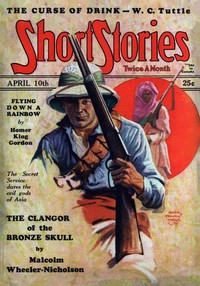
Flying down a rainbow
Language: en344 downloads on Project Gutenberg
Subjects
Public-domain ebook sourced from Project Gutenberg #75097.
Public-domain ebook
Language: en344 downloads on Project Gutenberg
Subjects
Public-domain ebook sourced from Project Gutenberg #75097.
The opening · free to read
Author of “The Sky Pirate,” “The Morgan Kid” etc.
As the old-timer said, “Gold’s a funny old gal. She’ll flirt with you for years and then go throw herself on some total stranger’s neck.” And it seemed as if it were going to be the same even in these days when they go prospecting in airplanes.
Jimmy Devlin handed the pilots of Pacific Field a laugh when he paid four hundred dollars for the old biplane wreck that had been lying in Hangar Number Three ever since the field opened. Jimmy himself indulged in a laugh, but it was a hopeful one. He had gone over the wreck pretty thoroughly and knew exactly what he was buying. The landing gear was pretty much of a mess. One of the lower wings would have to be almost completely replaced. The prop was splintered and the crankshaft of the engine was broken. So were several tie wires, one wing strut, and the tail skid.
It took practically all of his money, two months of his time, several square yards of fabric, and many buckets of dope before Jimmy was able to wheel his wreck out of the hangar and convince a deputy instructor from the Department of Commerce that it was an aeroplane. The inspector stood on the grounds while Jimmy made a couple of flights around the field to prove his contention. It was a successful demonstration and he got a license to carry passengers in it.
That, of course, was just a beginning. In the three or four weeks which followed, Jimmy had but one passenger. Competition was too keen for Jimmy at Pacific Field. His patched and remodeled old flying crate would not stand comparison with the new modern planes used by the other commercial pilots. Nor could he afford to hire salesmen or runners to circulate among the spectators at the airport and solicit business, as did the other pilots.
Had Jimmy been a more determined salesman, he might have circulated among the prospective customers himself and drummed up business, but he was too modest to extol the virtues of his second-hand ship and his own skill as a pilot.
Jimmy was a favorite among the other pilots at Pacific Field. They liked his sunny disposition and his hearty laugh. But business was business, and he had invited competition by trying to break into their established commercial traffic. They dubbed his plane the “Calico Peacock,” and kidded him unmercifully about his inability to get any passengers into it. Jimmy did not mind their fun, but the situation began to get desperate. He would have moved to some roadside cow pasture and tried to pick up passengers from the highway, but he owed the field a forty-dollar hangar bill and had nothing with which to pay it. He was considering putting the Calico Peacock on the auction block and knocking it off to the highest bidder when he had his first lucky break.
It happened early one Saturday morning. Jimmy’s Calico Peacock was one of the first aeroplanes on the starting line. After he had made sure that enough gasoline remained in the tanks to accommodate a passenger if some miracle should happen and one should appear, Jimmy wandered over to the field headquarters and stretched his lean, lanky frame against the side of the Administration Building to soak up some of the warmth of the morning sun.
Sunshine was not a very satisfactory substitute for a hearty breakfast, but Jimmy couldn’t afford the breakfast, and the sun was free. He had not been there long when the field superintendent came out of his office and looked questioningly down the field toward the spot where the commercial passenger planes were being trundled out onto the field. It was so early that none of the flying salesmen had appeared.
“Got a job for somebody, Cap?” Jimmy asked eagerly.
The field superintendent looked at Jimmy for a moment and then grinned.
“Made to order for you,” he chuckled. “But don’t blame me; you asked for it.”
A stoop-shouldered old man with thin, straggly white hair came timidly from the Administration Building and stood at the field superintendent’s side.
“Am I too early?” he asked timidly, his mild blue eyes apologizing silently for his temerity in addressing such a magnificent personage as the field superintendent, resplendent in correct cut flying togs and polished riding boots.
“Here’s one of the best pilots on the field.” The field superintendent turned to Jimmy. “His plane’s one of the fastest ships on the ground.”
Jimmy stepped forward promptly.
“This is Jimmy Devlin--Mr. Weber.”
“Ed Weber.” The old man offered his hand shyly. “I am pleased to meet you.”
“Take good care of Mr. Weber, Jimmy.” The field superintendent winked broadly and sauntered back to his office.
“Where was it you wanted to go, Mr. Weber?” Jimmy asked. “Did you just want to take a little ride around the field or did you want to go somewhere particularly?”
“I want to go to Keno, Nevada,” the old man confided.
“You mean Reno, don’t you?” Jimmy asked.
“No, I mean Keno,” the old man said. “But I don’t wonder you never heerd of it. ’Tain’t nothin’ more than a water hole to begin with, and it’s way out on the edge of the mountains more’n a hundred miles south and east of Reno.”
“Is there a landing field there?”
Jimmy realized that his question was foolish, and, furthermore, that the old man did not know what he meant.
“I mean a level place, maybe half a mile long or so where I could land the plane.”
“There’s a flat down between the hills where I reckon you could maneuver her into a place to set down,” the old man explained. “But how much will you take to fly me there?”
Jimmy took the old man off behind one of the hangars where he would not be grabbed by one of the other pilots and then got out his map. Keno did not show on the map, but Weber made a pencil cross to indicate its approximate location.
“What is it--a town or a ranch?” Jimmy inquired.
“Wal,” Weber explained, “there used to be a shack there where a man could get a drink and maybe a slab of bacon and some beans, but I reckon there ain’t much right now except the water hole. Figgerin’ it conservative, though, inside of three days there’ll be five thousand men there and the name of Keno will be spread over the front page of every newspaper in the U. S.”
The old man chuckled quietly at Jimmy’s bewilderment.
“It’s a gold strike, son,” he said quietly. “I’ve got a sister living up there in that country. Last night I got a long distance telephone call from her saying that an old hard pan miner had staggered in with a bag of samples and his tongue hanging out, blabbing about the strike he’d made at Keno.”
“When do you want to go?”
“Jist as soon as we can get started, son,” the old man said earnestly. “Here’s the way I’ve got it figgered out. If we can get into Keno today we’ll be ahead of the first of the rush. Old-time gold strikes don’t happen often nowadays, but there’s still enough prospectors and would-be prospectors left to make a fairly sizable gold rush. But at the best, they can’t commence to come in until tomorrow morning. I know every foot of that ground. I always knowed there was gold around Keno somewheres. I found plenty of rich float but I was never able to track it down. From the information I got over the telephone last night, I know just where the strike was made, and if we can get there ahead of the rest of them, I’ll stake out a claim that will put me on Easy Street for the rest of my life.”
“Say,” Jimmy asked excitedly, “is there anything to prevent me from staking out a claim too?”
“Not that I know of, son,” Weber replied, “and I’ll help you pick out a good one too. Then we’ll fly down to the Carson Land Office and register them and the trick’s done. I guess I’ll have to go back and see that nobody squats on the claim, but once they’re registered they’ll be safe unless it’s so rich that they have to be watched night and day.”
Such a trip would require a capacity supply of gasoline and oil and a landing on the flat might mean broken landing gear and a repair bill.
“I don’t see how I could do it for any less than a hundred dollars,” he declared. “Of course if I could pick up a passenger there for the return trip, I might do it cheaper.”
“I’ve only got fifty,” Weber said. “I’ve throwed up my job collecting bills for the light company and bought enough grub to last for the trip, and that’s all I’ve got left.”
The old man tried to hide his disappointment, but Jimmy saw his shoulders sag and an expression of hopeless discouragement spread across his face.
The book keeps going
Reading is free forever. Sign up and watch scenes appear while you read.



Scenes Storieta drew for other classics.
New illustrated classics
Once or twice a month: the latest books to get full character casts, scene art, and free comic editions. No account needed.