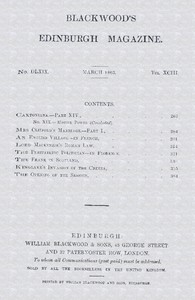
NO. XIX.—MOTIVE POWER (concluded).
The next day the atmosphere was much cooler, refreshed by a heavy shower that had fallen at dawn; and when, not long after noon, Percival and I, mounted on ponies bred in the neighbouring forests, were riding through the narrow lanes towards the house we had agreed to visit, we did not feel the heat oppressive. It was a long excursion; we rode slowly, and the distance was about sixteen miles.
We arrived at last at a little hamlet remote from the highroads. The cottages, though old-fashioned, were singularly neat and trim—flower-plots before them, and small gardens for kitchen use behind. A very ancient church, with its parsonage, backed the broad village-green; and opposite the green stood one of those small quaint manor-houses which satisfied the pride of our squires two hundred years ago. On a wide garden-lawn in front were old yew-trees cut into fantastic figures of pyramids and obelisks and birds and animals; beyond the lawn, on a levelled platform immediately before the house, was a small garden, with a sundial, and a summer-house or pavilion of the date of William III., when buildings of that kind, for a short time, became the fashionable appendage to country-houses, frequently decorated inside with musical trophies, as if built for a music-room; but, I suspect, more generally devoted to wine and pipes by the host and his male friends. At the rear of the house stretched an ample range of farm-buildings in very good repair and order, the whole situated on the side of a hill, sufficiently high to command an extensive prospect, bounded at the farthest distance by the sea, yet not so high as to lose the screen of hills, crested by young plantations of fir and larch; while their midmost slopes were, in part, still abandoned to sheep-walks; in part, brought (evidently of late) into cultivation; and farther down, amid the richer pastures that dipped into the valley, goodly herds of cattle indolently grazed or drowsily reposed.
We dismounted at the white garden-gate. A man ran out from the farmyard and took our ponies; evidently a familiar acquaintance of Tracey’s, for he said heartily, “that he was glad to see his honour looking so well,” and volunteered a promise that the ponies should be well rubbed down, and fed. “Master was at home; we should find him in the orchard swinging Miss Lucy.”
So, instead of entering the house, Tracey, who knew all its ways, took me round to the other side, and we came into one of those venerable orchards which carry the thought back to the early day when the orchard was, in truth, the garden.
A child’s musical laugh guided us through the lines of heavy-laden apple-trees to the spot where the once famous prizeman—the once brilliant political thinker—was now content to gratify the instinctive desire _tentare aërias vias_—in the pastime of an infant.
He was so absorbed in his occupation that he did not hear or observe us till we were close at his side. Then, after carefully arresting the swing, and tenderly taking out the little girl, he shook hands with Percival; and when the ceremony of mutual introduction was briefly concluded, extended the same courtesy to myself.
Gray was a man in the full force of middle life, with a complexion that seemed to have been originally fair and delicate, but had become bronzed and hardened by habitual exposure to morning breezes and noonday suns. He had a clear bright blue eye, and a countenance that only failed of being handsome by that length and straightness of line between nostril and upper lip, which is said by physiognomists to be significant of firmness and decision. The whole expression of his face, though frank and manly, was, however, rather sweet than harsh; and he had one of those rare voices which almost in themselves secure success to a public speaker—distinct and clear, even in its lowest tone, as a silvery bell.
I think much of a man’s nature is shown by the way in which he shakes hands. I doubt if any worldly student of Chesterfieldian manners can ever acquire the art of that everyday salutation, if it be not inborn in the kindness, loyalty, and warmth of his native disposition. I have known many a great man who lays himself out to be popular, who can school his smile to fascinating sweetness, his voice to persuasive melody, but who chills or steels your heart against him the moment he shakes hands with you.
But there is a cordial clasp which shows warmth of impulse, unhesitating truth, and even power of character—a clasp which recalls the classic trust in the “faith of the right hand.”
And the clasp of Hastings Gray’s hand at once propitiated me in his favour. While he and I exchanged the few words with which acquaintance commences, Percival had replaced Miss Lucy in the swing, and had taken the father’s post. Lucy, before disappointed at the cessation of her amusement, felt now that she was receiving a compliment, which she must not abuse too far; so she very soon, of her own accord, unselfishly asked to be let down, and we all walked back towards the house.
“You will dine with us, I hope,” said Gray. “I know when you come at this hour, Sir Percival, that you always meditate giving us that pleasure.” (Turning to me,) “It is now half-past three, we dine at four o’clock, and that early hour gives you time to rest, and ride back in the cool of the evening.”
“My dear Gray,” answered Percival, “I accept your invitation for myself and my friend. I foresaw you would ask us, and left word at home that we were not to be waited for. Where is Mrs Gray?”
“I suspect that she is about some of those household matters which interest a farmer’s wife. Lucy, run and tell your mamma that these gentlemen will dine with us.”
Lucy scampered off.
“The fact is,” said Tracey, “that we have a problem to submit to you. You know how frequently I come to you for a hint when something puzzles me. But we can defer that knotty subject till we adjourn, as usual, to wine and fruit in your summer-house. Your eldest boy is at home for the holidays?”
“Not at home, though it is his holidays. He is now fifteen, and he and a school friend of his are travelling on foot into Cornwall. Nothing, I think, fits boys better for life than those hardy excursions in which they must depend on themselves, shift for themselves, think for themselves.”
“I daresay you are right,” said Tracey; “the earlier each of us human beings forms himself into an individual God’s creature, distinct from the servum pecus, the better chance he has of acquiring originality of mind and dignity of character. And your other children?”
“Oh, my two younger boys I teach at home, and one little girl—I play with.” Here addressing me, Gray asked “If I farmed?”
“Yes,” said I, “but very much as les Rois Fainéants reigned. My bailiff is my Maire du Palais. I hope, therefore, that our friend Sir Percival will not wound my feelings as a lover of Nature by accusing me of wooing her for the sake of her turnips.”
“Ah!” said Gray, smiling, “Sir Percival, I know, holds to the doctrine that the only pure love of Nature is the æsthetic; and looks upon the intimate connection which the husbandman forms with her as a cold-blooded mariage de convenance.”
“I confess,” answered Percival, “that I agree with the great German philosopher, that the love of Nature is pure in proportion as the delight in her companionship is unmixed with any idea of the gain she can give us. But a pure love may be a very sterile affection; and a mariage de convenance may be prolific in very fine offspring. I concede to you, therefore, that the world is bettered by the practical uses to which Nature has been put by those who wooed her for the sake of her dower: and I no more commend to the imitation of others my abstract æsthetic affection for her abstract æsthetic beauty, than I would commend Petrarch’s poetical passion for Laura to the general adoption of lovers. I give you, then, gentlemen farmers, full permission to woo Nature for the sake of her turnips. Our mutton is all the better for it.”
“And that is no small consideration,” said Gray. “If I had gazed on my sheep-walks with the divine æsthetic eye, and without one forethought of the profit they might bring me, I should not already have converted 200 out of the 1000 acres I possess into land that would let at 30s. per acre, where formerly it let at 5s. But, with all submission to the great German philosopher, I don’t think I love Nature the less because of the benefits with which she repays the pains I have taken to conciliate her favour. If, thanks to her, I can give a better education to my boys, and secure a modest provision for my girl, is it the property of gratitude to destroy or to increase affection? But you see, sir, there is this difference between Sir Percival and myself:—He has had no motive in improving Nature for her positive uses, and therefore he has been contented with giving her a prettier robe. He loves her as a grand seigneur loves his mistress. I love her as a man loves the helpmate who assists his toils. According as in rural life my mind could find not repose, but occupation—according as that occupation was compatible with such prudent regard to fortune as a man owes to the children he brings into the world—my choice of life would be a right or a wrong one. In short, I find in the cultivation of Nature my business as well as my pleasure. I have a motive for the business which does not diminish my taste for the pleasure.”
Tracey and I exchanged looks. So, then, here was a motive for activity. But why was the motive towards activity in pursuits requiring so little of the intellect for which Gray had been characterised, and so little of the knowledge which his youth had acquired, so much stronger than the motive towards a career which proffered an incalculably larger scope for his powers? Here, there was no want of energy—here, there had been no philosophical disdain of ambition—here, no great wealth leaving no stimulant to desires—no niggard poverty paralysing the sinews of hope. The choice of retirement had been made in the full vigour of a life trained from boyhood to the exercises that discipline the wrestlers for renown.
While I was thus musing, Gray led the way towards the farmyard, and on reaching it said to me,—
“Since you do farm, if only by deputy, I must show you the sheep with which I hope to win the first prize at our agricultural show in September.”
“So you still care for prizes?” said I: “the love of fame is not dead within your breast.”
“Certainly not; ‘Pride attends us still.’ I am very proud of the prizes I have already won; last year for my wurzel—the year before, for the cow I bred on my own pastures.”
We crossed the farmyard, and arrived at the covered sheep-pens. I thought I had never seen finer sheep than those which Gray showed me with visible triumph. Then we two conversed with much animation upon the pros and cons in favour of stall-feeding versus free grazing, while Tracey amused himself, first in trying to conciliate a great dog, luckily for him chained up in the adjoining yard, and next, in favouring the escape of a mouse who had incautiously quitted the barn, and ventured within reach of a motherly hen, who seemed to regard it as a monster intent on her chicks.