Public-domain ebook
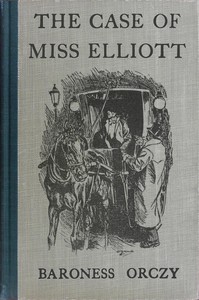
The case of Miss Elliott
Language: en425 downloads on Project Gutenberg
Subjects
In: Crime, Thrillers and Mystery·Novels·British Literature
Public-domain ebook sourced from Project Gutenberg #75461.
Public-domain ebook
Language: en425 downloads on Project Gutenberg
Subjects
In: Crime, Thrillers and Mystery·Novels·British Literature
Public-domain ebook sourced from Project Gutenberg #75461.
The opening · free to read
The man in the corner was watching me over the top of his great bone-rimmed spectacles.
“Well?” he asked, after a little while.
“Well?” I repeated with some acerbity. I had been wondering for the last ten minutes how many more knots he would manage to make in that same bit of string, before he actually started undoing them again.
“Do I fidget you?” he asked apologetically, whilst his long bony fingers buried themselves, string, knots, and all, into the capacious pockets of his magnificent tweed ulster.
“Yes, that is another awful tragedy,” he said quietly, after a while. “Lady doctors are having a pretty bad time of it just now.”
This was only his usual habit of speaking in response to my thoughts. There was no doubt that at the present moment my mind was filled with that extraordinary mystery which was setting all Scotland Yard by the ears, and had completely thrown into the shade the sad story of Miss Hickman’s tragic fate.
The Daily Telegraph had printed two columns headed “Murder or Suicide?” on the subject of the mysterious death of Miss Elliott, matron of the Convalescent Home, in Suffolk Avenue—and I must confess that a more profound and bewildering mystery had never been set before our able detective department.
“It has puzzled them this time, and no mistake,” said the man in the corner, with one of his most gruesome chuckles, “but I daresay the public is quite satisfied that there is no solution to be found, since the police have found none.”
“Can you find one?” I retorted with withering sarcasm.
“Oh, my solution would only be sneered at,” he replied. “It is far too simple—and yet how logical! There was Miss Elliott, a good-looking, youngish, lady-like woman, fully qualified in the medical profession and in charge of the Convalescent Home in Suffolk Avenue, which is a private institution largely patronised by the benevolent.
“For some time, already, there had appeared vague comments and rumours in various papers, that the extensive charitable contributions did not all go towards the up-keep of the Home. But, as is usual in institutions of that sort, the public was not allowed to know anything very definite, and contributions continued to flow in, whilst the Honorary Treasurer of the great Convalescent Home kept up his beautiful house in Hamilton Terrace, in a style which would not have shamed a peer of the realm.
“That is how matters stood, when on 2nd November last the morning papers contained the brief announcement that at a quarter past midnight two workmen walking along Blomfield Road, Maida Vale, suddenly came across the body of a young lady, lying on her face, close to the wooden steps of the narrow foot-bridge which at this point crosses the canal.
“This part of Maida Vale is, as you know, very lonely at all times, but at night it is usually quite deserted. Blomfield Road, with its row of small houses and bits of front gardens, faces the canal, and beyond the foot-bridge is continued in a series of small riverside wharves, which is practically unknown ground to the average Londoner. The foot-bridge itself, with steps at right angles and high wooden parapet, would offer excellent shelter at all hours of the night for any nefarious deed.
“It was within its shadows that the men had found the body, and to their credit be it said, they behaved like good and dutiful citizens—one of them went off in search of the police, whilst the other remained beside the corpse.
“From papers and books found upon her person, it was soon ascertained that the deceased was Miss Elliott, the young matron of the Suffolk Avenue Convalescent Home; and as she was very popular in her profession and had a great many friends, the terrible tragedy caused a sensation, all the more acute as very quickly the rumour gained ground that the unfortunate young woman had taken her own life in a most gruesome and mysterious manner.
“Preliminary medical and police investigation had revealed the fact that Miss Elliott had died through a deep and scientifically-administered gash in the throat, whilst the surgical knife with which the deadly wound was inflicted still lay tightly grasped in her clenched hand.”
The man in the corner, ever conscious of any effect he produced upon my excited imagination, had paused for a while, giving me time, as it were, to co-ordinate in my mind the few simple facts he had put before me. I had no wish to make a remark, knowing of old that my one chance of getting the whole of his interesting argument was to offer neither comment nor contradiction.
“When a young, good-looking woman in the heyday of her success in an interesting profession,” he began at last, “is alleged to have committed suicide, the outside public immediately want to know the reason why she did such a thing, and a kind of freemasonic, amateur detective work goes on, which generally brings a few important truths to light. Thus, in the case of Miss Elliott, certain facts had begun to leak out, even before the inquest, with its many sensational developments. Rumours concerning the internal administration, or rather maladministration of the Home began to take more definite form.
“That its finances had been in a very shaky condition for some time was known to all those who were interested in its welfare. What was not so universally known was that few hospitals had had more munificent donations and subscriptions showered upon them in recent years, and yet it was openly spoken of by all the nurses that Miss Elliott had on more than one occasion petitioned for actual necessities for the patients—necessities which were denied to her on the plea of necessary economy.
“The Convalescent Home was, as sometimes happens in institutions of this sort, under the control of a committee of benevolent and fashionable people who understood nothing about business, and less still about the management of a hospital. Dr. Kinnaird, President of the institution, was a young, eminently successful consultant; he had recently married the daughter of a peer, who had boundless ambitions for herself and her husband.
“Dr. Kinnaird, by adding the prestige of his name to the Home, no doubt felt that he had done enough for its welfare. Against that, Dr. Stapylton, Honorary Secretary and Treasurer of the Home, threw himself heart and soul into the work connected with it, and gave a great deal of his time to it. All subscriptions and donations went, of course, through his hands, the benevolent and fashionable committee being only too willing to shift all their financial responsibilities on to his willing shoulders. He was a very popular man in society—a bachelor with a magnificent house in Hamilton Terrace, where he entertained the more eminent and fashionable clique in his own profession.
“It was the evening papers, however, which contained the most sensational development of this tragic case. It appears that on the Saturday afternoon Mary Dawson, one of the nurses in the Home was going to the house surgeon’s office with a message from the head nurse, when her attention was suddenly arrested in one of the passages by the sound of loud voices proceeding from one of the rooms. She paused to listen for a moment and at once recognised the voices of Miss Elliott and of Dr. Stapylton, the Honorary Treasurer and Chairman of Committee.
“The subject of conversation was evidently that of the eternal question of finance. Miss Elliott spoke very indignantly, and Nurse Dawson caught the words:
“‘Surely you must agree with me that Dr. Kinnaird ought to be informed at once.’
“Dr. Stapylton’s voice in reply seems to have been at first bitingly sarcastic, then threatening. Dawson heard nothing more after that, and went on to deliver her message. On her way back she stopped in the passage again, and tried to listen. This time it seemed to her as if she could hear the sound of some one crying bitterly, and Dr. Stapylton’s voice speaking very gently.
“‘You may be right, Nellie,’ he was saying. ‘At any rate, wait a few days before telling Kinnaird. You know what he is—he’ll make a frightful fuss and——’
“Whereupon Miss Elliott interrupted him.
“‘It isn’t fair to Dr. Kinnaird to keep him in ignorance any longer. Whoever the thief may be it is your duty or mine to expose him, and if necessary bring him to justice.’
“There was a good deal of discussion at the time, if you remember, as to whether Nurse Dawson had overheard and repeated this speech accurately: whether, in point of fact, Miss Elliott had used the words ‘_or_ mine’ or ‘_and_ mine.’ You see the neat little point, don’t you?” continued the man in the corner. “The little word ‘and’ would imply that she considered herself at one with Dr. Stapylton in the matter, but ‘or’ would mean that she was resolved to act alone if he refused to join her in unmasking the thief.
“All these facts, as I remarked before, had leaked out, as such facts have a way of doing. No wonder, therefore, that on the day fixed for the inquest the coroner’s court was filled to overflowing, both with the public—ever eager for new sensations—and with the many friends of the deceased lady, among whom young medical students of both sexes and nurses in uniform were most conspicuous.
“I was there early, and therefore had a good seat, from which I could comfortably watch the various actors in the drama about to be performed. People who seemed to be in the know pointed out various personages to one another, and it was a matter of note that, in spite of professional engagements, the members of the staff of the Convalescent Home were present in full force and stayed on almost the whole time. The personages who chiefly arrested my attention were, firstly, Dr. Kinnaird, a good-looking Irishman of about forty, and President of the institution; also Dr. Earnshaw, a rising young consultant, with boundless belief in himself written all over his pleasant rubicund countenance.
“The expert medical evidence was once again thoroughly gone into. There was absolutely no doubt that Miss Elliott had died from having her throat cut with the surgical knife which was found grasped in her right hand. There was absolutely no signs of a personal struggle in the immediate vicinity of the body, and rigid examination proved that there was no other mark of violence upon the body; there was nothing therefore, to prove that the poor girl had not committed suicide in a moment of mental aberration or of great personal grief.
“Of course, it was strange that she should have chosen this curious mode of taking her own life. She had access to all kinds of poisons, amongst which her medical knowledge could prompt her to choose the least painful and most efficacious ones. Therefore, to have walked out on a Sunday night to a wretched and unfrequented spot and there committed suicide in that grim fashion seemed almost the work of a mad woman. And yet the evidence of her family and friends all tended to prove that Miss Elliott was a peculiarly sane, large-minded, and happy individual.
“However, the suicide theory was at this stage of the proceedings taken as being absolutely established, and when Police-Constable Fiske came forward to give his evidence no one in the court was prepared for a statement which suddenly revealed this case to be as mysterious as it was tragic.
The book keeps going
Reading is free forever. Sign up and watch scenes appear while you read.



Scenes Storieta drew for other classics.
New illustrated classics
Once or twice a month: the latest books to get full character casts, scene art, and free comic editions. No account needed.