Public-domain ebook
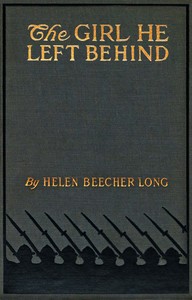
The girl he left behind
Language: en382 downloads on Project Gutenberg
Subjects
In: Romance·Novels·American Literature
Public-domain ebook sourced from Project Gutenberg #75475.
Public-domain ebook
Language: en382 downloads on Project Gutenberg
Subjects
In: Romance·Novels·American Literature
Public-domain ebook sourced from Project Gutenberg #75475.
The opening · free to read
“SO PERFECTLY CAPABLE”
Ethel Clayton gathered the several letters with their accompanying checks in a neat sheaf and rose from her desk, which was placed nearest the door of the manager’s office. With the papers in her left hand she went to the door on which was stenciled “Mr. Barton” and opened it without waiting for a reply to her knock. She knew only Jim Mayberry was in the room with the manager of the Hapwood-Diller Company.
As she pushed the door inward she heard Frank Barton saying:
“I am puzzled what answer to make them, Jim.”
The manager was at his desk. Mayberry, leaning back in his chair, nodded understandingly and in agreement. The general manager was not in the habit of taking the superintendent of the factory into his confidence in particular instances and Mayberry was alive to that fact. He listened. Listening, and keeping one’s mouth shut, never hurt a man yet.
The girl at the door of the office waited, too. Her business with the manager was important, if not imperative.
“The Bogata people have been good customers of ours in the past,” went on Barton, reflectively. “But I have inside information that their credit is wabbly. It is strained, just as ours has been. If we tied up twenty to thirty thousand dollars in their particular line of goods, and then had the goods left on our hands, it might be fatal to the Hapwood-Diller Company, even now.
“The expansion of mercantile values and the increase in profits have not struck our kind of production, as you very well know, Jim. Our stock is not listed among the ‘war brides.’ Rather it might better be termed a ‘war widow.’ The company has had a hard pull, Jim. We can’t afford to take many chances.”
Again the superintendent sat tight and merely nodded. The declining sun delivered slanting rays in through the high windows of the general manager’s office. The two men--neither of whom had arrived at thirty years--sat with preternaturally grave faces, one ruminating upon the event that had unexpectedly arisen in the affairs of the concern they had both worked for since boyhood; the other possibly giving much more thought to his own personal matters.
For Jim Mayberry, without being in the least neglectful of his duties as superintendent of the factory, was a person given much to the contemplation of what he called “the prime law of nature: Looking out for Number One.” He did, however, suggest:
“Those Bogata people have been all right folks, Frank. The factory’s made money on their orders.”
“That’s just it,” the manager returned briskly, but with a gesture that betrayed his indecision.
He was a tall, black-haired, virile fellow, clean shaven, good color in his cheeks, and impeccably dressed. Mayberry, in contrast, had light hair which already he plastered across his crown to hide an incipient bald spot. He wore a small blond moustache and had numerous wrinkles about his eyes.
“Just the same it is not safe, I firmly believe, to accept the order. But a brusk refusal might do the Hapwood-Diller Company untold harm at some future time. The Bogata concern may come back. Miracles do happen.”
“Better accept the order then,” Mayberry put in. “We can postpone filling it. We don’t have to give a bond. If they really prove to be shaky, we can renege.”
The girl, who had come in and softly closed the door, flashed the superintendent a glance that was all scorn for business ethics thus expressed. But Barton replied quite calmly:
“Two objections to that, Jim. In the first place the Hapwood-Diller Company has always based its policy on honor. Secondly, it is unwise for us to tie up any money at all in beginning a job we do not intend to complete.”
“Aw!” grunted the superintendent. His vocabulary--at this juncture at least--seemed not to be extensive.
There had been a rising murmur in the street under the open windows for some minutes. Now the sudden crash of martial music broke upon their ears. Barton’s countenance became vivid with interest, and he swung himself erect and strode to the nearest window.
“Here come the boys,” he said, pride vibrating in his voice. He was very military looking. Nothing but the “setting up exercise” could ever have made his shoulders so very square and his splendidly muscled torso taper to so narrow a waist.
Mayberry rose and sauntered after him. “Mailsburg’s heroes,” he observed. “I suppose you’re wishing you were marching away with them, Frank.”
The other said nothing, but his eyes glowed. The marching column swung around the corner following the band--a column in khaki, a color already becoming familiar on the streets although war was not many months old.
Ethel had gone to the other window and was likewise looking out upon the quota of the National Guard, with packs and rifles, on their way to the railroad station. A little group of women, girls and children clung to the column and kept pace with it. The men spectators seemed rather ashamed to follow on, but stood, nevertheless, on the curb to watch the boys go by.
“I expect they’ll have a hot old time down at that training camp,” drawled Mayberry.
Barton did not seem to hear him. His hand came to salute as the colors went by.
A volume of voices rose from below as the band music drifted into the distance.
“And mebbe marching to their graves!”
“It’s a shame that some that can least be spared have to go while them that would never be missed keep out of it.”
“You’re right! Some of ’em’s got fathers an’ mothers, an’ wives!” cried a shrill voice, “while them that ain’t got a soul dependent on ’em----”
“There’s one yonder,” was the quick rejoinder. “And had all the benefit of Guard training too!” And the speaker, a woman, directed the gaze of her companions to the office window.
Mayberry chuckled. “They’ve pinned you to the wall, Frank,” he murmured in the ear of the white-faced manager.
Ethel Clayton had turned suddenly from the window. “Have you time to sign these checks and letters before the outgoing mail, Mr. Barton?” she asked.
He took the papers, but did not verbally reply for a moment. His countenance had become calm again, if still pale, when he had seated himself in his chair and turned in it so that the others could both observe him.
“I will sign them at once, Miss Clayton,” Barton said quite composedly. “But first----”
For a moment his gaze centered upon her. There was something wholly good to look at in the girl’s face and figure. Had she not dressed so practically for her work her personal attractions would have been further enhanced. Mayberry was watching her, too; and his gaze betrayed a certain eagerness, whereas the manager’s eyes merely revealed expectancy. Then he flicked a glance in Mayberry’s direction.
“Perhaps Miss Clayton might give us a word of advice upon this matter, Jim?” he said questioningly, and with a quizzical little smile.
The superintendent, a little startled, shifted his gaze from the girl’s face to the manager’s countenance. Ethel, perfectly composed, waited for the explanation of Barton’s observation.
“Woman’s intuition forever!” the latter ejaculated.
“What do you mean, Frank?” hastily demanded Jim Mayberry. “If you and I don’t know what to do----”
Ethel flushed faintly, but looked questioningly at the manager. The implied doubt of her ability in Mayberry’s tone possibly piqued her. Frank Barton said in his good-natured, easy manner:
The book keeps going
Reading is free forever. Sign up and watch scenes appear while you read.



Scenes Storieta drew for other classics.
New illustrated classics
Once or twice a month: the latest books to get full character casts, scene art, and free comic editions. No account needed.