Public-domain ebook
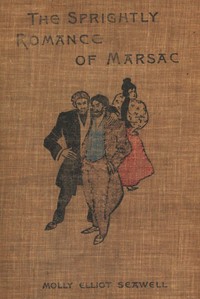
The sprightly romance of Marsac
Language: en506 downloads on Project Gutenberg
Subjects
Public-domain ebook sourced from Project Gutenberg #75477.
Public-domain ebook
Language: en506 downloads on Project Gutenberg
Subjects
Public-domain ebook sourced from Project Gutenberg #75477.
The opening · free to read
Madame Schmid, round and red, with the spotless lappets of her washerwoman’s cap flapping angrily, was plainly in a rage; and the three loud whacks she gave at the garret door of 17 Rue Montignal caused two young gentlemen on the other side of the door to quake visibly. One of them, Fontaine, ran incontinently into a closet and hid, while Marsac, the other, after a ghastly pretence of a joke about Madame Schmid’s whacks sounding like the three given at the Comédie Française before the curtain goes up, stalked with dignity to a corridor door. But, Madame Schmid bouncing in suddenly, Marsac as suddenly whisked out of sight.
Madame Schmid was of that coarse, buxom beauty common enough in her class. She had one year been elected queen of the washer-women, in that picturesque festival peculiar to Paris, and it had been said that fear of her stout arm and robust tongue had some share in her election. But she had a good heart, along with her vile temper; and as she planted her basket viciously on the floor, and whipped out a tremendously long bill, her quick eye took in the poverty of the surroundings, and she was softened in spite of herself. However, as one whistles going through a graveyard, so Madame Schmid always stormed the more when her excellent heart prevented her from taking stronger measures.
The room was excessively shabby. A moth-eaten sofa, and a large but rickety table, covered with newspapers and the implements of the journalist’s trade, were the principal articles of furniture. The light of a gray day shone dully in at the curtainless windows. A number of pipes, together with a cracked mirror, ornamented the mantel, while scattered about the room were a violin and case, an easel, and painting materials.
Madame Schmid belonged to that large class of persons who believe that a man who engages in any form of art is necessarily a loafer. The sight of the painter’s tools, the violin, and especially the abundance of pens, ink, and paper, acted on her like a red rag on a bull, and gave her the excuse she wanted to raise a tempest. First, she exclaimed scornfully,--
“Painters!”
“M’sieu Marsac! M’sieu Fontaine! Oh, I know you are somewhere about! This is an old dodge, running away when I come with my bill! You owe me, both of you, for seven weeks’ washing. Seven weeks have I rubbed and scrubbed for you, and I have not seen the colour of my money yet!”
Madame Schmid stopped for a moment to take breath, and then, noticing the door leading into the corridor, darted to it and began to tug vigorously at the knob. But Marsac, who was holding it on the other side, was Madame Schmid’s superior in muscle, though not in weight, and the door resisted successfully. She then marched over to the closet door; but Fontaine followed Marsac’s tactics, and Madame Schmid grew still redder in the face and shorter of breath, with no better luck than at the corridor door.
At that moment a very well-dressed little man entered the room, after an almost imperceptible knock, and, unrolling a bill about a yard long, began,--
“Gentlemen, I have a little bill here--” and then, raising his eyes, he said in a surprised voice, “Why, there aren’t any gentlemen here!”
“Not if gentlemen pay their bills, Monsieur Landais,” answered Madame Schmid, sarcastically, who recognised an old acquaintance in Monsieur Landais. Madame Schmid had had a good, obedient Alsatian husband, whom she had talked to death some years before, and Landais and the late lamented Schmid were from the same town.
Landais silently held out his bill, and Madame Schmid flourished hers in his face, with an air as if Landais owed the money instead of Marsac and Fontaine.
“Journalists are a bad lot, I can tell you,” rapidly began Madame Schmid, who liked to have the first as well as the last word, “and a lazy lot too. While you and I work for our living with our arms and our legs, Monsieur Marsac and that pretty boy Fontaine do nothing but sit in an easy-chair and write all day long. And they call that work!”
“I only wish I could sit in an easy-chair and amuse myself with a pen all day, instead of toiling over a cutting-board,” answered the tailor, ruefully.
“Painting and fiddling when they are not scribbling,--no wonder they can’t pay their wash-bills. I dare say they think washing is an elegant amusement. I’m sure I don’t know how I’ll ever get my money. Writing them letters is a sinful waste of paper and ink.”
“And calling to see them is a sinful waste of time. That Marsac always makes me laugh in spite of myself. The last time I saw him I put on a very determined air,” here little Landais assumed a fierce look, “and asked him why my bill had not been paid. He told me that he and Monsieur Fontaine threw all their bills into a basket, and every six months they drew one out at random and paid that bill,--and it so happened they had never drawn my bill! It was a wretched joke, but it made me laugh; and I assure you, the first thing I knew I was asking the fellow if he and his chum wanted anything in the tailoring line!”
“And he chucks me under the chin, and tells me I’m so young and handsome I’ll be getting married again; and then, like you, I turn fool and laugh, and pouf! goes my bill,” moaned Madame Schmid, wagging her head dolefully, while Landais shook his like a Chinese mandarin.
“Then,” said Landais, wearily, “what are we climbing up all these stairs for?”
“God knows,” answered Madame Schmid. “But I have no more time to waste on them, so I’ll leave my bill and go.”
“So will I,” said Landais; and they laid their bills on the rickety table and went out, Madame Schmid clacking angrily all the way downstairs.
The minute they disappeared, Fontaine slipped out of his closet, and locked the door after them. He was a handsome, fair-haired fellow of five-and-twenty, with the most winning air in the world; but it was plain at the first glance that, with all his grace and intelligence, he was a man to be led by his affections.
“I wish there was a drawbridge outside this door,” he muttered, and then began to rummage about the room. “I wonder where Marsac’s purse is,” he continued to himself. “Ah, here it is,--and only two francs five centimes in it; and the shoemaker wants three francs for half-soling Marsac’s shoes!” And then he began to call for Marsac, meanwhile going through the empty form of searching through his own pockets. In a moment Marsac entered the room.
It was easy enough to see who was the master mind there. Marsac was not so regularly handsome as Fontaine, but his dark bright eyes and captivating smile seemed to radiate brilliance all round him. After the first moment of seeing these two young men together, it was not necessary to explain their relations to each other. Fontaine could not look at Marsac without an almost feminine expression of fondness and tender reliance coming into his eyes; and at the bottom of his heart he thought Marsac the most brilliant, capable, and lovable of men. Marsac, on his part, could not look or speak to Fontaine without showing the affection of an elder for a younger brother.
They had been schoolmates, ten years before, at a provincial college. From the first moment of their meeting, they loved each other. Fontaine was of the best blood of the province; but he had neither father nor mother nor brother nor sister nor any near relative living. His was one of those hearts which must love something, and he could not help loving Marsac,--a tall, lithe boy, older than he, and quite able to fight Fontaine’s battles as well as his own. Marsac, like Fontaine, was fatherless and motherless. He was educated from a fund for the sons of poor gentlemen, which the recipient was expected to return when he was able. After taking all the honours in his classes, and being graduated with the highest distinction, Marsac went to Paris along with Fontaine, both to seek their fortunes in journalism. They soon got work, but they made precious little money. Marsac, inspired with but one idea, sent every franc he made back to the fund, and repaid the sum advanced in an astonishingly short time. But it was at the cost of getting into debt on all sides. Neither he nor his chum had that commercial knack, that intimate knowledge of the purchasing power of a franc, which comes naturally to young men whose lives have been spent in a large city. Marsac was of a buoyant temper, and constantly expected something to turn up which would relieve them of all their embarrassments. Meanwhile, confident of the honesty of his intentions, he met his debts, duns, and difficulties with an incomparable archness and good-humour.
When Fontaine asked him for a franc for the shoes, his reply was,--
“A franc! Do you think I have a complete counterfeiting apparatus, that I can produce such a sum as a franc at a moment’s notice?”
“Then,” said Fontaine, ruefully, who would willingly have given his only pair of shoes to Marsac would he accept them, “I don’t know what I am to do. The shoemaker said three francs or no shoes, and I have only two francs five centimes. You have already spent enough on them to have bought a new pair,--new vamps in December, new uppers in January, and now in February new soles.”
“Go along with you!” cried Marsac. “Tell the shoemaker I have a bad case of confluent small-pox, and I dare say he will be glad to let you have the shoes for nothing. But give me that paste-pot. Our friends Madame Schmid and Monsieur Landais have left us souvenirs which I can put to use.” And he began deftly cutting the bills, which were on stout paper, into square pieces to mend the screen with, which, like everything else in the room, had holes in it.
“I am afraid the small-pox story won’t be a--judicious subterfuge,” was Fontaine’s reply.
“What did you do with the eleven francs we had yesterday?”
“I bought four bottles of wine, a box of cigars, and two loaves of bread with it.”
“Why were you so extravagant about bread?” asked Marsac, very cheerfully working away at the old screen. “If you squander our substance on luxuries like bread, we sha’n’t have anything left for necessaries like wine and cigars. The fact is,” he continued, “when a man enters journalism, he ought to have an education suitable to the profession. Instead of going to the University, I should have been taught the shoemaking and tailoring trades. How often have I heard that no learning comes amiss in journalism! Now, if I had the most rudimentary knowledge of cobbling, I could have mended those shoes myself.”
“At all events,” said Fontaine, brushing his hat, “I am rather glad to be out of the way now; for this is the very day and hour that Madame Fleury always appears to ask for the rent.”
“There!” cried Marsac, for the first time showing impatience, “I have been trying for two weeks to forget what day the rent is due, and had just succeeded when you reminded me of it. I would rather see Joan of Arc coming at me full tilt on horseback, or Charlotte Corday with her dagger, than Madame Fleury with her bill.”
“I have heard it said that it is possible to live comfortably on a large capital of debts, but we have not found it so,” said Fontaine, still brushing his hat, which, however, not all the brushing in the world could benefit.
The book keeps going
Reading is free forever. Sign up and watch scenes appear while you read.



Scenes Storieta drew for other classics.
New illustrated classics
Once or twice a month: the latest books to get full character casts, scene art, and free comic editions. No account needed.