Public-domain ebook
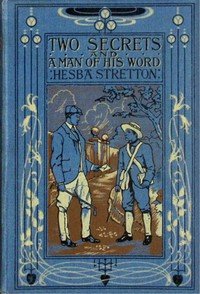
Two secrets, and, A man of his word
Language: en337 downloads on Project Gutenberg
Subjects
Public-domain ebook sourced from Project Gutenberg #75676.
Public-domain ebook
Language: en337 downloads on Project Gutenberg
Subjects
Public-domain ebook sourced from Project Gutenberg #75676.
The opening · free to read
ABOUT a stone's throw from the last house in the small country town of Armitage stood a cottage which had scarcely changed in aspect since it had been built two hundred years ago. The gambrel roof was high-pitched and closely thatched, with deep eaves, under which the swallows built their nests; the little elbow in the slope of the gable gave it a quaint look, as if the cottage had drawn a hood over its head. Along the top of the roof grew a row of purple flags, which contrasted well with the brown thatch and golden lichens. Casements, with small diamond windows, glistened in the light. A garden full of old-fashioned flowers ran down from the road to the little porch, which sheltered the door from rough weather, and made a pleasant and shady seat in the summer. It was certainly the most picturesque dwelling in the neighbourhood.
"What is the name of your cottage?" asked an artist, who had just finished a sketch of it.
"Oh! It hasn't any name, sir," answered Joanna Terry—"it's nothing; only our home."
She had been born there, and had not been away from it for a whole week at a time for fifty-five years. She hardly knew any other house. The ground floor of the cottage contained a large, old-fashioned living-room, with two very small ones opening out of it, one of which was a kind of scullery, and the other the bedroom in which she had been born, and where she had slept all her life. Under the gable of the thatched roof there was a large attic covering the whole area of the cottage, with sloping ceiling and two windows, one at each end, looking east and west. Joanna's mind could not grasp the idea of any improvement in the arrangement of her little homestead.
The tall, spare old woman was still very active and alert, with an eye keen to detect every weed venturing to grow in the garden, and every speck of dust that might blow in through the open window and door. Scarcely a bud opened on the roses and clematis climbing up the half-timber wall without her notice. The hollyhocks and sunflowers, standing as erect as herself, were every one known to her. The potato-patch behind the cottage, which her husband, Amos Terry, cultivated in his leisure time; the long rows of peas and beans; the beds of onions and lettuce; the fruit-trees which paid their rent—they were almost like children to her. Indoors, the old oak settle by the fireside, the oak table and dresser, all shining with the active work of her own hands, teemed with associations and memories which formed the sum and substance of her life. The roof-tree was not more planted to the spot than Joanna was.
Still more firmly rooted there, if possible, was her only child, Charlotte, who lived in the pleasant attic under the roof. She was lame, and an invalid from a spinal complaint, the result of a fall when she was a little child. It was very seldom that she felt well enough to creep painfully down the rude staircase to the ground floor. But from her two windows her eye could overlook both of the garden patches lying before and behind the house; and she knew everything growing in them as well as her mother did. Eastward her view was bounded by a low ridge of hill, above which the morning clouds hung tinged with lovely hues some time before the sun showed itself over the wooded outline. To the west there was a wide stretch of undulating land, with meadows and coppices and scattered cottages, ending far-off in a glimpse of the sea, which often glittered like gold under the setting of the sun. Charlotte seldom missed seeing both sunrise and sunset.
She was thirty years of age now, pallid and emaciated, with the pathetic look in her eyes which cripples and deformed people so often have. She looked almost as old as her mother. The mother and daughter had been slowly changing places for the last fifteen years. Charlotte was the adviser now, the head of the little household, the referee to whom every question was brought. She was always brooding over schemes for her father and mother's comfort, and suggesting gently what their actions should be from day to day. Joanna was still young in spirit, apt to act impetuously; occasionally giving way to almost girlish fits of temper, which she confessed and repented of by Charlotte's bedside. It did not seem possible there could ever come a secret between these two.
Amos Terry, who was two years older than his wife, had been a rural postman for thirty-seven years. The daily routine of his work had never altered. At six o'clock, summer and winter, he presented himself at the post-office in the town, and received the various letter-bags which he had to convey along a route, the farthest point of which was seven miles away. As it was out of the question for him to return home and walk the same distance again, he remained at this farthest point all day, and hired a small out-building, where he occupied his time profitably in mending the boots and shoes of a considerable circle of customers who valued his careful work. At four o'clock he started homeward, collected the bags he had distributed in the morning, and was timed to be at the post-office again at half-past six, soon enough to make up the evening mail. The old church clock never struck seven before he was at home, going first thing upstairs to his daughter's attic. The sight of her face, wan and drawn as it was with pain, but always lit up with a smile of welcome, was the most precious sight in the world to him. He had never had a secret from her in his life. His whole heart and mind and soul lay open to her as absolutely as it is possible for one human being to be open to another.
"I don't think there's anybody in the world as happy as me," said Amos, perfectly convinced of the truth of his assertion, "at least, not one bit happier; they couldn't be."
"Not if Charlotte was strong and well?" suggested Joanna, with a sigh. It was she who had let her child fall when a baby.
"Maybe I should have gone away and left you," said Charlotte; "it 'ud never have done for me to live idle here. Or I might have been married, you know," she added, with a faint blush and a smile.
"Anyhow, it is as the Lord has willed it," Amos answered, "and sometimes I think He'll be weary of me sayin' how happy I am."
There was very little to disturb that happiness. Ambition was unknown to them. No religious or political questions perplexed their humble souls. Care was a long way off, for they had more than enough for their simple wants. They needed neither fine clothes, nor dainty food, nor costly furniture. A few old-fashioned books, gathered together by Joanna's forefathers, were enough for their mental requirements. The "Pilgrim's Progress" and "Holy War," the "Vicar of Wakefield," the "Fool of Quality," and "Paradise Lost," were ranged on a little hanging shelf in Charlotte's attic, and with their Bible and a hymn-book provided amply for Joanna and Amos, whilst more modern books were now and then lent to Charlotte by friendly visitors from the town. They had beautified their little home, and cultivated their garden according to their own fancy; and if three wishes had been given to them, they would have been puzzled to fix upon one.
If Joanna knew and loved her house almost as her own soul, Amos also knew and loved the route he traversed daily in all weathers. More than six hundred times a year he passed the same cottages, tramped along the same lanes between high hedgerows, and looked up to the same constantly changing sky overhead. He loved it ardently though dumbly, possessing no language that could express his feelings. He was fond of singing, but he sang somewhat as the birds sing, that know only a strain or two. Amos knew only a few hymns, and he generally sang them through again and again as he went to and fro, until the cottagers on his route knew when he was drawing near, and hastened to their doors or windows to give him a friendly nod.
It was getting well on In October. The low-lying hills were covered with coppices of beech-trees, now wearing the loveliest tints of autumn. Down each valley ran a little rivulet, joining a broad and rapid but shallow stream, which hurried along a stony channel to the sea. Amos seldom went home without taking some flower or leafy branch for Charlotte; and he was gathering a cluster of crimson berries from a climbing bryony, when a young man, the eldest son of Squire Sutton, of Sutton Hall, where he had just called for the letter-bag, came running quickly, though cautiously, after him. He did not shout or call to Amos; and he was almost out of breath when he reached him.
"Amos," he gasped, "here's a letter. It's a matter of life or death to me. Let me put it into father's bag."
He had brought the key with him, and Amos watched him unlock and lock the bag again. He had recovered his breath now, and he looked at Amos with a world of anxiety in his face.
"You are never too late, I suppose?" he said.
"Now, Master Gerard, you've known me all your life," answered Amos, "and you might almost as well ask if the sun 'll set at the right time. I have come and gone on this road nigh on forty year, and never missed yet. Nobody ever gave me a letter for life or death afore; and it 'ud be odd indeed if I missed tonight."
As Amos trudged on the sun went down behind the sweet round outline of one of the low hills, and the sky looking nearer than in the summer, seemed about to close, like brooding wings, over the quiet woods. Two or three robins were chirping cheerfully among the thinning leaves, which came down with a rustle as the cool evening breeze blew up the valley from the sea. A profound peace rested on all the silent lanes and meadows he traversed, which would have been too solemn if he had not loved it so profoundly.
But all in a moment a tumult of children's voices scattered the silence, and Amos saw a troop of terrified little ones running towards him and screaming for help. Looking beyond them he saw that one of their playfellows had fallen into the stream, which was carrying the child swiftly away towards the sea. He had no time to deliberate; there was not a moment to lose. In another minute the drowning child would be abreast of the spot where he stood. He laid his bags down safely on the bank, and waded into the shallow river, which, a few minutes ago, was running like a thread of gold between its banks in the radiance of the setting sun.
There was no great risk in what Amos was doing. The river, unless it was swollen by rain, was never more than breast-high. He caught the child in his hands as the current bore it past him, and carried it in safety to the bank. But there was no one in all the band of its companions old enough to take care of the little creature. The child's head had struck against a stone, and it lay a heavy load in his arms. He must carry it himself to the nearest cottage, which was almost a mile away. With his letter-bags slung across his shoulders, and his clothes heavy with water, Amos could not make very rapid progress. The cottagers were not very willing to take in a strange child, belonging to nobody but gipsies, and he had some trouble to get them to relieve him of his charge. More than an hour was gone before he could hasten on his ordinary way.
The book keeps going
Reading is free forever. Sign up and watch scenes appear while you read.



Scenes Storieta drew for other classics.
New illustrated classics
Once or twice a month: the latest books to get full character casts, scene art, and free comic editions. No account needed.