Public-domain ebook
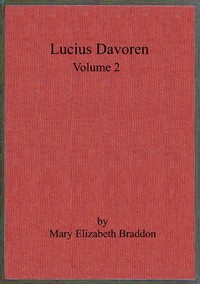
Lucius Davoren; or, Publicans and sinners, vol. 2
Language: en347 downloads on Project Gutenberg
Subjects
Public-domain ebook sourced from Project Gutenberg #75876.
Public-domain ebook
Language: en347 downloads on Project Gutenberg
Subjects
Public-domain ebook sourced from Project Gutenberg #75876.
The opening · free to read
GEOFFREY LEARNS THE WORST.
They had dined, and the letter was written. A week-old moon shone in the placid heaven; the tender night-stillness had descended upon the always quiet town; lights twinkled gaily from the casements of surrounding villas; like a string of jewels gleamed the lamps of the empty High-street. The slow river wound his sinuous course between the rushes and the willows with scarce a ripple. No sweeter air could have breathed among the leaves, no calmer sky could have o’er-canopied this earth on that night in Verona when young Romeo stole into Capulet’s garden under the midnight stars. It was a night made for lovers.
The clock struck the half hour after nine as Geoffrey left the hotel, with his friend’s letter in his pocket; assuredly a strange hour in which to visit a lady who had forbidden him to visit her at all. But a man who feels that he is taking a desperate step will hardly stop to consider the details of time or place which may render it a little more or less desperate.
To approach the woman he loved armed with a letter from another man; to bring a stranger’s influence to bear upon her who had been deaf to his most passionate pleading; to say to her, ‘I myself have failed to touch your heart, but here is my bosom friend’s prayer in my behalf: will you grant to his vicarious wooing the grace you have persistently denied to me?’—what could seem madder, more utterly desperate, than such a course as this?
Yet women are doubtless strange creatures—a fact which those classic poets and satirists whose opinions it had been his pleasing task to study had taken pains to impress on Mr. Hossack’s mind. He remembered Mrs. Bertram’s agitation in that brief scene with Lucius, her exalted sense of gratitude. It was just possible that she really might regard him, even at this hour, as the preserver of her child’s life—second only to Providence in that time of trouble. And if she thought of him thus, his influence might have some weight.
‘Dear old fellow!’ thought Geoffrey affectionately; ‘he wouldn’t let me see the letter. I daresay he has given me no end of a character,—like other written characters, which are generally of the florid order—praised me up to the skies. Will his eloquence move her to pity me, I wonder? I fear not. And I feel odiously caddish, going to deliver my own testimonials.’
If he could have faced Lucius with any grace, it is possible that he would have turned back, even on the very threshold of Mrs. Bertram’s tiny garden. But after bringing his friend down from London, could he be so churlish as to reject his aid, let it be offered in what manner so ever?
He plucked up his courage at sight of the lamp in her window—a gentle light. The upper half of the casement was open, and he heard the dreamy arpeggios of one of Mendelssohn’s Lieder played by the hand whose touch even his untutored ear knew so well. In another minute he was admitted by a neat little servant, who opened the door of the parlour unhesitatingly, and ushered him straightway in, assured that he had come to propose a new pupil, and regarding him as the harbinger of fortune.
‘A gentleman, if you please ’m, to see you.’
Mrs. Bertram rose from the piano, the graceful figure he knew so well, in the plain black dress, just as he had seen her the first time at the morning concert in Manchester-square—a certain lofty pose of the head, the dark eyes looking at him with a grave steady look, after just one briefest flash of glad surprise, just one faint quiver of the perfect lips.
‘Mr. Hossack!’
‘Yes, I know you have forbidden me to call upon you, and yet I dare to come, at this unseasonable hour, in defiance of your command. Forgive me, Mrs. Bertram, and for pity’s sake hear me. A man cannot go on living for ever betwixt earth and heaven. A time has come when I feel that I must either leave this place, and,’ with a faint tremble in his voice, ‘all that makes it dear to me, or remain to be happier than I am—happy, at least, in the possession of some sustaining hope. You remember my friend Davoren—’
Remember him! Her cheek blanched even at the mention of his name.
‘The doctor who came down to see your daughter?’
‘Yes,’ she said, looking at him strangely; ‘I am not likely to forget Mr. Davoren.’
‘You are too grateful for a trifling service. Well, Davoren, my dear old friend, the best and truest friend I have, is here again.’
‘Here!’ she cried, looking towards the door as if she expected to see it open to admit him. ‘O, I should so like to see him again.’
‘He will be only too proud to call upon you to-morrow; but in the mean time he—Mrs. Bertram, you must forgive me for what I am going to say. Remember, Davoren is my friend, as near and dear to me as ever brother was to brother. I have told him the story of my hopeless love—’
‘O, pray, pray, not that subject!’ she said, with a little movement of her hand, half in warning, half entreaty.
‘I have told him all,’ continued Geoffrey, undeterred by that deprecating gesture, ‘and he has written to you, believing that his influence might move you a little in my favour. You will not refuse to read his letter, will you, Mrs. Bertram, or feel offended by his interference?’
‘No,’ she said, holding out her hand to receive the letter; ‘I can refuse him nothing.’
She betrayed neither surprise nor anger, but read the letter, which was somewhat long, with deepest interest. Her countenance, as she read, watched closely by her lover, betrayed stronger emotion than he had ever yet seen in that inscrutable face. Tears gathered on her eyelids ere she had finished, and at the end a half-stifled sob burst from that proud bosom.
‘_His_ eloquence has more power than mine,’ said Geoffrey, with kindling jealousy.
‘He pleads well,’ she answered, with a slow sad smile—‘pleads as few men know how to plead for another. He urges me to be very frank with you, Mr. Hossack; bids me remember the priceless worth of a heart as true and noble as that you have offered me; entreats me, for the sake of my own happiness and of yours, to tell you the wretched story of my past life. And if, when all is told, wisdom or honour counsels you to leave me, why,’ with a faint broken laugh, ‘you have but to bid me good-bye, and go away, disenchanted and happy.’
‘Happy without you! Never; nor do I believe your power to disenchant me.’
‘Do not promise too much. My—this letter bids me do what, of my own free will, I never could have done—tell you the story of my life. Perhaps I had better write to you; yet no, it might be still more difficult. I will tell you all, at once. And then hate me or despise me, as you will. You must at least remember that I have never courted your love.’
‘I know that you have been the most cruel among women, the most inexorable—’
‘I was not so once, but rather the weakest. Hear my story, as briefly, as plainly as I can tell it. Years ago I was a guest at a great lady’s house—a visitor among people who were above me in rank, but who were pleased to take a fancy to me, as the phrase goes, because I had some little talent for music. I sang and played well enough to amuse them and their guests. The lady was an amateur, raved about music, and delighted in bringing musical people about her. Among her favourites when I visited her was one who had a rare genius—a man with whom music was a second nature, whose whole being seemed to be absorbed by his art. Violinist, pianist, organist, with a power of passionate expression that gave a new magic even to the most familiar melodies, he seemed the very genius of music. I heard him, and, like my patroness, was enchanted. She was amused to see my delight; threw us much together; wove a little romance out of our companionship; made us play and sing together; and in a word, with the most innocent and kindly intentions, prepared the way for my deepest misery.’
‘You loved this man!’ cried Geoffrey, ready to hate him on that ground.
‘Loved him! I thought so then. There are times when I believe I never really loved him, that the glamour which he cast around me was only the magic of his art. But for the time being my mind was utterly subjugated by his influence; I had no thought but of him, and, fascinated by his genius, deemed him worthy of a self-sacrificing love. He was a creature of mystery—a mere waif and stray, admitted to the house where I met him on no better recommendation than his genius. He had the manners and education of a gentleman, the eccentricities of an artist. He asked me to be his wife, disregarded my refusal, pursued me with an unwearying persistence, and, aided by the wondrous power of his genius, triumphed over every argument, conquered every opposition, wrung from me my consent to a secret union. It would be useless to repeat his specious statements—his pretended reasons for desiring a secret marriage. I was weak enough, wicked enough, to consent to the arrangement he proposed; but not until after many a bitter struggle.’
‘Why pain yourself by these wretched memories?’ exclaimed Geoffrey. ‘Tell me nothing except that you will be my wife. I will take all the rest upon trust. There is no such thing as truth or purity in woman if you are not worthy of an honest man’s love.’
‘You shall hear me to the end,’ she answered quietly, ‘and then pronounce whether I am or not. The house in which we were visitors was only two miles from a cathedral city. He of whom I have been speaking—’
‘Mr. Bertram.’
‘I will call him Bertram, although I am bound to tell you that name is not the true one. Mr. Bertram proposed a marriage before the registrar in the cathedral town. We both had been long enough resident in the neighbourhood for the necessary notice. Indeed, that notice had been given some days before I gave my most reluctant consent. At the last, harassed by Mr. Bertram’s importunity, loving him with a girl’s first romantic fancy, and believing that I was the object of a most devoted love, without an adviser or friend at hand to whom I could appeal, conscious that I was guilty of ingratitude and disobedience towards the dearest and best of parents, I suffered myself to be hurried into this wretched union. We walked across the park early one morning, and went to the registrar’s office, where the brief form was gone through, and my lover told me I was his wife. I went home that very day, for the necessity of a fortnight’s notice to the registrar had deferred the marriage to the last day of my visit. I went back to the parents who loved and trusted me, weighed down by the burden of my guilty secret.’
‘Was Mr. Bertram’s rank superior to yours? and was that his reason for secrecy?’ asked Geoffrey.
‘He made me believe as much. He told me that he hazarded position and fortune by marrying me, and I believed him. I was not quite nineteen, and had been brought up in a small country town, brought up by people to whom falsehood was impossible. You may suppose that I was an easy dupe. Some time after my return he appeared in our little town. I implored him to tell my father and mother, or to let me tell them of our marriage. He refused, giving me his reasons for that refusal; using the same arguments he had employed before, and to which I was obliged to submit, reluctantly enough, Heaven knows. But when he claimed me as his wife, and reminded me that I was bound to follow his fortunes, I refused to obey. I told him that the marriage before the registrar had to me seemed no marriage at all, and that I would never leave home and kindred for his sake until I had stood before God’s altar by his side. This, which he called a mere school-girl prejudice, made him angry; but after a time he gave way, and told me that I should be satisfied. He would marry me in my father’s church, but our union must not the less remain a secret. He had a friend, a curate in a London parish, who would come down to perform the ceremony quietly one morning, without witnesses. The marriage before the registrar was ample for all legal purposes, he told me. This marriage in the church was to be only for the satisfaction of my conscience, and it mattered not how informal it might be. No witnesses would be wanted, no entry need be made in the Register.’
The book keeps going
Reading is free forever. Sign up and watch scenes appear while you read.



Scenes Storieta drew for other classics.
New illustrated classics
Once or twice a month: the latest books to get full character casts, scene art, and free comic editions. No account needed.